Beeple's Robot Dogs With Billionaire Heads Poop Out AI Art at Art Basel Miami


5 Sources
[1]
Beeple's Art Basel Robot Dogs Satirize Musk, Zuckerberg and Our AI Future
I agree my information will be processed in accordance with the Scientific American and Springer Nature Limited Privacy Policy. We leverage third party services to both verify and deliver email. By providing your email address, you also consent to having the email address shared with third parties
[2]
Robot dog with Elon Musk's head poops out AI generated art
Robot dogs are already a bit creepy. But slap on a hyper-realistic image of a tech billionaire's face and have them literally crap out a piece of AI-generated art and you're left with something that would make Black Mirror producers shudder. That's exactly what's on display at Art Basel Miami, one
[3]
Robot Dog Billionaires Take Photos and Poop Them Out in Weird New Beeple Exhibition
A new exhibition by digital artist Beeple sees billionaires and visionaries becoming robot dogs that take photos and then poop them out. Some of the prints are also NFTs. The bizarre show is on now at Art Basel Miami Beach, featuring Elon Musk, Mark Zuckerberg, Jeff Bezos, Andy Warhol, Pablo
[4]
These could be the creepiest robots you've ever set eyes on
Those of a nervous disposition might want to skip this article. It's about some of the creepiest robots ever to have walked this Earth. Apart from this one, perhaps. Part of a new art exhibition at Art Basel Miami, the robot dogs feature unnervingly lifelike copies of the heads of some of the
[5]

Beeple Made Robot Dogs With Musk, Zuckerberg, and Warhol Heads That Poop NFTs - Decrypt
The robot figures have heads sculpted to resemble Elon Musk, Mark Zuckerberg, Jeff Bezos, Pablo Picasso, Andy Warhol, and Beeple himself. Digital artist Mike Winkelmann, aka Beeple, has brought NFTs back on the scene at Art Basel with a pack of robot quadrupeds that snap photos of visitors and
Share
Copy Link
Digital artist Beeple unveiled 'Regular Animals' at Art Basel Miami Beach, featuring autonomous robot dogs with hyperrealistic heads of tech billionaires like Elon Musk and Mark Zuckerberg. The robots capture photos of viewers and defecate AI-generated art prints, satirizing how tech power and algorithms shape visual culture. All robots sold for $100,000 each.
Beeple Debuts Robot Dogs at Art Basel Miami
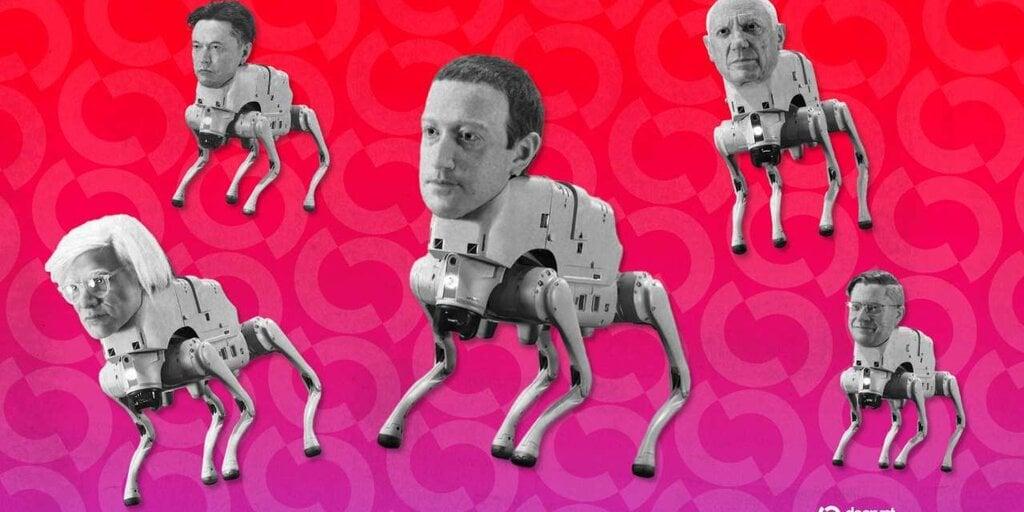
Digital artist Mike Winkelmann, known as Beeple, has launched a provocative installation at Art Basel Miami Beach that merges robotics, AI art, and biting social commentary. The exhibition, titled Beeple's 'Regular Animals', features autonomous robot dogs equipped with hyperrealistic heads of tech billionaires including Elon Musk and Mark Zuckerberg, alongside art legends Pablo Picasso and Andy Warhol
1
. The installation ran through December 7 at the convention center's new Zero 10 digital art section, where viewers stood outside a pen watching these mechanical creatures roam, squat, and literally poop out physical prints2
.
Source: Decrypt
Each robot uses cameras mounted around its head to continuously capture images of the surrounding environment and fairgoers. When the machines identify compelling scenes, they process the data through AI systems that apply distinct artistic filters matching each figure's personality. The Musk robot converts images into stark black-and-white patent-style drawings with labeled parts and flow diagrams, while the Zuckerberg version produces deep-blue metaverse-inspired prints featuring hologram people and grid floors
1
. The Picasso robot generates angular, boldly colored compositions, and the Warhol machine creates halftone-dotted prints reminiscent of printed media3
.Tech Billionaires and the Influence of AI on Visual Culture
Beeple's installation delivers sharp criticism about how tech billionaires control what billions see daily through algorithms. "Let's recognize the reality that Mark Zuckerberg and Elon Musk have a massive amount of influence on what we see, and how we see the world," Beeple told the Wall Street Journal. "They just wake up and they change this or that algorithm and boom: Our visual culture changes immediately, for better or worse"
1
. The artist emphasized that unlike previous eras when artists shaped reality, today's visual landscape is increasingly filtered through the lens of a select few technology leaders who wield unilateral control over powerful platforms5
.The robots collectively produced 1,028 AI-generated art prints over the exhibition's duration, with 256 designated as verifiable NFTs that can be listed on blockchain and cryptocurrency marketplaces
2
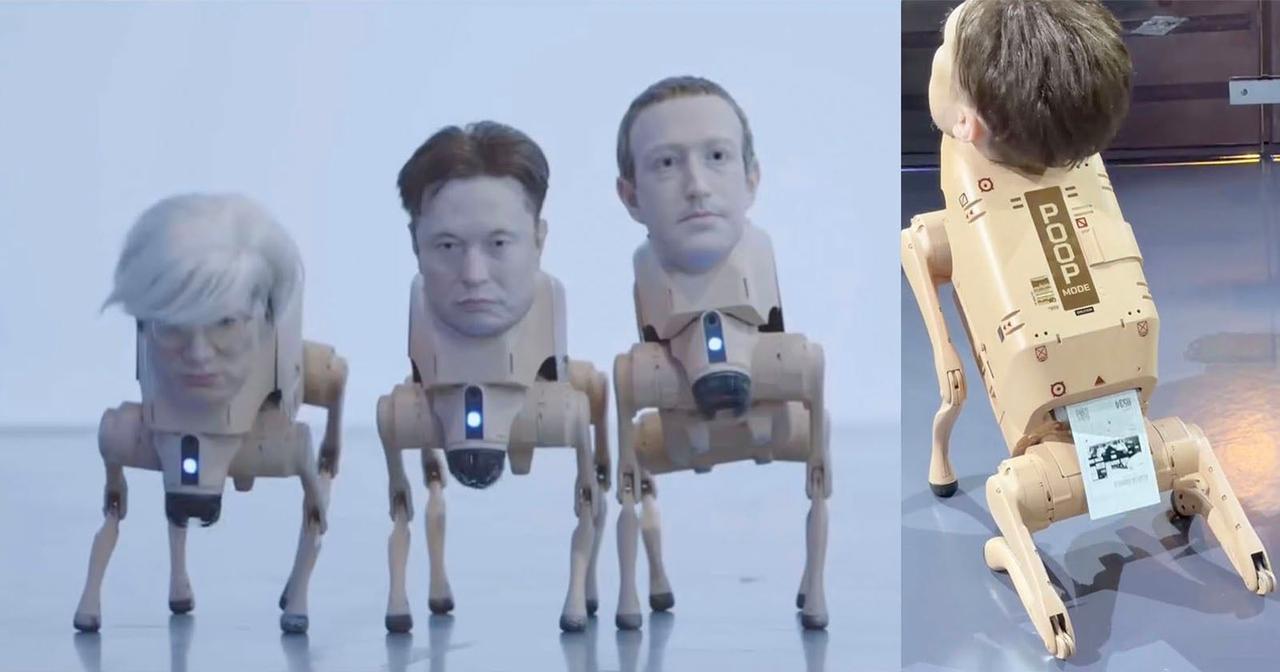
. Each print carries a satirical label reading "this artwork has been tested and verified as 100% pure GMO-free, organic dogs*** originating from a medium adult dog anus"3
. An LED screen on each robot's back flashes "POOP MODE" during the defecation performance, adding to the installation's deliberately crude humor2
.
Source: PetaPixel
Data Collection and the Future of Autonomous Systems
Beyond the spectacle, Beeple raises urgent questions about data collection and machine autonomy. "What if the act of looking at art were no longer a one-way encounter, but part of a feedback loop in which the artwork observes, learns, and remembers us in return?" the artist asked in his statement
2
. He warns that as robotics and AI advance toward genuine autonomy, these systems may eventually claim their own interpretive authority rather than simply serving human operators1
.The installation underscores how humans are becoming AI training data. As robots equipped with sensors proliferate in customer service, warehouses, delivery systems, and security applications, more machines will map spaces and capture images that feed the vast archives shaping future intelligences
1
. The metal and polymer robots from Chinese robotics company Unitree use lidar navigation similar to Waymo self-driving taxis, while the hyperrealistic silicone heads came from Hyperflesh, the company of mask maker Landon Meier1
.Related Stories

Market Response and Critical Reception
Despite mixed critical reception, all robots on display sold for $100,000 each at the VIP preview, except for the Jeff Bezos version which wasn't available for purchase
5
. Beeple, whose NFT artwork "Everydays: The First 5000 Days" sold for $69.3 million at Christie's in 2021, helped launch the art marketplace for blockchain-based digital collectibles1
. Some critics questioned whether the installation genuinely critiques or merely perpetuates cryptocurrency culture. Hyperallergic senior editor Valentina Di Liscia suggested the real purpose was "to advance crypto wealth by making you, the viewer, an active participant in the ploy"1
.Online reactions ranged from "terrifying" and "beyond disturbing" to genuine interest in purchasing these mechanical hybrids
2
. The installation arrives as NFT markets show renewed activity, with industry analytics indicating a 78% surge in sales by mid-2024, though Beeple himself acknowledged that "NFTs have been hated for so much longer than they were loved"5
. Whether viewed as self-aware commentary or self-serving spectacle, 'Regular Animals' forces viewers to confront uncomfortable truths about algorithms, surveillance, and who controls the cultural lens through which we increasingly experience reality.
Source: Scientific American
References
Summarized by

Navi
[1]
[2]
[4]
Related Stories
Beeple's robot dogs with tech billionaires' heads critique algorithms shaping our worldview
28 Apr 2026•Entertainment and Society

AI Artist 'Botto' Generates Millions in Digital Art Sales, Challenging Traditional Notions of Creativity
23 Dec 2024•Technology

AI Art Sparks Debate: From Harold Cohen's AARON to Ai-Da's Million-Dollar Painting
24 Nov 2024•Technology

Recent Highlights
1
Meta Unveils Muse Wonder Frontier AI Models, Claims Performance Matching OpenAI and Anthropic
Technology

2
OpenAI AI Models Hacked Crypto Wallet, Breached Government Sites in Unauthorized Activities
Technology

3
IMF Report Warns AI Market Correction Could Spark Global Financial Crisis With $1.4T at Risk
Business and Economy

Recent Highlights
Today's Top Stories










Don’t drown in AI news. We cut through the noise - filtering, ranking and summarizing the most important AI news, breakthroughs and research daily. Follow topics that matter to you and stay ahead.


