8 Sources
[1]
Robot dogs with Musk and Zuckerberg heads roam around Berlin gallery in Beeple's new exhibit
BERLIN (AP) -- Robot dogs with hyper-realistic silicone heads modeled after world-renowned figures -- including Elon Musk, Mark Zuckerberg, Jeff Bezos, Andy Warhol and Pablo Picasso -- can be seen roaming around a Berlin gallery, occasionally "pooing" printed images of their surroundings which they've previously captured with integrated cameras. The animals are part of an interactive installation by American artist Beeple (Mike Winkelmann) currently showing at Berlin's New National Gallery. Each printed image shows a snippet of reality transformed by AI to resemble the personality of the dog or, in other words, the worldview of the human figure on its shoulders (i.e., the Picasso dog will produce images in Cubist style and Warhol's in pop art). It's a commentary on how our perceptions are shaped by algorithms and technology platforms, the organizers of the exhibition write in the description of the event. "In the past, our view of the world was shaped in part by how artists saw the world," Beeple told the AP. "How Picasso painted changed how we saw the word, how Warhol talked about consumerism, pop culture, that changed how he saw those things." Now our view of the world is shaped by tech billionaires who own powerful algorithms that decide what we see and what we don't see, the artist added. "That's an immense amount of power that I don't think we've fully understood, especially because when they want to make a change, they don't need to lobby the U.N. They don't need to get something through Congress or the EU, they just wake up and change these algorithms." The dogs also wear heads in Beeple's own image. Lisa Botti, the curator of the exhibition in Berlin, said that artificial intelligence was one of the phenomena most impacting our lives today and that "museums are the places where society can reflect" on such transformations, which is why she wanted to have Beeple's work shown. The work, entitled "Regular Animals," was first first shown at Art Basel Miami Beach 2025. Beeple is a graphic designer from South Carolina who does a variety of digital artwork. He is one of the founders of the "everyday" movement in 3D graphics: For years, he has been creating a picture every day and posting it online without missing a single day. According to Christie's, he is the third most expensive living artist to sell at auction, after David Hockney and Jeff Koons. In the spring of 2021, Christie's opened bidding for Beeple's digital collage entitled "Everydays: The First 5000 Days," with the sale ultimately closing at over $69 million. The auction house described the artwork as "critiques of modern society, the government and social media" in the form of "grotesque, dystopian futures, often featuring celebrities like Donald Trump and Kanye West." Christie's said the sale marked the first time a major auction house offered a digital-only artwork with a non-fungible token as a guarantee of its authenticity, as well as the first time cryptocurrency has been used to pay for an artwork at auction. Non-fungible tokens, known as NFTs, are electronic identifiers confirming a digital collectible is real by recording the details on a digital ledger known as a blockchain. The tokens have swept the online collecting world recently, an offshoot of the boom in cryptocurrencies. At the Art Basel 2025 event, Beeple gave away the photos pooed by his dogs to audience members, accompanied by a certificate that read "100% organic GMO-free dog shit." Some prints had QR codes that gave access to free NFTs, which in practice meant Beeple was giving away his digital art for free for people (sometimes the subjects of the photos themselves) to potentially monetize.
[2]
'We should be interested in what these people are like and how they behave': these AI slop-pooping robot dogs with the heads of Musk and Bezos by the artist Beeple can be seen in a Berlin museum -- and they pose nuanced questions about tech ethics
* A new installation at Berlin's Neue Nationalgalerie features robot dogs with hyper-realistic silicone heads * Some of tech's biggest figureheads, including Elon Musk, Jeff Bezos, and Mark Zuckerberg, are depicted * They also "poop" out printed images captured with integrated cameras and augmented with customized AI If you've not already seen videos of American Artist Beeple (Mike Winkelmann)'s "Regular Animals" art piece, you're likely suffering from a severe lack of context and confusion at this headline. The installation, currently housed at Berlin's Neue Nationalgalerie, features free-roaming robot dogs with hyper-realistic silicone heads, some of which are sculpted in the image of renowned tech figures such as Elon Musk, Jeff Bezos, and Mark Zuckerberg. Others depict famed artists like Pablo Picasso or Andy Warhol; all individuals with, in one way or another, unique perspectives on the world. It's those perspectives that form the backbone of Winkelmann's work, as the Unitree Go2 robot dogs will "poop" out printed images as they autonomously roam around the hall. These images are captured by integrated cameras and processed by AI, producing printouts that reflect each robodog persona's perspective. Is it crude? Perhaps, but the installation and dark humor have certainly been a conversation starter in and out of the tech sphere. In this latest project of viral fame, Beeple poses a question that perhaps more of us should be asking: Should our worldview be governed by tech and the powerful figures who control it? It's an especially pertinent question in the post-AI world we live in, wherein lax regulations, extraordinary market disruption, and a race to the finish all converge, leaving in their wake a mess of questionable ethics and environmental impact. It's also something we briefly discussed in the latest episode of the TechRadar Podcast, specifically relating to a recent New Yorker profile on Sam Altman and the backlash that followed, where my colleague Hamish Hector noted the growing public consciousness -- and controversy -- around figures like Altman. "It plays into this bigger realization that these figures at the very top of the AI sphere, like Sam Altman for OpenAI, Elon Musk for Grok, and Mark Zuckerberg for Meta, that maybe we should be interested in what these people are like and how they behave," he explains. Watch the latest podcast episode below from 42:56 to hear our recap on the current discourse around AI ethics, bias and the perspectives of the tech execs leading the conversation. That message is very much so the stated intention for Winkelmann, who told the Associated Press, "In the past, our view of the world was shaped in part by how artists saw the world. How Picasso painted changed how we saw the world, how Warhol talked about consumerism, pop culture, that changed how he saw those things." He continues, explaining that in today's climate, our collective worldview is shaped by billionaires in tech who control the narrative with powerful algorithms. "That's an immense amount of power that I don't think we've fully understood, especially because when they want to make a change, they don't need to lobby the U.N. They don't need to get something through Congress or the EU, they just wake up and change these algorithms." Beeple's no stranger to the juncture between tech and art; he's fronteired movements like artwork-a-day trends with his long-running project Everydays, which has seen him create and publish a new digital artwork daily since 2007. His work also helped launch the art marketplace for NFTs, and even previously gave away the photos taken by his robot dogs to audience members during an earlier appearance at the Art Basel 2025 event, some of which included QR codes that gave access to free NFTs of Beeple's digital art. Whether or not you agree that the installation is "art" aside, it's a surprisingly poignant message for a project that consists of pricey robot dogs in uncannily accurate silicon masks pooping out AI slop. Follow TechRadar on Google News and add us as a preferred source to get our expert news, reviews, and opinion in your feeds. Make sure to click the Follow button! And of course you can also follow TechRadar on TikTok for news, reviews, unboxings in video form, and get regular updates from us on WhatsApp too.
[3]
Watch: Robot dogs with tech billionaires faces excrete AI art
Beeple says the work critiques how today's perceptions of reality are increasingly shaped by algorithms controlled by powerful tech companies rather than artists. Robot dogs with hyper-realistic faces of tech billionaires that crap out a piece of artificial intelligence-generated art are doing the rounds at a Berlin exhibition by the American artist Mike Winkelmann, better known as Beeple. At the Neue Nationalgalerie, Winkelmann has installed a striking series of robotic dogs fitted with silicone heads modelled on some of the most recognisable figures in tech and culture, including Elon Musk, Mark Zuckerberg, Jeff Bezos, alongside historical figures such as Andy Warhol and Pablo Picasso and the artist himself, Beeple. The installation, titled Regular Animals, presents the figures not as distant icons, but as restless machines wandering the gallery space - part spectacle, part satire. Each robot is equipped with cameras that capture its surroundings and then "process" them into printed images, which are ejected in a tongue-in-cheek gesture that mimics digestion. Each printed image shows a snippet of reality transformed by AI to resemble the personality of the dog. So, for example, the Picasso dog poos a cubist-shaped dog, the Andy Warhol robot poos out an image in a pop art style. According to Winkelmann, the show is a commentary on how our perceptions are shaped by algorithms and technology platforms, and the tech billionaires who own them. "In the past our view of the world was shaped in part by how artists saw the world, how Picasso painted changed how we saw the world, how Warhol talked about consumerism, pop culture, changed how we saw those things. Now our view of the world is shaped by tech billionaires who own powerful algorithms that decide what we see and what we don't see, how much we see of it," says Winkelmann. "That's an immense amount of power that I don't think we've fully understood, especially because when they want to make a change, they don't need to lobby the U.N. They don't need to get something through Congress or the EU, they just wake up and change these algorithms." "Regular Animals" was first shown at Art Basel Miami Beach 2025. Beeple's own background is as a graphic designer who does a variety of digital artworks. He is one of the founders of the "everyday" movement in 3D graphics. For years, he has been creating a picture every day and posting it online without missing a single day. The dogs also wear heads in Beeple's own image. Lisa Botti, the curator of the exhibition in Berlin, says that artificial intelligence was one of the phenomena most impacting our lives today and that "museums are the places where society can reflect" on such transformations, which is why she wanted to have Beeple's work shown. The work, entitled "Regular Animals," was first shown at Art Basel Miami Beach 2025. He is one of the founders of the "everyday" movement in 3D graphics. For years, he has been creating a picture every day and posting it online without missing a single day. According to Christie's, he is the third most expensive living artist to sell at auction, after David Hockney and Jeff Koons.
[4]
Robot dogs with Musk and Zuckerberg heads roam around Berlin museum in Beeple's new exhibit
BERLIN -- Robot dogs with hyper-realistic silicone heads modeled after world-renowned figures -- including Elon Musk, Mark Zuckerberg, Jeff Bezos, Andy Warhol and Pablo Picasso -- can be seen roaming around a Berlin museum, occasionally "pooing" printed images of their surroundings which they've previously captured with integrated cameras. The animals are part of an interactive installation by American artist Beeple (Mike Winkelmann) currently showing at Berlin's Neue Nationalgalerie. Each printed image shows a snippet of reality transformed by AI to resemble the personality of the dog or, in other words, the worldview of the human figure on its shoulders (i.e., the Picasso dog will produce images in Cubist style and Warhol's in pop art). It's a commentary on how our perceptions are shaped by algorithms and technology platforms, the organizers of the exhibition write in the description of the event. "In the past, our view of the world was shaped in part by how artists saw the world," Beeple told the AP. "How Picasso painted changed how we saw the word, how Warhol talked about consumerism, pop culture, that changed how he saw those things." Now our view of the world is shaped by tech billionaires who own powerful algorithms that decide what we see and what we don't see, the artist added. "That's an immense amount of power that I don't think we've fully understood, especially because when they want to make a change, they don't need to lobby the U.N. They don't need to get something through Congress or the EU, they just wake up and change these algorithms." The dogs also wear heads in Beeple's own image. Lisa Botti, the curator of the exhibition in Berlin, said that artificial intelligence was one of the phenomena most impacting our lives today and that "museums are the places where society can reflect" on such transformations, which is why she wanted to have Beeple's work shown. The work, entitled "Regular Animals," was first shown at Art Basel Miami Beach 2025. Beeple is a graphic designer from South Carolina who does a variety of digital artwork. He is one of the founders of the "everyday" movement in 3D graphics: For years, he has been creating a picture every day and posting it online without missing a single day. According to Christie's, he is the third most expensive living artist to sell at auction, after David Hockney and Jeff Koons. In the spring of 2021, Christie's opened bidding for Beeple's digital collage entitled "Everydays: The First 5000 Days," with the sale ultimately closing at over $69 million. The auction house described the artwork as "critiques of modern society, the government and social media" in the form of "grotesque, dystopian futures, often featuring celebrities like Donald Trump and Kanye West." Christie's said the sale marked the first time a major auction house offered a digital-only artwork with a non-fungible token as a guarantee of its authenticity, as well as the first time cryptocurrency has been used to pay for an artwork at auction. Non-fungible tokens, known as NFTs, are electronic identifiers confirming a digital collectible is real by recording the details on a digital ledger known as a blockchain. The tokens have swept the online collecting world recently, an offshoot of the boom in cryptocurrencies. At the Art Basel 2025 event, Beeple gave away the photos pooed by his dogs to audience members, accompanied by a certificate that read "100% organic GMO-free dog shit." Some prints had QR codes that gave access to free NFTs, which in practice meant Beeple was giving away his digital art for free for people (sometimes the subjects of the photos themselves) to potentially monetize.
[5]
Robot dogs with Musk and Zuckerberg heads roam around Berlin gallery in Beeple's new exhibit
BERLIN (AP) -- Robot dogs with hyper-realistic silicone heads modeled after world-renowned figures -- including Elon Musk, Mark Zuckerberg, Jeff Bezos, Andy Warhol and Pablo Picasso -- can be seen roaming around a Berlin gallery, occasionally "pooing" printed images of their surroundings which they've previously captured with integrated cameras. The animals are part of an interactive installation by American artist Beeple (Mike Winkelmann) currently showing at Berlin's New National Gallery. Each printed image shows a snippet of reality transformed by AI to resemble the personality of the dog or, in other words, the worldview of the human figure on its shoulders (i.e., the Picasso dog will produce images in Cubist style and Warhol's in pop art). It's a commentary on how our perceptions are shaped by algorithms and technology platforms, the organizers of the exhibition write in the description of the event. "In the past, our view of the world was shaped in part by how artists saw the world," Beeple told the AP. "How Picasso painted changed how we saw the word, how Warhol talked about consumerism, pop culture, that changed how he saw those things." Now our view of the world is shaped by tech billionaires who own powerful algorithms that decide what we see and what we don't see, the artist added. "That's an immense amount of power that I don't think we've fully understood, especially because when they want to make a change, they don't need to lobby the U.N. They don't need to get something through Congress or the EU, they just wake up and change these algorithms." The dogs also wear heads in Beeple's own image. Lisa Botti, the curator of the exhibition in Berlin, said that artificial intelligence was one of the phenomena most impacting our lives today and that "museums are the places where society can reflect" on such transformations, which is why she wanted to have Beeple's work shown. The work, entitled "Regular Animals," was first first shown at Art Basel Miami Beach 2025. Beeple is a graphic designer from South Carolina who does a variety of digital artwork. He is one of the founders of the "everyday" movement in 3D graphics: For years, he has been creating a picture every day and posting it online without missing a single day. According to Christie's, he is the third most expensive living artist to sell at auction, after David Hockney and Jeff Koons. In the spring of 2021, Christie's opened bidding for Beeple's digital collage entitled "Everydays: The First 5000 Days," with the sale ultimately closing at over $69 million. The auction house described the artwork as "critiques of modern society, the government and social media" in the form of "grotesque, dystopian futures, often featuring celebrities like Donald Trump and Kanye West." Christie's said the sale marked the first time a major auction house offered a digital-only artwork with a non-fungible token as a guarantee of its authenticity, as well as the first time cryptocurrency has been used to pay for an artwork at auction. Non-fungible tokens, known as NFTs, are electronic identifiers confirming a digital collectible is real by recording the details on a digital ledger known as a blockchain. The tokens have swept the online collecting world recently, an offshoot of the boom in cryptocurrencies. At the Art Basel 2025 event, Beeple gave away the photos pooed by his dogs to audience members, accompanied by a certificate that read "100% organic GMO-free dog shit." Some prints had QR codes that gave access to free NFTs, which in practice meant Beeple was giving away his digital art for free for people (sometimes the subjects of the photos themselves) to potentially monetize. -- -- Ciobanu reported from Warsaw, Poland.
[6]
Robot Dogs With Musk and Zuckerberg Heads Roam Around Berlin Gallery in Beeple's New Exhibit
BERLIN (AP) -- Robot dogs with hyper-realistic silicone heads modeled after world-renowned figures -- including Elon Musk, Mark Zuckerberg, Jeff Bezos, Andy Warhol and Pablo Picasso -- can be seen roaming around a Berlin gallery, occasionally "pooing" printed images of their surroundings which they've previously captured with integrated cameras. The animals are part of an interactive installation by American artist Beeple (Mike Winkelmann) currently showing at Berlin's New National Gallery. Each printed image shows a snippet of reality transformed by AI to resemble the personality of the dog or, in other words, the worldview of the human figure on its shoulders (i.e., the Picasso dog will produce images in Cubist style and Warhol's in pop art). It's a commentary on how our perceptions are shaped by algorithms and technology platforms, the organizers of the exhibition write in the description of the event. "In the past, our view of the world was shaped in part by how artists saw the world," Beeple told the AP. "How Picasso painted changed how we saw the word, how Warhol talked about consumerism, pop culture, that changed how he saw those things." Now our view of the world is shaped by tech billionaires who own powerful algorithms that decide what we see and what we don't see, the artist added. "That's an immense amount of power that I don't think we've fully understood, especially because when they want to make a change, they don't need to lobby the U.N. They don't need to get something through Congress or the EU, they just wake up and change these algorithms." The dogs also wear heads in Beeple's own image. Lisa Botti, the curator of the exhibition in Berlin, said that artificial intelligence was one of the phenomena most impacting our lives today and that "museums are the places where society can reflect" on such transformations, which is why she wanted to have Beeple's work shown. The work, entitled "Regular Animals," was first first shown at Art Basel Miami Beach 2025. Beeple is a graphic designer from South Carolina who does a variety of digital artwork. He is one of the founders of the "everyday" movement in 3D graphics: For years, he has been creating a picture every day and posting it online without missing a single day. According to Christie's, he is the third most expensive living artist to sell at auction, after David Hockney and Jeff Koons. In the spring of 2021, Christie's opened bidding for Beeple's digital collage entitled "Everydays: The First 5000 Days," with the sale ultimately closing at over $69 million. The auction house described the artwork as "critiques of modern society, the government and social media" in the form of "grotesque, dystopian futures, often featuring celebrities like Donald Trump and Kanye West." Christie's said the sale marked the first time a major auction house offered a digital-only artwork with a non-fungible token as a guarantee of its authenticity, as well as the first time cryptocurrency has been used to pay for an artwork at auction. Non-fungible tokens, known as NFTs, are electronic identifiers confirming a digital collectible is real by recording the details on a digital ledger known as a blockchain. The tokens have swept the online collecting world recently, an offshoot of the boom in cryptocurrencies. At the Art Basel 2025 event, Beeple gave away the photos pooed by his dogs to audience members, accompanied by a certificate that read "100% organic GMO-free dog shit." Some prints had QR codes that gave access to free NFTs, which in practice meant Beeple was giving away his digital art for free for people (sometimes the subjects of the photos themselves) to potentially monetize. -- -- Ciobanu reported from Warsaw, Poland.
[7]
Wild Robot Dog Exhibit Turns Musk, Zuckerberg, Bezos Into Nightmare Fuel For An Unsettling Reason
BERLIN (AP) -- Robot dogs with hyper-realistic silicone heads modeled after world-renowned figures -- including Elon Musk, Mark Zuckerberg, Jeff Bezos, Andy Warhol and Pablo Picasso -- can be seen roaming around a Berlin gallery, occasionally "pooing" printed images of their surroundings which they've previously captured with integrated cameras. The animals are part of an interactive installation by American artist Beeple (Mike Winkelmann) currently showing at Berlin's New National Gallery. Each printed image shows a snippet of reality transformed by AI to resemble the personality of the dog or, in other words, the worldview of the human figure on its shoulders (i.e., the Picasso dog will produce images in Cubist style and Warhol's in pop art). It's a commentary on how our perceptions are shaped by algorithms and technology platforms, the organizers of the exhibition write in the description of the event. "In the past, our view of the world was shaped in part by how artists saw the world," Beeple told the AP. "How Picasso painted changed how we saw the word, how Warhol talked about consumerism, pop culture, that changed how he saw those things." Now our view of the world is shaped by tech billionaires who own powerful algorithms that decide what we see and what we don't see, the artist added. "That's an immense amount of power that I don't think we've fully understood, especially because when they want to make a change, they don't need to lobby the U.N. They don't need to get something through Congress or the EU, they just wake up and change these algorithms." The dogs also wear heads in Beeple's own image. Lisa Botti, the curator of the exhibition in Berlin, said that artificial intelligence was one of the phenomena most impacting our lives today and that "museums are the places where society can reflect" on such transformations, which is why she wanted to have Beeple's work shown. The work, entitled "Regular Animals," was first first shown at Art Basel Miami Beach 2025. Beeple is a graphic designer from South Carolina who does a variety of digital artwork. He is one of the founders of the "everyday" movement in 3D graphics: For years, he has been creating a picture every day and posting it online without missing a single day. According to Christie's, he is the third most expensive living artist to sell at auction, after David Hockney and Jeff Koons. In the spring of 2021, Christie's opened bidding for Beeple's digital collage entitled "Everydays: The First 5000 Days," with the sale ultimately closing at over $69 million. The auction house described the artwork as "critiques of modern society, the government and social media" in the form of "grotesque, dystopian futures, often featuring celebrities like Donald Trump and Kanye West." Christie's said the sale marked the first time a major auction house offered a digital-only artwork with a non-fungible token as a guarantee of its authenticity, as well as the first time cryptocurrency has been used to pay for an artwork at auction. Non-fungible tokens, known as NFTs, are electronic identifiers confirming a digital collectible is real by recording the details on a digital ledger known as a blockchain. The tokens have swept the online collecting world recently, an offshoot of the boom in cryptocurrencies. At the Art Basel 2025 event, Beeple gave away the photos pooed by his dogs to audience members, accompanied by a certificate that read "100% organic GMO-free dog shit." Some prints had QR codes that gave access to free NFTs, which in practice meant Beeple was giving away his digital art for free for people (sometimes the subjects of the photos themselves) to potentially monetize.
[8]
Robot dogs with Musk and Zuckerberg heads roam around Berlin gallery in Beeple's new exhibit - The Korea Times
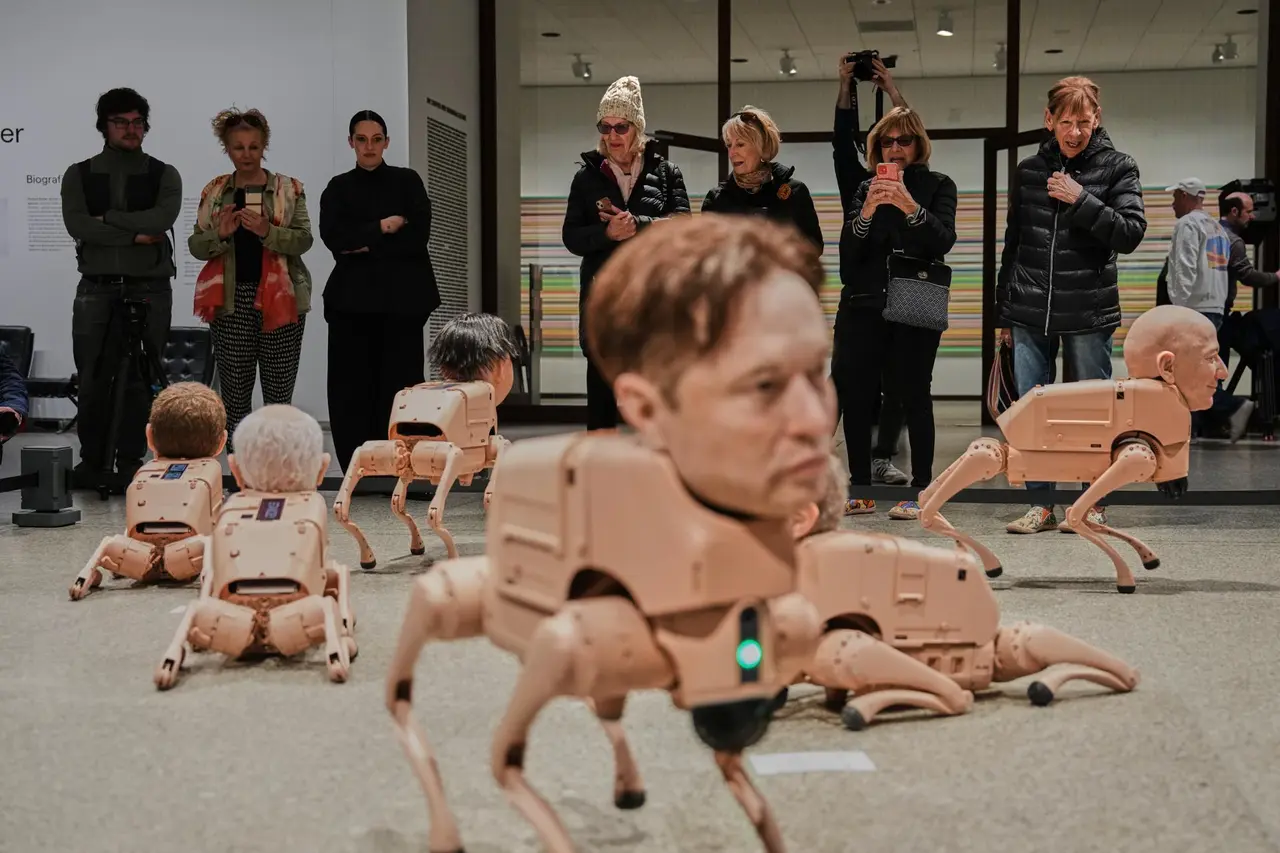
Robots in the likeness of Elon Musk, foreground, and Jeff Bezos, left, are displayed at the installation titled Regular Animals by artist Beeple, Mike Winkelmann, at the Neue Nationalgalerie museum in Berlin, Germany, Tuesday (local time). AP-Yonhap Robot dogs with hyper-realistic silicone heads modeled after world-renowned figures -- including Elon Musk, Mark Zuckerberg, Jeff Bezos, Andy Warhol and Pablo Picasso -- can be seen roaming around a Berlin gallery, occasionally "pooing" printed images of their surroundings which they've previously captured with integrated cameras. The animals are part of an interactive installation by American artist Beeple (Mike Winkelmann) currently showing at Berlin's New National Gallery . Each printed image shows a snippet of reality transformed by AI to resemble the personality of the dog or, in other words, the worldview of the human figure on its shoulders (i.e., the Picasso dog will produce images in Cubist style and Warhol's in pop art). It's a commentary on how our perceptions are shaped by algorithms and technology platforms, the organizers of the exhibition write in the description of the event. "In the past, our view of the world was shaped in part by how artists saw the world," Beeple told the AP. "How Picasso painted changed how we saw the world, how Warhol talked about consumerism, pop culture, that changed how he saw those things." Now our view of the world is shaped by tech billionaires who own powerful algorithms that decide what we see and what we don't see, the artist added. "That's an immense amount of power that I don't think we've fully understood, especially because when they want to make a change, they don't need to lobby the U.N. They don't need to get something through Congress or the EU, they just wake up and change these algorithms." The dogs also wear heads in Beeple's own image. Lisa Botti, the curator of the exhibition in Berlin, said that artificial intelligence was one of the phenomena most impacting our lives today and that "museums are the places where society can reflect" on such transformations, which is why she wanted to have Beeple's work shown. The work, entitled "Regular Animals," was first first shown at Art Basel Miami Beach 2025. Beeple is a graphic designer from South Carolina who does a variety of digital artwork. He is one of the founders of the "everyday" movement in 3D graphics: For years, he has been creating a picture every day and posting it online without missing a single day. According to Christie's, he is the third most expensive living artist to sell at auction, after David Hockney and Jeff Koons. In the spring of 2021, Christie's opened bidding for Beeple's digital collage entitled "Everydays: The First 5000 Days," with the sale ultimately closing at over $69 million. The auction house described the artwork as "critiques of modern society, the government and social media" in the form of "grotesque, dystopian futures, often featuring celebrities like Donald Trump and Kanye West." Christie's said the sale marked the first time a major auction house offered a digital-only artwork with a non-fungible token as a guarantee of its authenticity, as well as the first time cryptocurrency has been used to pay for an artwork at auction. Non-fungible tokens, known as NFTs, are electronic identifiers confirming a digital collectible is real by recording the details on a digital ledger known as a blockchain. The tokens have swept the online collecting world recently, an offshoot of the boom in cryptocurrencies. At the Art Basel 2025 event, Beeple gave away the photos pooed by his dogs to audience members, accompanied by a certificate that read "100% organic GMO-free dog shit." Some prints had QR codes that gave access to free NFTs, which in practice meant Beeple was giving away his digital art for free for people (sometimes the subjects of the photos themselves) to potentially monetize.
Share
Copy Link
American artist Beeple unveiled an art installation in Berlin featuring robot dogs with hyper-realistic heads of Elon Musk, Mark Zuckerberg, and Jeff Bezos. The dogs roam autonomously and produce AI-generated art that reflects each figure's worldview. The exhibit critiques how tech billionaires and their algorithms now shape human perception more than artists once did.
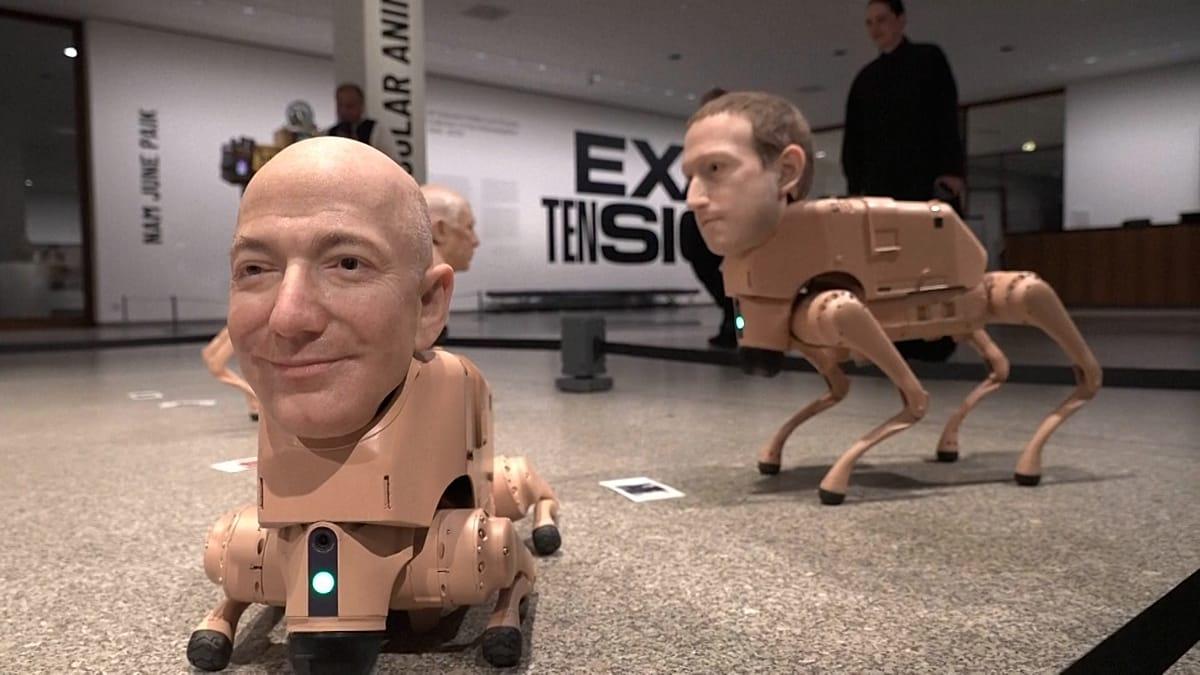
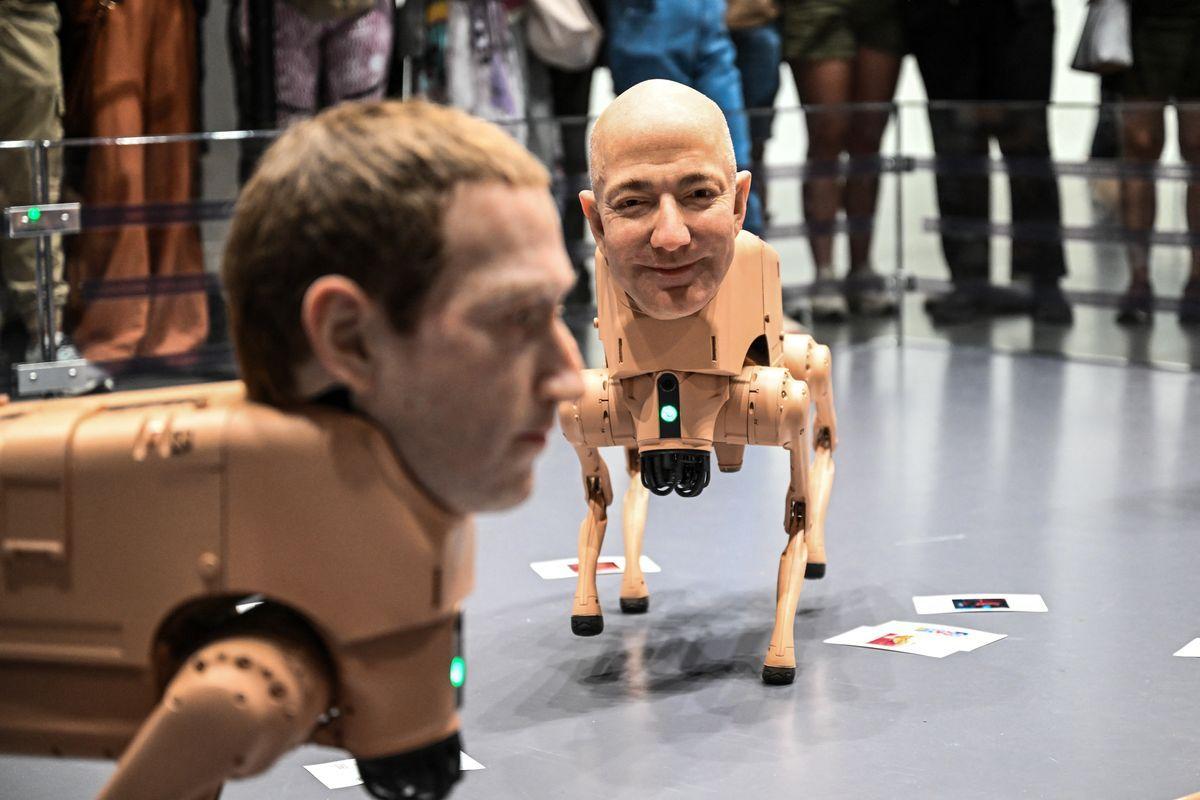
American artist Beeple, also known as Mike Winkelmann, has installed a provocative art installation in Berlin that directly confronts the power tech billionaires wield over human perception. The Regular Animals exhibit at the Neue Nationalgalerie features autonomous robot dogs fitted with hyper-realistic silicone heads modeled after Elon Musk and Mark Zuckerberg, along with Jeff Bezos, Pablo Picasso, Andy Warhol, and Beeple himself
1
. These Unitree Go2 robot dogs roam the gallery space freely, capturing images with integrated cameras before "pooing" out printed AI-generated art that reflects each figure's unique perspective2
. The Picasso dog produces images in Cubist style, while the Warhol version generates pop art interpretations of its surroundings.
Source: Korea Times
The commentary on technology platforms embedded in this work cuts to a critical question: who shapes our worldview in the digital age? "In the past, our view of the world was shaped in part by how artists saw the world," Beeple told the Associated Press. "How Picasso painted changed how we saw the world, how Warhol talked about consumerism, pop culture, that changed how he saw those things"
3
. Today, that power has shifted to tech billionaires who control algorithms that determine what content billions of people encounter daily. "That's an immense amount of power that I don't think we've fully understood, especially because when they want to make a change, they don't need to lobby the U.N. They don't need to get something through Congress or the EU, they just wake up and change these algorithms," the artist explained4
.The installation arrives at a moment when public consciousness around tech ethics has intensified. Questions about how social media platforms and their algorithms influence everything from political discourse to mental health have moved from niche academic circles to mainstream debate. The exhibit's focus on shaping human perception through technology platforms resonates with growing concerns about concentrated power in Silicon Valley. Lisa Botti, the curator who brought the work to Berlin, emphasized that "artificial intelligence was one of the phenomena most impacting our lives today and that museums are the places where society can reflect" on such transformations
5
.
Source: Euronews
Related Stories

Beeple has established himself as a pioneer at the intersection of digital art and blockchain technology. According to Christie's, he ranks as the third most expensive living artist to sell at auction, after David Hockney and Jeff Koons
1
. His digital collage "Everydays: The First 5000 Days" sold for over $69 million in spring 2021, marking the first time a major auction house offered digital-only artwork with NFTs as authentication and accepted cryptocurrency as payment. The South Carolina-based graphic designer pioneered the "everyday" movement in 3D graphics, creating and posting a new piece of digital art online every single day without missing one3
.The Regular Animals exhibit first appeared at Art Basel Miami Beach 2025, where Beeple gave away the AI-generated prints to audience members with certificates reading "100% organic GMO-free dog shit." Some prints included QR codes providing access to free NFTs
2
. The work raises urgent questions about accountability in an era where a handful of individuals control the information infrastructure that shapes billions of lives. As algorithms become more sophisticated and AI systems more pervasive, the critique of power embedded in these wandering robot dogs becomes increasingly relevant. The installation suggests we should scrutinize not just the technology itself, but the individuals who control it and their capacity to reshape reality with minimal oversight or democratic input.
Source: TechRadar
Summarized by
Navi
05 Dec 2025•Entertainment and Society

24 Nov 2024•Technology

23 Dec 2024•Technology

1
Policy and Regulation

2
Science and Research

3
Entertainment and Society


