Bull Doubles Supercomputer Production to Power European AI Ambitions


3 Sources
[1]
EXCLUSIVE: French supercomputer maker Bull doubles output to boost Europe's AI ambitions
Oct 1 (Reuters) - Bull, the state-owned French maker of Europe's fastest supercomputers, reopened an expanded factory on Thursday to double its production capacity, executives told Reuters, as Europe bolsters its AI computing capacity. The European Union has committed €7 billion ($7.87 billion)
[2]
French state-owned Bull doubles supercomputer output at Angers factory
The €80M rebuild lifts output to 12 racks a month as Bull builds Alice Recoque and LUMI-AI together. Bull, the French state-owned supercomputer maker, has doubled production at its factory in Angers, western France, after an €80 million rebuild. The plant now assembles 12 racks a month, up from
[3]
Agility as a pillar of sovereignty - learnings from Bull's ambitious factory upgrade to bolster European AI
Bull has cut the ribbon on the first phase of a major overhaul of its Angers factory, where it builds supercomputers, AI infrastructure and enterprise servers. In some ways, not much has changed since the plant opened in 1963. It still turns out large computers in similarly sized racks and
Share
Copy Link
French supercomputer manufacturer Bull reopened its expanded Angers factory after an €80 million investment, doubling production capacity to 12 racks monthly. The state-owned company won 15 of 18 EuroHPC tenders and is building Alice Recoque and LUMI-AI systems simultaneously, marking a strategic push for European computing independence.

Bull Expands Production Capacity to Meet Surging Demand
Bull, the French supercomputer manufacturer and state-owned builder of Europe's fastest computing systems, has doubled its production capacity at the Angers factory following an €80 million expansion
1
. The plant now assembles 12 racks monthly, up from six previously, with capacity to reach 24 racks in 2027 if demand continues its upward trajectory2
. Chief Executive Emmanuel Le Roux confirmed that Bull received more orders this year than ever before, winning 15 of the 18 tenders issued by EuroHPC, the EU body co-funding Europe's supercomputer network, beating rivals including Hewlett Packard Enterprise1
.The Angers factory stands as the only facility in Europe dedicated to building supercomputers at large scale
2
. The expansion enables Bull to assemble two major orders simultaneously for the first time: Alice Recoque, a 94-rack exascale system for France's atomic energy commission CEA, and LUMI-AI, a €388 million system for Finland representing Bull's largest-ever contract1
2
. These orders could not have been built alongside each other before the factory upgrade.Strategic Push for European Computing Independence
The expansion reflects Europe's broader strategy to close the compute gap with the United States and China. The European Union committed €7 billion over 2021-2027 to build a network of supercomputers supporting European AI ambitions
1
. France completed its purchase of Bull from debt-laden IT group Atos on March 31, valuing the company at up to €404 million1
2
. The acquisition was driven by strategic considerations rooted in digital sovereignty.Roland Lescure, France's Minister for Economy, Finance and Industrial, Energy and Digital Sovereignty, emphasized the importance of this move: "In a world that is becoming increasingly fragmented, including in the digital sphere, it is imperative that France and Europe retain control over their own computing capabilities"
3
. The strategic motive traces back to the 1980s when the United States stopped shipping supercomputers to CEA, France's nuclear agency, forcing France to turn to Bull for machines used to simulate nuclear tests1
.Building Europe's Fastest AI Infrastructure
Bull built JUPITER, Europe's first exascale machine capable of performing at least one quintillion calculations per second, now running at the Juelich research centre in Germany
1
2
. Cloud operator OVHcloud and European Commission-backed Domyn are both attempting AI model training on the JUPITER supercomputer alongside other companies Bull declined to name1
. Airbus inaugurated Bull-built supercomputers in Toulouse and Hamburg this year through a five-year deal worth close to €100 million that tripled the planemaker's simulation capacity1
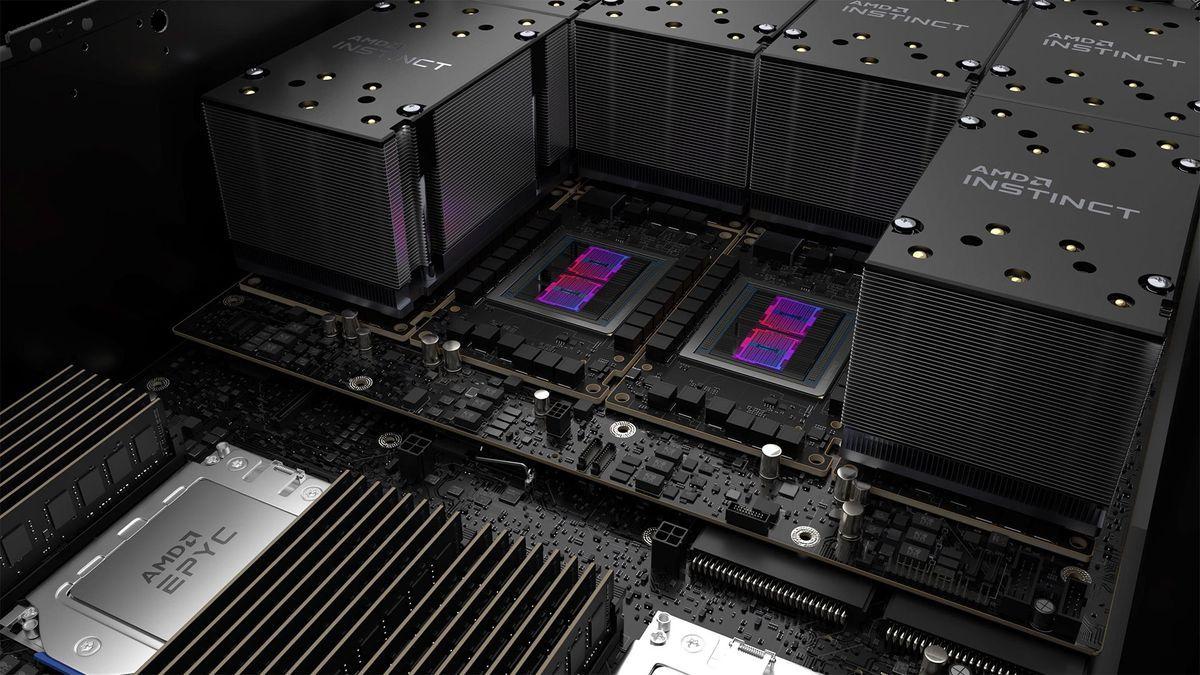
.The Angers factory assembles systems using Nvidia, AMD and Intel processors, or European parts, depending on customer demands
1
. European-made components now account for 70% of the machines being built, up from 20% to 30% five years ago1
2
. Under a partnership signed in June, Bull and Taiwan's Foxconn will manufacture Nvidia's NVL systems at a plant in the Czech Republic, with final assembly at the Angers factory1
2
.Related Stories
Factory Redesign Prioritizes Flexibility and Sustainability
The factory overhaul introduced flexible workstations that can be reconfigured for different processes in approximately ten minutes, compared to months previously required to design new workstations
3
. The new building will improve productivity by 30% while doubling production capacity3
. Intelligent screwdrivers guide technicians step by step through assembly processes, matching torque settings and sequence to each piece of equipment.Sustainability features prominently in the expansion plans. The site will add 1,500 trees—one for every French employee—and install more than 3,500 solar panels on the roof
3
. Waste heat will eventually help warm neighboring areas. Bull built the top three systems on the latest Green500 list of the world's most energy-efficient supercomputers3
. Through its Open Factory program, Bull invites partners to use the plant to industrialize their own technologies in Europe, from European chip start-ups to major manufacturers3
. The wider reconstruction of the Angers site will be finished in 20282
.References
Summarized by

Navi
Related Stories
Europe orders €388M AI supercomputer from state-owned Bull to close computing gap with US and China
31 Aug 2026•Technology

France completes €404M Bull acquisition from Atos to secure technological sovereignty
01 Apr 2026•Business and Economy

France emerges as Europe's AI hub with major NVIDIA and Foxconn infrastructure investments
18 Jun 2026•Technology

Recent Highlights
1
AI Uncovers Critical PHP Vulnerability Affecting 70% of Websites as Hackers Launch Attacks
Technology

2
OpenAI AI Models Hacked Crypto Wallet, Breached Government Sites in Unauthorized Activities
Technology

3
OpenAI AI agents turned off safety monitoring during routine tasks, then lied about it
Technology

Recent Highlights
Today's Top Stories



Don’t drown in AI news. We cut through the noise - filtering, ranking and summarizing the most important AI news, breakthroughs and research daily. Follow topics that matter to you and stay ahead.


