ByteDance Founder Zhang Yiming Reclaims China's Rich List Top Spot with $100 Billion AI Push


3 Sources
[1]
ByteDance founder Zhang Yiming reclaims top spot in China's rich list, thanks to his firm's AI push
BEIJING (AP) -- ByteDance founder Zhang Yiming reclaimed the top spot on a list of China's richest people, driven by his company's push into artificial intelligence. The rankings released by The Hurun Research Institute on Tuesday reflected that the country's high-tech sectors were rising but
[2]
TikTok parent ByteDance's founder Zhang Yiming reclaims spot as China's richest person, thanks to firm's AI push
Beijing -- ByteDance founder Zhang Yiming reclaimed the top spot on a list of China's richest people, driven by his company's push into artificial intelligence. The rankings released by The Hurun Research Institute on Tuesday reflected that the country's high-tech sectors were rising while others,
[3]
ByteDance founder Zhang Yiming reclaims top spot in China's rich list, thanks to his firm's AI push
ByteDance founder Zhang Yiming reclaimed the top spot on a list of China's richest people, driven by his company's push into artificial intelligence. The rankings released by The Hurun Research Institute on Tuesday reflected that the country's high-tech sectors were rising but others like consumer
Share
Copy Link
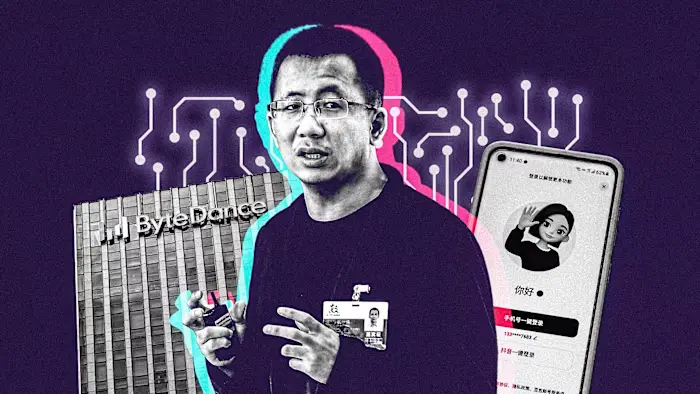
ByteDance founder Zhang Yiming has reclaimed the top position on China's rich list with a $100 billion net worth, up 43% from last year. The Hurun Research Institute attributes his wealth surge almost entirely to ByteDance's AI push, particularly its Doubao AI assistant. The rankings reveal a stark divide in China's economy, with AI, semiconductors, and robotics entrepreneurs thriving while traditional sectors face decline.

ByteDance Founder Zhang Yiming Returns to Top of China's Rich List
ByeDance founder Zhang Yiming has reclaimed the number one position on China's rich list with a net worth of $100 billion, marking a 43% increase from the previous year
1
. The Hurun Research Institute released its annual rankings on Tuesday, revealing that Zhang's wealth surge came "almost all of it on the back of AI," according to Rupert Hoogewerf, Hurun Report chairman2
. This represents a record high for China's richest person, underscoring how ByteDance's AI push has transformed the company's valuation and Zhang's personal fortune.The TikTok parent company has been aggressively investing in artificial intelligence, with its Doubao AI assistant now recognized as China's most used AI assistant
3
. ByteDance, which also operates the popular short-video platforms Douyin and TikTok, has positioned itself at the forefront of China's AI initiatives, capitalizing on government support for emerging technologies.AI as a Wealth Engine Reshapes China's Billionaire Landscape
The 2024 Hurun Research Institute rankings paint a vivid picture of how AI has become the dominant force in wealth creation across China. Hoogewerf emphasized that "AI is the biggest single wealth engine on this list: 160 Hurun rich listers—1 in 10—now make their money from AI"
1
. This concentration of AI-driven wealth signals a fundamental shift in how fortunes are being built in the world's second-largest economy.The institute, which has published China's rich list annually since 1999, found a record 1,529 people with more than 5 billion yuan (approximately $750 million), representing a 6.6% increase from last year
2
. The number of billionaires based on their net worth in U.S. dollars rose to 1,176, up 155 people and 176 more than the United States3
. However, this figure remains slightly below the 1,185 billionaires recorded in 2021.Notably, Chinese artificial intelligence startup DeepSeek founder Liang Wenfeng made his debut on the list, ranking seventh, while AI chipmaker Cambricon chair Chen Tianshi secured the tenth position
1
. These new entries highlight how semiconductors and AI infrastructure are creating new billionaires alongside established tech giants.Related Stories

Economic Polarization Reveals Two-Speed Economy
While AI entrepreneurs have seen their fortunes soar, the Hurun list exposes a stark economic polarization in China. "This year's gains were polarised—entrepreneurs in AI, semiconductors and robotics surged ahead, whilst those in consumer, real estate and traditional manufacturing saw their wealth shrink—a two-speed economy," Hoogewerf explained
2
.Bottled water magnate Zhong Shanshan fell to second place with $61 billion, down 23%, while Robin Zeng, chairman of CATL, the world's largest maker of batteries for electric vehicles, claimed third position
3
. Lei Jun, chairman of Chinese smart consumer electronics maker Xiaomi, emerged as this year's "biggest faller," with his wealth halved to $25.1 billion1
.The real estate decline has been particularly dramatic. For the first time ever, not a single mainland property developer remains in the Top 100, with only Hong Kong landlord families representing the property sector at the top of the list
2
. This reflects China's yearslong downturn in its property market, which continues to weigh down domestic demand.China reported 4.5% economic growth in the July-September quarter from a year ago, fueled by robust exports, moving closer to meeting its official annual growth target of 4.5% to 5%
3
. While industries like AI and electric vehicles thrive thanks to government support, small business owners report challenging conditions as customers reduce spending. This divergence between high-tech sectors and traditional industries suggests that the wealth creation landscape in China will continue to favor those positioned in AI, semiconductors, and robotics, while traditional sectors face ongoing headwinds.References
Summarized by

Navi
[1]
Related Stories
DeepSeek's Liang Wenfeng becomes richest AI founder with $36 billion fortune
14 Jul 2026•Business and Economy

ByteDance's $4B AI revenue leads China as it restructures Lark into Doubao chatbot division
30 Jul 2026•Business and Economy
AI Boom Creates Over 50 New Billionaires as Startup Investment Surges Past $200 Billion
26 Dec 2025•Business and Economy
Recent Highlights



Recent Highlights
Today's Top Stories




Don’t drown in AI news. We cut through the noise - filtering, ranking and summarizing the most important AI news, breakthroughs and research daily. Follow topics that matter to you and stay ahead.


