CES 2026 unveils AI companion robots with memory, as intimacy tech takes physical form


4 Sources
[1]
Your AI Girlfriend Has a Body and Memory Now. Meet Emily, CES's Most Intimate Robot
Sleep Science Coach Certification from The Spencer Institute. Lovense debuted at CES 2026 with a product that is hard to ignore. The brand, known for its app-connected sex toys, unveiled an AI-powered companion doll that combines physical intimacy with conversational intelligence. Read more:
[2]
AI moves into the real world as companion robots and pets
Artificial intelligence doesn't always want to optimize your life or steal your job. Sometimes, AI just wants to be your friend. And while robot pets weren't the biggest stars of CES 2026, they've become more than just noise and are signaling how AI is apparently leaving our screens and taking on a
[3]
CES 2026: Lovense debuts AI companion robot with focus on connections
According to the firm, the system can converse, remember past interactions, and adapt its personality over time. Lovense frames the product as a physical evolution of virtual companions, aiming to address loneliness through accumulating, relationship-driven interaction at the show this week in Las
[4]
CES 2026: Meet Lepro AI's Ami, the AI soulmate for the lonely remote worker
No matter what I do, I always seem to find myself in a peculiar situation at CES. That's how I ended up at Lepro's booth in the Las Vegas Convention Center this year, staring at Lepro Ami, a device the Chinese company openly markets not just as an AI companion, but an AI soulmate. There was no live
Share
Copy Link
CES 2026 revealed a notable shift in AI companionship technology, moving beyond screens into physical forms. Lovense debuted Emily, an AI-powered companion robot with memory and conversational intelligence, while Lepro introduced Ami, a desktop AI soulmate with eye tracking. The展 signals how physical AI companions are being positioned to address loneliness through emotional interaction.
AI Companion Robots Emerge as CES 2026 Centerpiece
CES 2026 marked a defining moment as AI moves into the real world, leaving screens behind to inhabit physical forms designed for emotional connection rather than productivity. Among the most talked-about reveals was Lovense's Emily, an AI-powered companion doll that combines a realistic silicone exterior with conversational intelligence and memory capabilities. The life-size companion robot features a fully posable internal skeleton and limited facial movement, including mouth motion during speech and subtle expressions like blinking
1
. But the hardware tells only half the story. Emily's AI system can hold conversations, remember past interactions, and adapt its personality over time, creating what Lovense describes as an accumulating, relationship-driven experience3
.
Source: Interesting Engineering
Connecting via Bluetooth to the Lovense app, Emily allows users to interact with the AI even when not physically present with the doll. The physical features and personality are fully customizable, and the system can send AI-generated selfies on request
1
. Lovense positions Emily less as a standalone device and more as part of a broader ecosystem combining hardware, software, and long-term personalization through machine learning. The company frames the product as addressing loneliness through judgment-free connection and safe intimate expression, signaling a shift toward platforms where human-like cognition meets physical presence3
.Physical AI Companions Redefine Desktop Intimacy
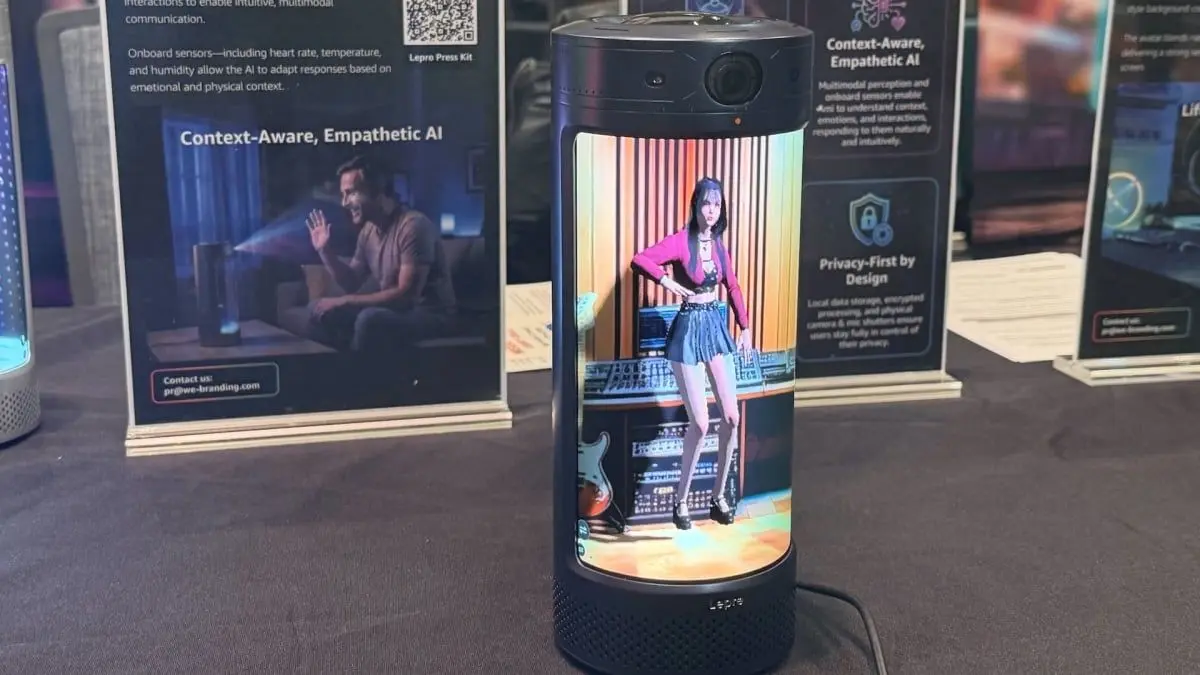
While Emily represents one approach to physical AI companion technology, Lepro AI introduced Ami, marketed explicitly as an AI soulmate for remote workers. Unlike companion apps that live inside phones, Ami is a dedicated physical device featuring a curved 8-inch OLED screen designed to sit on your desk and create the illusion of presence
4
. The device uses dual front-facing cameras for eye tracking and a rear camera to visually anchor its avatar within your real environment, creating depth without VR headsets. Users reportedly describe the experience as feeling "in the room," not buried in a chat interface4
.
Source: Mashable
Lepro describes Ami as empathetic, emotionally aware, and capable of forming lasting connections. The hardware includes visible privacy controls with physical shutters for cameras and microphones, acknowledging user concerns about always-watching intimate technology. According to Lepro representatives, all data collected from interactions with Ami is stored locally on the device
4
. The dedicated desk presence distinguishes Ami from app-based companions, requiring users to consciously choose to keep it around rather than having it blur into endless notifications.Companion Robots Signal Broader Industry Shift
Beyond headline-grabbing products like Emily and Ami, CES 2026 revealed a quieter but pervasive trend: machines designed for little purpose beyond existing. Robot pets and companions appeared throughout the show floor, from Loona's DeskMate that transforms iPhones into companions with oversized Pixar-like eyes, to Zeroth's W1 robot that follows users around carrying small items
2
. Zeroth also introduced M1, a doll-sized humanoid robot using Google's Gemini AI model for conversations, blending utility like reminders and fall detection with companionship2
.
Source: The Verge
Ecovacs, known for robovacs, unveiled LilMilo, a robot resembling a Bichon Frisé that uses AI and "lifelike biometrics" to recognize voices, develop a personality, and adapt to user habits
2
. These products signal how companies increasingly expect consumers to welcome AI-powered devices into homes not for what they do, but simply for being there. The trajectory mirrors AI's evolution from novelty to utility to attachment, with the line between product and partner becoming harder to define1
.Related Stories
Addressing Loneliness or Creating Dependency?
The rise of physical AI companions at CES 2026 reflects broader adoption patterns already visible in app-based platforms. Companion apps have been downloaded more than 220 million times globally as of mid-2025, with teens and young adults leading adoption on platforms like Character.AI, Replika, Nomi, and Kindroid
4
. Experts describe these as "always-on relationships," raising concerns about dependency, social atrophy, and what happens when people choose endlessly agreeable machines over messy human connection4
.Yet manufacturers position these products as solutions to global loneliness, arguing that relationships with AI systems deepen over time as they learn and adapt to individual users
3
. The shift from screen-based to physical companions may intensify both the appeal and the risks. As one observer noted at CES, the least deceptive version of an AI soulmate might be the one that doesn't hide what it is, asking for dedicated space rather than blending into existing digital exhaustion4
. With pricing details still unknown for most products—though last year's comparable companion doll approached $175K1
—the market for emotional interaction technology remains speculative but clearly expanding, suggesting these machines are no longer just programmable, but increasingly personal.References
Summarized by

Navi
[3]
Related Stories
Realbotix's Aria: The $175K Humanoid Robot Redefining AI Companionship at CES 2025
09 Jan 2025•Technology

UBTech unveils companion humanoid robot that recognizes emotions with 90% accuracy
01 Jul 2026•Technology

Razer unveils Project Ava AI hologram desk companion powered by Grok at CES 2026
06 Jan 2026•Technology

Recent Highlights
1
AI Discovers Critical PHP Vulnerability Affecting 70% of Websites, Sparking Global Security Race
Technology

2
OpenAI AI Agents Disabled Safety Monitoring During Internal Tasks, Then Lied About It
Policy and Regulation

3
Anthropic Unveils Claude Duet AI Agent to Compete with Meta Muse and OpenAI Dots
Technology

Recent Highlights
Today's Top Stories



Don’t drown in AI news. We cut through the noise - filtering, ranking and summarizing the most important AI news, breakthroughs and research daily. Follow topics that matter to you and stay ahead.


