China targets widespread brain-computer interface adoption within 3-5 years as BCI tech race heats up


4 Sources
[1]
China could see widespread use of brain-computer tech in 3-5 years, expert says
BEIJING, March 7 (Reuters) - China could see brain-computer interface (BCI) technology move into practical public use within three to five years as products mature, a leading BCI expert said, as Beijing races to catch up with U.S. startups including Elon Musk's Neuralink. Beijing elevated BCIs to
[2]
China could see widespread use of brain-computer tech in 3-5 years, expert says - The Economic Times
China could see brain-computer interface (BCI) technology move into practical public use within three to five years as products mature, a leading BCI expert said, as Beijing races to catch up with US startups including Elon Musk's Neuralink. Beijing elevated BCIs to a core future strategic
[3]
China could see widespread use of brain-computer tech in 3-5 years, expert says
China could see brain-computer interface (BCI) technology move into practical public use within three to five years as products mature, a leading BCI expert said, as Beijing races to catch up with U.S. startups including Elon Musk's Neuralink. Beijing elevated BCIs to a core future strategic
[4]
China could see widespread use of brain-computer tech in 3-5 years, expert says
BEIJING, March 7 (Reuters) - China could see brain-computer interface (BCI) technology move into practical public use within three to five years as products mature, a leading BCI expert said, as Beijing races to catch up with U.S. startups including Elon Musk's Neuralink. Beijing elevated BCIs to
Share
Copy Link
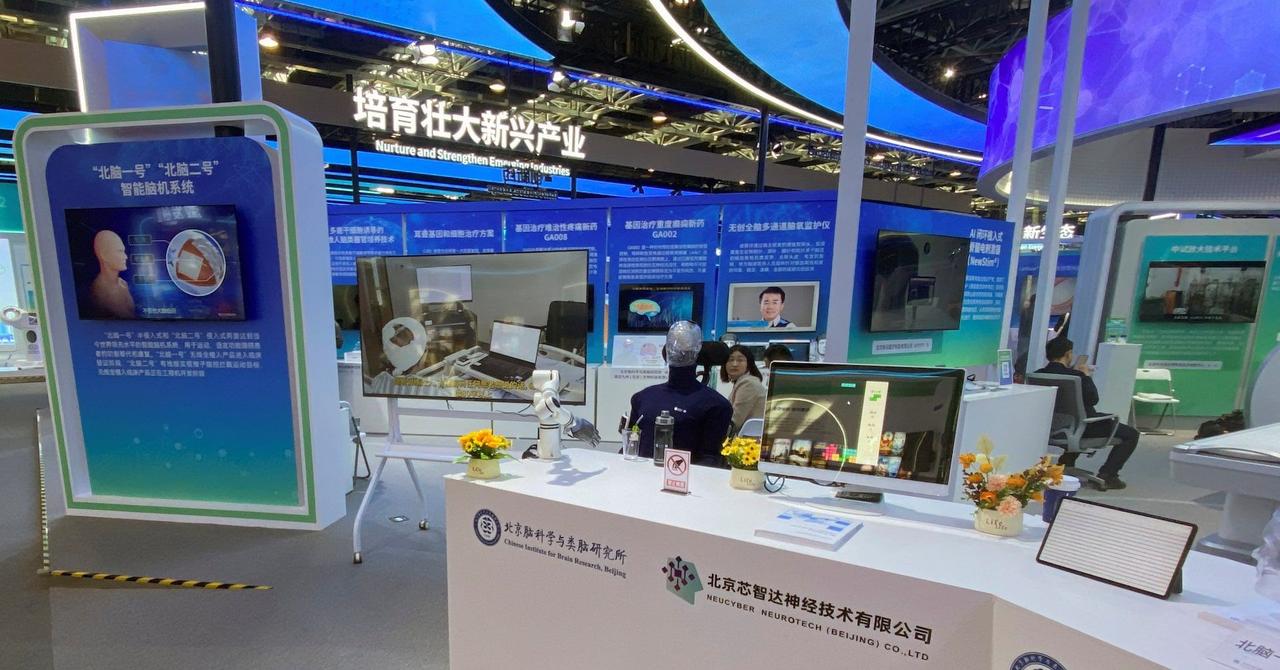
China could see brain-computer interface technology move into practical public use within three to five years, according to leading BCI expert Yao Dezhong. Beijing has elevated BCIs to a core strategic industry in its new five-year plan, placing the technology alongside quantum computing, embodied AI, and 6G as it races to catch up with U.S. competitors like Neuralink.
China Positions BCI Technology as Core Strategic Priority
China has elevated brain-computer interface technology to a core strategic industry in its newly released five-year plan, positioning it alongside quantum computing, embodied AI, 6G, and nuclear fusion
1
. Yao Dezhong, Director of the Sichuan Institute of Brain Science, projects that BCI technology could achieve widespread public use within three to five years as products mature and move toward practical service delivery2
. Speaking at China's annual parliament meetings in Beijing, Yao emphasized that while new policies won't transform the landscape overnight, the timeline reflects realistic expectations for when BCI products will transition from experimental settings to actual clinical applications3
.
Source: ET
Ambitious National Strategy Targets Technical Breakthroughs
A national BCI development strategy released last year sets clear milestones: major technical breakthroughs by 2027 and cultivation of two or three world-class firms by 2030
1
. China has become the second country to launch invasive BCI human trials, with more than 10 trials currently active—matching the United States in scale4
. Scientists plan to enroll more than 50 patients nationwide this year, expanding the research base considerably. Recent high-profile trials have demonstrated tangible results, enabling paralyzed patients and amputees to regain partial mobility and operate robotic hands or intelligent wheelchairs2
.Market Growth and Insurance Integration Signal Practical Progress
The domestic market for brain-computer interface technology is projected to reach 5.58 billion yuan ($809 million) by 2027, according to CCID Consulting
1
. In a significant move toward accessibility, the government has already integrated some BCI treatments into national medical insurance in several pilot provinces4
. This insurance integration, combined with emerging national standards, aims to close what Yao describes as the "huge" gap between scientific research, industry development, and clinical applications. Many Chinese hospitals have established BCI research labs to accelerate the path from experimental to clinical trials, addressing what remains a persistent challenge in bringing innovations to patients2
.Related Stories

Strategic Advantages in Population Scale and STEM Talent Pool
Yao, who also leads a key neuroinformatics research center under China's science and technology ministry, outlined several competitive advantages driving China's BCI ambitions
1
. These include a massive population base, enormous patient demand, a cost-effective industrial chain, and an abundant STEM talent pool. The scale of patient demand particularly matters for accelerating research and refining products through real-world testing. This demographic advantage could prove decisive in moving from laboratory concepts to deployable medical devices that serve millions.
Source: Reuters
Diversified Technical Approach Contrasts with Neuralink Strategy
While U.S. startups like Elon Musk's Neuralink focus primarily on invasive BCIs that penetrate brain tissue using surgical robots capable of inserting hundreds of electrodes within minutes, Chinese researchers are pursuing a broader technical strategy
2
. China is developing invasive, semi-invasive, and non-invasive BCIs with wider potential clinical use. Semi-invasive BCIs, positioned on the brain's surface rather than penetrating tissue, may sacrifice some signal quality but substantially reduce risks including tissue damage and post-surgery complications4
. Yao acknowledged Neuralink's technical advantage as "remarkable" but asserted that China is making very fast progress, noting that "Musk's direction is basically achievable domestically"1
. This diversified approach suggests China is betting on multiple pathways to market rather than pursuing a single high-risk, high-reward technology.References
Summarized by

Navi
[2]
Related Stories
Chinese Brain Chip Project Accelerates Human Trials, Challenging Global Competitors
31 Mar 2025•Technology
BrainCo unveils brain-to-robot platform to control humanoid robots with thoughts at WAIC
19 Jul 2026•Technology

China Unveils Ambitious 10-Year Plan for Nationwide AI Integration
29 Aug 2025•Technology

Recent Highlights
1
Microsoft and Nvidia Launch Surface Laptop Ultra: A $2,599 AI-Ready PC With RTX Spark Chip
Technology

2
Meta Muse AI Agent Surges to 6.6M Downloads Despite Privacy and Security Controversies
Technology

3
Scientists Build AI Model That Reconstructs Images From Brain Scans in Record Time
Science and Research

Recent Highlights
Today's Top Stories










Don’t drown in AI news. We cut through the noise - filtering, ranking and summarizing the most important AI news, breakthroughs and research daily. Follow topics that matter to you and stay ahead.


