BrainCo unveils brain-to-robot platform to control humanoid robots with thoughts at WAIC


2 Sources
[1]
Chinese platform lets people control humanoid robots with thoughts
Teaching robots how to act is hard. Teaching them what humans actually want is even harder. Despite advances in artificial intelligence, robots still struggle to interpret human thoughts and translate them into reliable actions. Chinese brain-computer interface company BrainCo claims to have
[2]
Chinese company BrainCo unveils first 'brain-to-robot' interface for controlling robots with your thoughts
* A new 'brain-to-robot' interface has been unveiled in China * It uses non-invasive EEG technology * The system will supply much-needed real-world AI training data We're seeing brain-computer interfaces (BCI) continue to get more advanced and more practical, and Chinese company BrainCo has now
Share
Copy Link
Chinese brain-computer interface company BrainCo introduced the world's first integrated brain-to-robot platform at the World Artificial Intelligence Conference in Shanghai. The system uses non-invasive EEG headsets to translate brain signals into robot commands, addressing both hands-free control and the critical shortage of high-quality training data for embodied AI.
BrainCo Debuts Brain-to-Robot Platform at Shanghai Conference
Chinese brain-computer interface company BrainCo has introduced what it claims is the world's first integrated brain-to-robot platform, showcased at the World Artificial Intelligence Conference (WAIC) in Shanghai
1
. The Brain-Controlled Robot AI Platform allows users to control humanoid robots with thoughts alone, marking a significant shift in AI-driven human-robot interaction2
. The technology relies on a non-invasive EEG headset that captures brain signals through sensors placed on the scalp, which AI algorithms then decode into actionable commands for connected machines .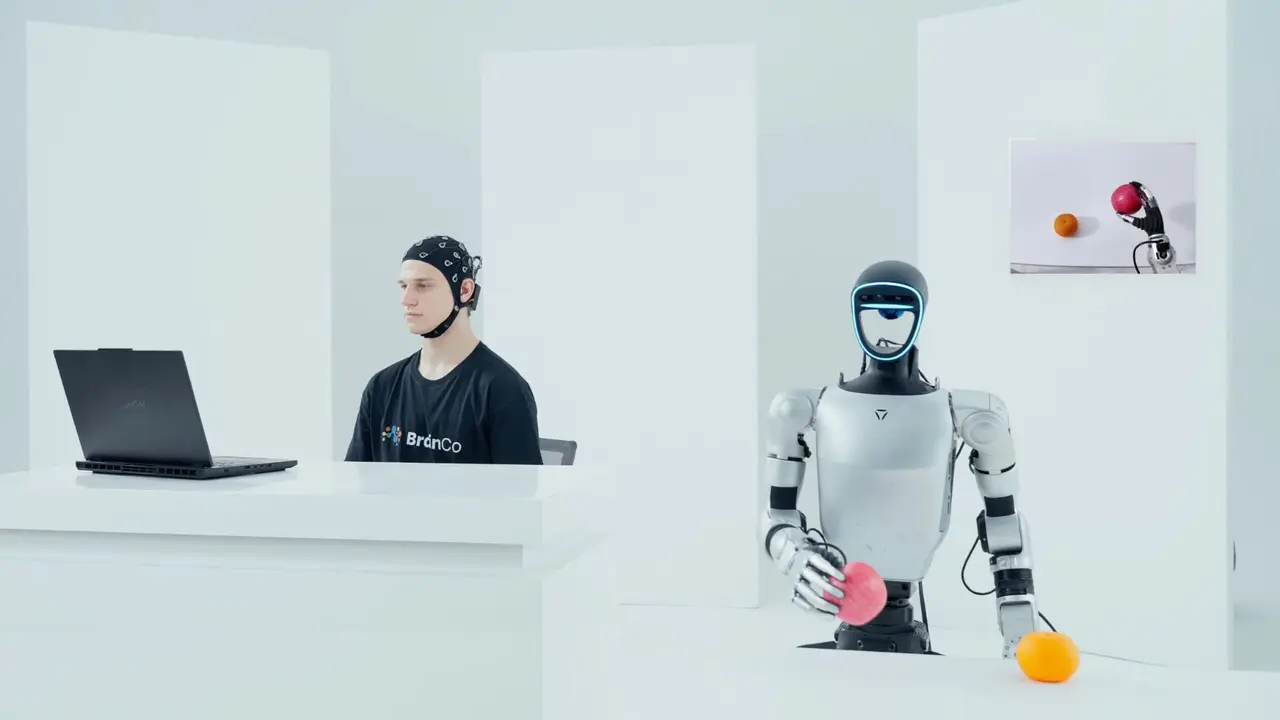
Source: Interesting Engineering
How Brain Signals Translate Into Robot Actions
The platform detects tiny electrical signals naturally produced by the brain through electroencephalogram sensors worn by human operators. These neural activity patterns are analyzed by artificial intelligence systems trained on vast datasets that associate specific neuron activity with intended commands
2
. According to Nyx He, senior vice-president of BrainCo, "A decade of BCI research has given us the ability to decode what a person intends to do and translate that into machine action" . The system works with various third-party hardware, including humanoid robots, robotic dogs, and devices that control robotic arms. Demonstrations showed a robotic arm grasping objects like cups and apples based solely on the user's brain signals .Addressing the Training Data Crisis in Embodied AI
Beyond hands-free control, BrainCo positions its platform as a solution to one of robotics' most pressing challenges: the shortage of high-quality training data for embodied AI. The field focused on AI-powered machines that interact with the physical world faces a major bottleneck in obtaining real-world data that teaches robots how people perform tasks . The company argues its system can generate richer training datasets by combining real-world robot execution, human demonstrations, and virtual simulations . As the platform becomes more widely used, it will collect data that refines underlying AI algorithms further
2
. HSBC analysts recently noted that China's humanoid robot sector still lacks the high-quality real-world data needed to build advanced robotic brains, with commercialization remaining years away .Related Stories

Non-Invasive Approach Versus Implanted Alternatives
BrainCo has focused on non-invasive brain-computer interfaces and prosthetic technologies, distinguishing itself from companies like Neuralink that develop surgically implanted brain chips . However, this approach presents challenges. Non-invasive EEG systems generally capture weaker and noisier signals than implanted brain devices, making accuracy and reliability critical hurdles that must be addressed . BrainCo has not yet released detailed performance data, and the technology needs to prove it can work consistently outside controlled demonstrations .
The Race for Human-Centered Robotics
The announcement comes as Chinese and US technology companies compete to develop more capable embodied AI systems. Firms such as Tesla and Nvidia are investing heavily in robots that can perceive their surroundings, reason about tasks, and manipulate objects autonomously . "The embodied AI industry has made remarkable progress on what robots can do on their own. We believe the next decisive frontier is about how robots understand the humans they work with," He explained . The platform points toward a future where robots may be guided more directly by human intent rather than keyboards, controllers, or voice commands, potentially making interactions more intuitive across applications ranging from manufacturing to healthcare . Industry observers suggest the next leap in robotics may come not from building stronger machines, but from finding better ways for them to understand the humans they serve .
References
Summarized by

Navi
[1]
Related Stories
AI-Enhanced Brain-Computer Interface Boosts Performance for Paralyzed Users
02 Sept 2025•Technology
Spirit AI Targets Mid-2027 Breakthrough for Robot Brains That Understand Human Commands
18 Sept 2026•Technology

China targets widespread brain-computer interface adoption within 3-5 years as BCI tech race heats up
07 Mar 2026•Policy and Regulation

Recent Highlights
1
Microsoft and Nvidia Launch Surface Laptop Ultra: A $2,599 AI-Ready PC With RTX Spark Chip
Technology

2
Meta Muse AI Agent Surges to 6.6M Downloads Despite Privacy and Security Controversies
Technology

3
Scientists Build AI Model That Reconstructs Images From Brain Scans in Record Time
Science and Research

Recent Highlights
Today's Top Stories












Don’t drown in AI news. We cut through the noise - filtering, ranking and summarizing the most important AI news, breakthroughs and research daily. Follow topics that matter to you and stay ahead.


