Cisco acquires Astrix Security to tackle growing AI agent security challenges


2 Sources
[1]
Cisco acquires cybersecurity firm Astrix to strengthen AI agent security
Cisco Systems Inc. announced its acquisition of the Israeli cybersecurity firm Astrix Security Ltd. to enhance the security of artificial intelligence agents. The terms of the deal remain undisclosed, but sources speculated it could be valued around $300 million. Peter Bailey, senior vice
[2]
Cisco To Acquire Astrix To Boost Identity Security For AI Agents
Astrix is a top specialist in securing identities and credentials used by modern systems such as API keys, OAuth tokens and service accounts, Cisco's Peter Bailey wrote in a post announcing the deal. Cisco Systems announced Monday it has reached an agreement to acquire identity protection startup
Share
Copy Link
Cisco Systems Inc. has acquired Israeli cybersecurity firm Astrix Security in a deal valued between $250 million and $400 million. The acquisition strengthens Cisco's ability to secure AI agents and non-human identities like API keys and OAuth tokens. With only 24% of businesses able to control AI agents effectively, the move addresses critical security blind spots as AI agents increasingly outnumber human users in enterprise environments.
Cisco Acquisition Targets Growing AI Agent Security Gap
Cisco Systems Inc. announced its acquisition of Israeli cybersecurity firm Astrix Security Ltd., marking a strategic move to address mounting concerns around AI agent security
1
. While Cisco did not disclose official terms, reports suggest the deal ranges between $250 million and $400 million, with Calcalist estimating approximately $400 million2
. Founded in 2021, Astrix Security has raised $85 million in total funding from investors including Menlo Ventures and Anthropic2
.Securing Non-Human Identities Becomes Critical Priority
Peter Bailey, senior vice president and general manager of Cisco's Security Business Group, emphasized that Astrix Security specializes in protecting credentials that power modern systems, particularly API keys, OAuth tokens, and service accounts
1
. These are "the very credentials that AI agents are now using (and abusing) to gain access and execute work at scale," Bailey noted2
. The platform developed by Astrix enables organizations to identify, manage, and secure AI agents operating in production environments, maintaining a real-time inventory of AI agents and non-human identities with contextual awareness of their activities1
.Identity Security Integration Expands Cisco's AI Defense Capabilities
Cisco plans to integrate Astrix's technology into its Cisco Identity Intelligence platform, enhancing visibility and context of identities within its security ecosystem
1
. The capabilities will extend to Cisco Secure Access and Duo Identity and Access Management offerings, allowing customers to authenticate and authorize agentic identities while responding to threats1
2
. Key capabilities include AI agent discovery and governance, agentic access management, and threat detection and response for agents2
.Related Stories


Security Blind Spots Plague Enterprise AI Deployments
Cisco's AI Readiness Index reveals alarming statistics: only 24% of businesses can effectively control AI agents, while just 31% of enterprises consider themselves fully capable of securing their AI deployments
1
. Astrix co-founders Alon Jackson and Idan Gour highlighted that AI agents significantly outnumber human users, creating substantial security blind spots for many organizations1
. The tools support agent lifecycle management and threat detection, essential for reducing attack surfaces and preventing compliance violations1
.Cisco Builds Comprehensive AI Security Portfolio
This acquisition follows Cisco's recent purchase of observability startup Galileo Technologies Inc., aimed at enhancing the trustworthiness and reliability of AI models
1
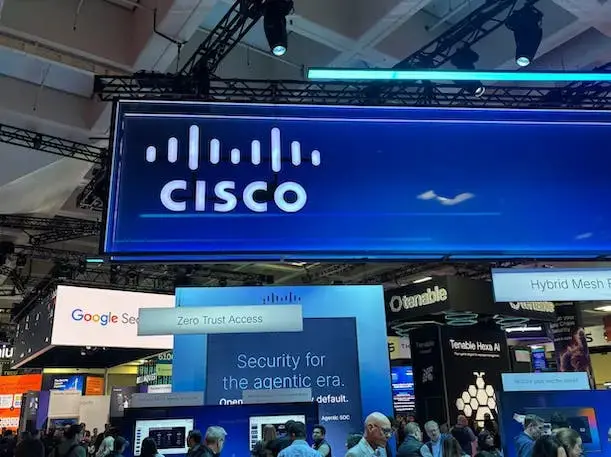
. At the RSAC 2026 Conference in March, Cisco introduced Zero Trust Access for AI agents, along with tools like Duo IAM for access management and DefenseClaw for scanning vulnerabilities1
2
. Bailey emphasized that Cisco's differentiation lies in its "visibility across identity, network, application and infrastructure layers," enabling the company to understand not just what an agent is, but how it behaves2
.
Source: CRN
References
Summarized by

Navi
Related Stories
Recent Highlights



Recent Highlights
Today's Top Stories



Don’t drown in AI news. We cut through the noise - filtering, ranking and summarizing the most important AI news, breakthroughs and research daily. Follow topics that matter to you and stay ahead.


