4 Sources
[1]
Claude Cowork finally remembers what you told the app in chat
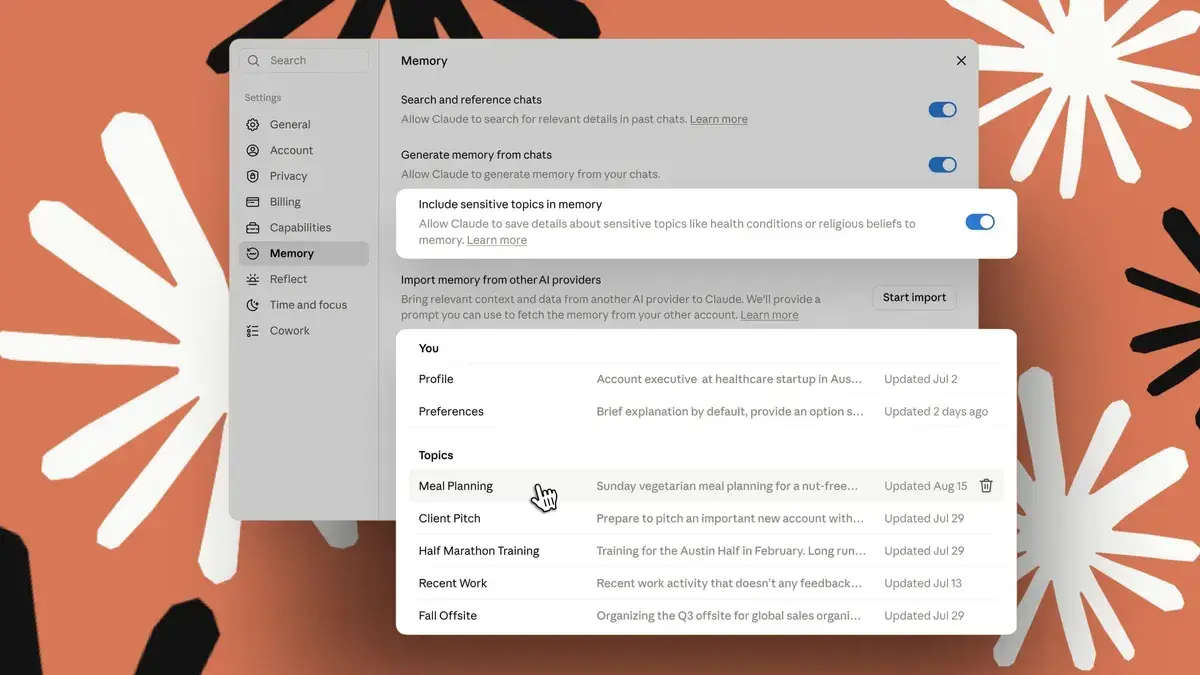
A change to Claude's memory system will eliminate one of the most annoying things about using agents -- the constant need to rebrief the AI on things it already knows. On Tuesday, Anthropic announced it's merging the memory system used by chat and Claude Cowork, which means that Claude will always remember what it learned in one area, even when you're engaging with it in another. Anthropic is also exposing what Claude has retained in its memory, allowing users to read, edit, or delete information on any topic. The update will improve the experience for Claude's users as it will allow them to more seamlessly move between the research phase and taking action. Before, you may have developed ideas for projects over time while chatting with Claude, but when it came time to actually enact the changes, you'd have to start over by telling Cowork all the details. This was incredibly frustrating. The update makes Claude now feel like one continuous assistant, rather than two separate products under one roof. Anthropic offers an example of someone needing to draft an update for their manager or an agenda for a conference, where Cowork would already understand the references because of the past conversations about the matter at hand. For instance, it would know the headcount, city, and speakers at the conference, so you wouldn't have to re-input that information. In addition, Claude will now add topics to its memory as you chat, instead of summarizing a conversation when it ends. That makes it easier to move back and forth between chat and Cowork, as the new memories are more quickly updated and shared between the two experiences, even if the chat is ongoing. Anthropic says that, by default, Claude won't store personal or sensitive information like your health data, race, ethnicity, religious beliefs, politics, gender identity, and more. However, users can opt to enable these things by toggling on "include sensitive topics in memory" if they prefer. The app will also notify users whenever a sensitive topic is saved in memory. However, the company says that Claude won't ever save certain things, like government-issued ID and Social Security numbers, criminal history, immigration status, or other things that violate its acceptable use policy. The memory feature is enabled by default on Free, Pro, and Max plans across web, desktop, and mobile. On iOS and Android, users will need to update their app to the latest version.
[2]
Anthropic's Claude and Cowork will share memories about you now - unless you opt out
Follow ZDNET: Add us as a preferred source on Google. ZDNET's key takeaways * Claude chat and Cowork now share one memory system. * Memory updates as you chat, with sensitive-data controls. * The productivity boost comes with serious privacy tradeoffs. Today, Anthropic announced the merger of the memory systems for Claude chat and Claude Cowork. "Starting today, the memory you use in chat is the same as in Claude Cowork. Now, wherever you work with Claude, it starts from what it already knows about you," said Anthropic. Memory is now two-way. What you do in Claude chat is remembered by Claude Cowork. What you do in Cowork is remembered in chat. It seems that what happens in Claude Code still stays in Claude Code. The company made no mention of Claude Code whatsoever in the announcement. When I asked, I was told this update is "focused on Claude Cowork and chat." Progress in implementing AI systems and services has been moving forward at warp speed, which some have taken to calling "AI speed." One of the side effects of this rapid pace of innovation is that experiments have turned into projects and then into products, often without the benefit of an end-to-end product plan. As a result, we've been seeing capabilities mirrored across products but not necessarily coordinated between them. Features appear in one implementation but mysteriously vanish in the next (ChatGPT desktop, I'm looking at you). We're also starting to see the consolidation of features. This can be best seen in the trend, on the part of both OpenAI and Anthropic, to turn their individual desktop app offerings into "super apps," apps that contain the features of more than one previously individual desktop app. Also: I used Claude Code to vibe code a Mac app in 8 hours, but it was more work than magic Now, we're seeing another consolidation. Up until now, the memory of chat sessions you had with Claude as a chatbot was locked into the chatbot. The memory of sessions you've had with Claude Cowork was locked into Cowork. Your Claude chat history is now available to Cowork Anthropic described this feature this way: "Cowork now has memory, and it's the same one you use in chat." It also said: "The context you've built up across months of conversations...is there the moment you hand Cowork a task, and what comes up in Cowork carries back to chat." This implies that Claude's existing memory of your conversations will be available to Cowork, not just conversations that you start going forward. The company gives an example that supports this idea of preexisting knowledge: "Ask Cowork to draft an update for your manager, and it already knows who that is and how she likes updates written. Brainstorm the agenda in chat for a conference you're organizing; when Cowork builds the budget and logistics doc, it knows the headcount, the city, and the speakers. Explain once in chat how your team defines its metrics, and every quarterly business review deck Cowork builds after that uses them, with no rebriefing." Also: 75% of developers I surveyed prefer Claude Code - here's why they choose it over Codex One interesting operational change is how Claude adds topics to memory. They are now added to memory as you chat. Previously, Claude used to summarize conversations after they ended. This is dynamic. You don't have to tell Claude to "remember this" for it to remember. Advanced memory management This update includes a number of safety and quality-of-life improvements to memory as well. You can pause or reset memory at any time. That means nobody needs to know about your unhealthy fascination with British cozy mysteries or 1980s hair bands. In all seriousness, Claude also has fairly deep controls over sensitive topics. According to Anthropic, "By default, Claude does not store topics related to personal or sensitive subject matter, like your health, race, ethnicity, religious beliefs, politics, gender identity, and other similar areas." That said, you might want Claude to know about topics some consider sensitive. Anthropic's example was that you might want Claude to remember you have a gluten allergy so it takes that into account when suggesting recipes. If you've granted Claude permission to save sensitive topics, Claude will display a notice. On one hand, that's helpful, so you know information is being recorded. But if you're struggling with something and just want some help, I'm not sure getting a warning about it every time you want to discuss it will be conducive to increasing your internal peace. Also: Claude Code vs. Codex: Why I use both and how to choose one (if you must) Anthropic lists a number of topics that it will not store, even if you allow sensitive topics to be stored. These include sensitive identification numbers, criminal history, immigration status, or anything that violates Anthropic's acceptable use policy. How to control your Claude memories These memory features are available in all tiers of chat and Cowork. Anthropic said, "Memory is on by default on Free, Pro and Max plans across web, desktop, and mobile." However, saving sensitive topics is off by default. Enterprise and Teams tier users are a bit different. Both the memory features and the sensitive topics features are "off for organizations by default and subject to eligibility." Also: How to keep your conversations with ChatGPT, Gemini, Copilot or Claude as private as possible Controls for the memory features are available directly from the Settings menu in the new Memory section. To control whether Claude keeps track of your chat memories, toggle "Generate memory from chats" on or off. To control sensitive memory retention, toggle "Include sensitive topics in memory" on or off. You can also go back and edit your saved memories. Claude stores a list of files under Topics in the Memory settings area. You can read, edit, or delete them. They apply globally. The example Anthropic used was that if you correct your company's "old name," then every conversation afterward will know the new name. My thoughts I have to tell you, I am seriously conflicted about this. But then again, I'm seriously conflicted about the whole AI thing. Also: Claude's Record-a-Skill cut my research from hours to 30 minutes - but the magic has limits On one hand, there is incredible value to be derived from using generative AI tools. I've been using Claude Code this week to build a really cool Mac app that would have taken years to build by hand. I've used Claude, Gemini, and ChatGPT to help out in so many projects over the last few years. Then again, the AI companies trained their AIs on all our work, mostly without permission. To this day, Anthropic uses some of our data for model training because if you accept the terms prompt where it says "Help Improve Claude," your data is sucked down. Enterprise accounts are not included. To turn this off, go to Settings > Privacy > Help Improve our AI models and toggle the switch off. From a productivity point of view, it's fairly helpful to have the various AIs know about you because they can approach your requests with context. It saves time when you don't have to reintroduce them to your preferences over and over again. On the other hand, the AI knows that, in 2025, I had a possibly unhealthy fascination with the murder rates in Midsomer, Kembleford, and Grantchester. Do I want the AI to assume that one category of research informs my overall profile? Probably not. For the record, Grantchester is way worse than Kembleford. The AI even made the case that TV's Father Brown might be the smiling angel of death. Also: Claude's Record-a-Skill cut my research from hours to 30 minutes - but the magic has limits In any case, like any other tool that is both powerful and dangerous, we need to apply care and attention to our AIs. They can help us mightily, but there may also be risks and unintended consequences. As for me, I'm keeping the memory feature on in Claude, although I won't enable the sensitive information option. After all the time I've spent telling my stories to the entire internet, I don't have much to hide. But still, there need to be some boundaries. Are you planning on turning Claude's memory on or turning it off? Let us know in the comments below. You can follow my day-to-day project updates on social media. Be sure to subscribe to my weekly update newsletter, and follow me on Twitter/X at @DavidGewirtz, on Facebook at Facebook.com/DavidGewirtz, on Instagram at Instagram.com/DavidGewirtz, on Bluesky at @DavidGewirtz.com, and on YouTube at YouTube.com/DavidGewirtzTV.
[3]
Claude Cowork will now remember your conversations with chat
You'll be able to turn "include sensitive topics in memory" on or off. It has been about a week since Anthropic gave Claude the ability to send emails in Gmail and manage files in Google Drive. Now the AI company is rolling out another feature. This feature will make switching back and forth between Claude chat and Cowork a little easier. Anthropic has announced that Claude Cowork now has memory, so you can spend less time re-explaining. Not only does Cowork have memory, but it also shares the same memory as chat. That means when you run a task in Cowork, Claude will remember it in chat, and vice versa. As a result of this update, chat will now add topics to memory as you chat rather than summarizing conversations after they end. In the past, you had to tell Claude to "remember this." Anthropic says that you'll be able to pause or reset memory at any time. All the memories you create will be kept in a list of files under Topics in the Memory settings. When you visit this page, you'll be able to read, edit, or delete any of the memories. While memory is on by default, Anthropic says that sensitive information (e.g. health, race, ethnicity, religious beliefs, politics, or gender identity) is not saved by default. You'll have the option to turn on "include sensitive topics in memory" if you do want that information included. However, the company claims that identification numbers (SSN, government ID numbers, etc), criminal history, immigration status, or other information that violates its Acceptable Use Policy will never be saved. Memory has been rolled out to users on Free, Pro, and Max plans. The feature is available on the web, desktop, and mobile. If it's not available on mobile, Anthropic advises that you update your Android or iOS app to the latest version.
[4]
Anthropic updates Claude's memory to enhance customization and protect sensitive topics
Anthropic updates Claude's memory to enhance customization and protect sensitive topics Artificial intelligence startup Anthropic PBC announced today it's changing how Claude, its flagship AI product, uses memory by allowing users to see everything it remembers "topic by topic," and edit or delete any of it. Claude also does not store sensitive subjects by default. This includes topics mentioned by users, including health concerns, race, ethnicity, gender identity, religion or political beliefs. However, if a user flips a toggle, the AI will add them to its memory. With the update, the AI's memory will also persist across both chat and Cowork, the company's desktop AI agent that can perform multi-step jobs. It is now the same one that Claude uses when a user is asking questions and brainstorming, or diving deep into agentic work, building documents, coding large-scale websites, or running tasks in the cloud. This means that it doesn't matter if a user is sitting at their desktop, on mobile, on the web or connecting to the Cowork agent - it still "remembers" topics said in chat across months of context. Anthropic framed this as not needing to re-explain the same thing over and over. Claude already knows simple subjects that you tell it often. For example, if you use Cowork to build a report for your manager, it can recollect all of the context from your chats where you've discussed who your manager is, her name, her preferences for how she likes reports written and the voice you like to use (for example, not starting bullet points with a "loud" verb). Explain once in chat how the team defines metrics and how it likes them visualized and Cowork uses that when it builds slide decks from then on. If the user doesn't like it, they can quickly drop into the memory, find the topic within the interface and quickly change it to their liking. They can also just tell Claude - it adds memories as chat happens, instead of summarizing conversations after they end. Mention a project deadline moved to September, and the next conversation already knows without needing to say "remember this." Minding sensitive topics Although Claude is set to automatically ignore sensitive topics, once sensitive topics are allowed, users will see a notice that the AI model believes it has stored what might be considered a delicate subject. Anything from before the toggle was flipped is not saved. Anthropic noted that certain subjects are never saved, even with sensitive subjects turned on. These include highly private information such as Social Security numbers, government ID numbers, criminal history, immigration status, and subjects that could violate the company's Acceptable Use Policy - which includes numerous guidelines involving safety, emotional harm, privacy, and identity.
Share
Copy Link
Anthropic announced a major update to Claude's memory system, merging chat and Claude Cowork into one unified AI memory framework. The Claude AI assistant now retains and recalls conversation topics across all platforms, eliminating the need to re-explain context when switching between research and action modes.
Anthropic announced a significant memory system update for its Claude AI assistant that merges the previously separate memory frameworks used by chat and Claude Cowork
1
. The change addresses one of the most frustrating aspects of using AI agents: constantly re-briefing the system on information it already knows. Starting now, Claude will remember conversations and user preferences across both chat sessions and Cowork tasks, creating a seamless experience whether users are brainstorming ideas or executing multi-step projects2
.The update transforms how users interact with Claude across desktop, mobile, and web platforms. Previously, developing project ideas through chat meant starting from scratch when moving to Cowork to implement changes. Now the desktop agent already understands references from past conversations without requiring users to re-input details like conference headcount, city locations, or speaker names
3
. This shared memory across platforms creates context retention that persists regardless of which interface users choose.Anthropic fundamentally changed how Claude adds information to its AI memory. The system now captures topics dynamically as conversations unfold, rather than summarizing discussions after they conclude
1
. This shift enables faster context retention between chat and Cowork, allowing users to move fluidly between research and action without waiting for conversation endpoints. When someone mentions a project deadline moved to September, the next interaction already incorporates that change without requiring explicit "remember this" commands4
.
Source: ZDNet
The memory feature now operates across Free, Pro, and Max plans on all supported platforms
3
. Users can access a comprehensive list of retained topics through Memory settings, where they can read, edit, or delete any stored information. This transparency gives users complete control over what the Claude AI assistant remembers, addressing concerns about AI systems retaining unwanted information.Anthropic implemented robust privacy controls alongside the memory system update. By default, Claude does not store sensitive topics including health data, race, ethnicity, religious beliefs, politics, or gender identity
1
. Users who want Claude to remember conversations about these subjects can enable "include sensitive topics in memory" through opt-out options in settings. When this toggle is activated, the system displays notices whenever it saves information it identifies as potentially sensitive4
.Certain categories remain permanently excluded from memory regardless of user preferences. Anthropic never stores government-issued ID numbers, Social Security numbers, criminal history, immigration status, or any information violating its Acceptable Use Policy
2
. These hard boundaries protect users from inadvertently exposing highly sensitive personal data through casual conversation with the AI.Related Stories
The unified memory framework delivers immediate productivity gains for users who regularly switch between ideation and execution. Anthropic provided examples showing how Cowork can now draft manager updates using remembered preferences for writing style, or build conference budgets incorporating previously discussed logistics without re-briefing
1
. Teams that explain their metric definitions once will see those standards applied consistently across every quarterly business review deck Cowork generates afterward4
.
Source: TechCrunch
This consolidation reflects broader industry trends toward AI "super apps" that integrate previously separate capabilities. The memory merger makes Claude feel like one continuous assistant rather than disconnected products under shared branding
2
. Users can pause or reset memory at any time, providing flexibility for those who want to compartmentalize different projects or maintain separation between personal and professional contexts.The update arrives approximately one week after Anthropic enabled Claude to send emails through Gmail and manage files in Google Drive, demonstrating rapid iteration on agent capabilities
3
. Mobile users need to update their iOS or Android apps to access the new memory features, which are enabled by default across all subscription tiers.Summarized by
Navi
[3]
23 Oct 2025•Technology

12 Sept 2025•Technology

12 Aug 2025•Technology

1
Technology

2
Policy and Regulation

3
Technology