CScale Secures $145M from Nvidia and Intel to Replace Copper Cables with Optical Interconnect


4 Sources
[1]
CScale raises $145 million for AI networking, with backing from Nvidia and Intel
SAN FRANCISCO, Sept 30 (Reuters) - CScale, a Silicon Valley startup developing a way to connect AI chips with fiber-optic cables instead of fiber, said on Wednesday it has raised $145 million in venture capital, with backing from Nvidia (NVDA.O), opens new tab and Intel (INTC.O), opens new
[2]
CScale raises $145m for AI optical interconnect, backed by Nvidia
The Palo Alto startup builds optical interconnect for AI data centres. Nvidia and Intel Capital joined the round as its first strategic investors, taking total funding to $188m. CScale, a Palo Alto startup building optical interconnect for AI data centres, has come out of stealth with $145m in
[3]
Scale-up interconnect startup CScale launches with $188M in funding
Scale-up interconnect startup CScale launches with $188M in funding CScale Inc., a startup that develops optical interconnects for data centers, launched today with $188 million in funding. The company raised about three quarters of the capital through a recently closed Series C round. It was
[4]
CScale Secures $145 Million in Funding to Revolutionize AI Networking with Optical Technology
The Silicon Valley startup, backed by Nvidia and Intel, is developing technology to replace copper links inside AI data-centre servers with fibre-optic connections and plans to ship its chips by 2028. CScale, a Silicon Valley startup developing a way to connect AI chips with fibre-optic cables
Share
Copy Link
Silicon Valley startup CScale raised $145 million in Series C funding backed by Nvidia and Intel to develop optical interconnect technology for AI data centers. Led by former Cisco executive Martin Lund, the company aims to replace copper cables with fiber-optic connections that link thousands of AI accelerators across dozens of racks by 2028.
CScale Emerges from Stealth with $188 Million in Total Funding
CScale, formerly known as CSpeed, has emerged from stealth mode announcing $145 million in Series C funding, bringing its total venture capital funding to $188 million since its founding in 2023
1
3
. The Palo Alto-based scale-up interconnect startup secured strategic investments from industry giants Nvidia and Intel Capital as first-time investors, signaling strong confidence in its optical technology for AI data centers2
. Atreides Management led the round, with Valor Equity Partners and Premji Invest serving as co-leads, while existing investors Sutter Hill Ventures and Maverick Silicon also participated4
.Tackling the Copper Cable Bottleneck in AI Infrastructure
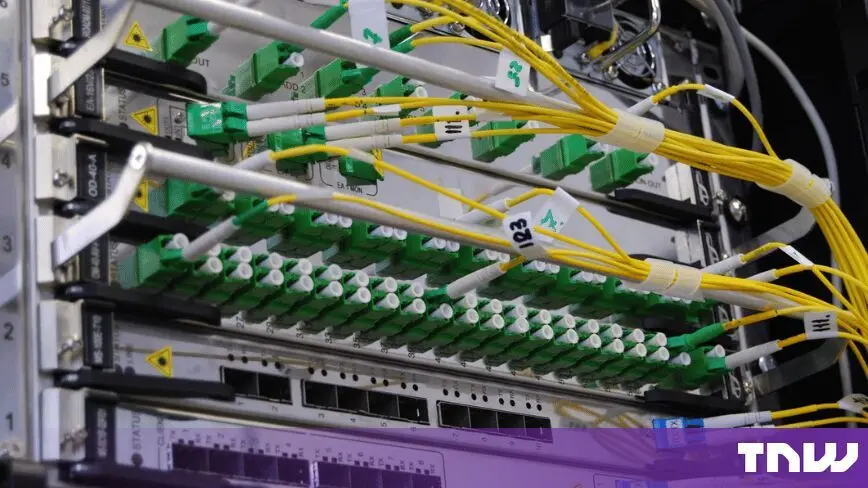
CScale joins an intensifying race in Silicon Valley to replace copper cables with fiber-optic connections inside AI data center servers
1
. Copper cables, while fast and reliable, have severe reach limitations that force chip designers such as Nvidia and Advanced Micro Devices to pack processors tightly together inside servers4
. This tight packing generates substantial heat, requiring elaborate liquid cooling systems that add complexity and cost to AI infrastructure. The company's optical interconnect technology is specifically designed to link thousands of AI accelerators across dozens of racks, enabling what the industry calls large scale-up cluster configurations2
3
.Solving the Laser Failure Problem in AI Networking
Public companies and startups are pouring billions of dollars into optical connections that use flashes of laser light instead of electrons to carry data between AI chips
1
. However, these lasers are prone to frequent failures, leading many firms to keep lasers separate from chips for easy replacement. CScale's approach differs fundamentally. CEO Martin Lund stated the company will integrate lasers onto chips in a way that does not interrupt data flow when lasers fail1
. "We're designing the interconnect for continuity. Lasers will fail. Compute shouldn't," Lund explained2
. The company describes its product as an "integrated light engine" capable of containing optical failures without disrupting compute operations3
.Related Stories

Proven Leadership Driving AI Optical Interconnect Technology
Martin Lund, who left his position overseeing chip and hardware systems for networking giant Cisco Systems earlier this year, leads CScale as CEO
1
. Lund previously built Broadcom's switching business and held senior roles at Microsoft and Cadence2
. Founder and chief technology officer Sanjai Kohli brings extensive experience, having co-founded SiRF Technologies, which brought GPS technology to the mass market, and later founded Inovi, which Facebook acquired in 20142
. The company currently employs approximately 85 people focused on developing this critical AI infrastructure technology2
.Market Context and Timeline for Commercial Deployment
CScale enters a competitive landscape where optical interconnect startups have attracted substantial venture capital funding. Atreides Management, which led CScale's round, also backed Lumilens with $700 million in August, while Celero raised $275 million and Eliyan secured $145 million in Series C funding in July
2
. "As scale-up systems move toward gigawatt-class deployments, interconnect bandwidth means nothing without system reliability," said Gavin Baker, managing partner and chief investment officer at Atreides Management. "Every optical failure is a compute failure. At this scale, failures are not hypothetical -- they are inevitable"3
. Lund emphasized the company uses proven technologies integrated in novel ways while preserving trusted fiber technology that has shipped in the industry for many years1
. CScale plans to ship its chips by 2028, positioning itself to address the growing demands of linking thousands of AI accelerators as data centers scale to gigawatt-class deployments1
3
.References
Summarized by

Navi
Related Stories
Upscale AI Hits $1 Billion Valuation With $200M Funding to Challenge Nvidia and Broadcom
22 Jan 2026•Startups

Xscape Photonics Secures $44M to Revolutionize Data Center Connectivity with Silicon Photonics
16 Oct 2024•Technology

Celero Raises $275M to Connect AI Chips with Coherent DSP Technology at $3B Valuation
09 Sept 2026•Technology
Recent Highlights



Recent Highlights
Today's Top Stories






Don’t drown in AI news. We cut through the noise - filtering, ranking and summarizing the most important AI news, breakthroughs and research daily. Follow topics that matter to you and stay ahead.


