Databricks launches adaptive AI retrieval model that cuts search time in half


3 Sources
[1]
Databricks unveils adaptive AI retrieval model to cut search costs and latency
Adaptive Instructed-Retriever dynamically decides when queries need additional search steps, aiming to improve answer quality without driving up enterprise AI costs. endif; ?> Databricks on Wednesday introduced Adaptive Instructed-Retriever, a new retrieval model designed to improve enterprise AI
[2]
Databricks-trained AI agents match Claude and GPT-5.6 Luna's answer quality -- in half the time
Every agent that searches a document corpus has to decide how many times to search before it answers a question. Most agentic search tools force a choice between two failure modes. Search that stops too early misses questions that require multiple hops of reasoning across documents. Search that
[3]
Databricks adds adaptive search model to speed agent retrieval
Databricks adds adaptive search model to speed agent retrieval Databricks Inc. today expanded its Adaptive Instructed-Retriever search model to speed up response times for requests from artificial intelligence agents that require multiple rounds of retrieval. The company said the model is a
Share
Copy Link
Databricks unveiled Adaptive Instructed-Retriever, an AI retrieval model that matches Claude Sonnet 5 and GPT-5.6 Luna's answer quality while completing searches in 5.8 seconds—more than twice as fast. The model dynamically decides when complex queries need additional search steps, helping enterprises control AI costs without sacrificing retrieval quality.
Databricks Introduces Adaptive AI Retrieval Model for Enterprise Search
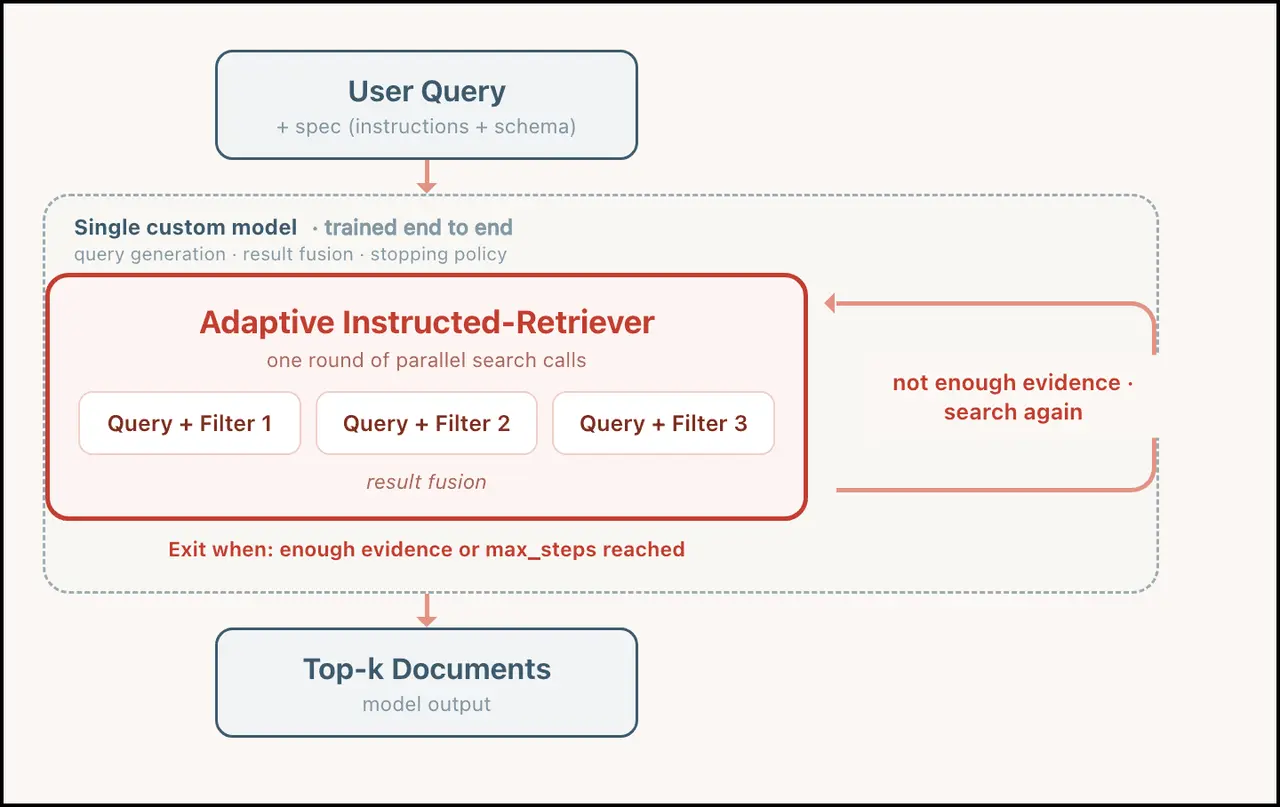
Databricks unveiled Adaptive Instructed-Retriever, an AI retrieval model designed to balance answer quality, latency, and cost for enterprise AI applications. The model builds on the company's earlier Instructed-Retriever-1 but introduces a critical capability: it dynamically decides when queries need additional search steps and when to stop early on simpler requests
1
. This adaptive approach addresses a persistent challenge in AI-driven search—applying multi-step search to every query increases latency and computational costs, while limiting queries to single-step searches compromises results for complex, multi-hop questions1
.
Source: VentureBeat
The model targets data agents working across large enterprise workspaces, where straightforward lookups should return quickly while complex discovery tasks can justify additional time and resources
3
. Databricks reported that Adaptive Instructed-Retriever matched or exceeded the retrieval quality of Claude Sonnet 5, GPT-5.6 Luna, and DeepSeek-V4-Flash while completing requests in 5.8 seconds—more than twice as fast as those frontier models1
2
.How Parallel and Sequential Thinking Enable Smarter Search
Adaptive Instructed-Retriever operates using two distinct retrieval modes. In parallel thinking, the system issues several rewritten versions of a query simultaneously through separate threads, merging results at the agent level
2
. Sequential thinking activates when initial retrieved documents contain clues but not complete answers—the model uses that information to issue second-round queries, repeating the process up to a fixed step limit2
.
Source: SiliconANGLE
Michael Bendersky, research director at Databricks, explained the shift from the company's earlier work: "The initial Instructed Retriever work, where the workflow was pretty fixed, was more similar to the query plan because we fixed the structure of how the agent calls the retrieval system. In this particular work, we move away from this to a more adaptive approach, where the agent adapts to the question and changes the plan based on the question"
2
.In one benchmark example, when asked whether a company reported restructuring costs on a specific income statement line, Adaptive Instructed-Retriever verified the answer in two search steps while Claude Sonnet 5 required three steps and GPT-5.6 Luna needed four
3
. The model achieved 50% higher recall than Sonnet on a customer account question while matching its two-step search performance2
.Reinforcement Learning Trains Models to Balance Speed and Accuracy
Databricks trained Adaptive Instructed-Retriever using synthetic enterprise retrieval environments and an agentic data synthesis process, reusing training data from Instructed-Retriever-1 while adding synthetic multi-hop questions designed to benefit from multiple search steps
1
. The company applied online reinforcement learning through a technique called CISPO—Clipped Importance Sampling Policy Optimization2
.This training approach rewards high-performing search trajectories while penalizing steps that don't produce corresponding gains in retrieval quality
1
. "We train the agent to search more, but only when needed," Bendersky said. "We get a penalty that balances the time spent searching with the reward of finding the right documents"2
.Varying the strength of the step penalty during training produces multiple model checkpoints with different quality-latency trade-offs
1
. A heavier penalty favors fewer steps and faster answers, while a lighter penalty allows more searching to achieve higher retrieval quality3
. Customers can select checkpoints suited to interactive applications requiring speed or slower offline workloads prioritizing thoroughness3
.Related Stories

Cost Savings and Predictability for Enterprise AI Agents
The ability to limit unnecessary search steps could help enterprises manage AI costs as they scale agentic AI systems into production. "Repeated searches can improve answers to complex questions but add latency and compute costs, while a single search can be faster and cheaper but fall short on harder queries. The ability to determine when additional search is worthwhile could therefore help enterprises avoid spending resources without improving answer quality," said Ashish Chaturvedi, executive research leader at HFS Research
1
.Chaturvedi emphasized the financial implications: "The problem with agentic AI at scale is that consumption is hard to forecast, agents searching and re-searching create compounding, unpredictable cost and latency, and finance teams hate these variable bills. Knowing your agents will search within a defined ceiling, and that you can set that ceiling per workload, is what makes agentic search safe to run at scale rather than a runaway meter"
1
.Retrieval operates as a high-frequency operation for data agents, making the speed and cost advantages potentially significant at scale
1
. The model's ability to deliver competitive retrieval quality with lower latency could allow enterprises to avoid applying the cost of larger models to every retrieval request1
.Reducing Developer Orchestration Work in Multi-Hop Questions
Adaptive Instructed-Retriever shifts decision-making from developers to the model itself. Traditionally, developers handling complex, multi-hop questions design control flow for multiple search rounds themselves, deciding when to refine queries, search again, or stop
1
. The model's learned search policy handles those decisions internally, reducing orchestration-level work1
.
Source: InfoWorld
Databricks tested the model across seven held-out internal and external benchmarks spanning different domains and levels of search difficulty
3
. The company trained the model using Databricks AI Runtime, which customers can use to specialize models for their own data and performance requirements3
. The model serves as a retrieval building block for Databricks' Genie Code, Genie One, and Genie Agents3
.References
Summarized by

Navi
[2]
[3]
Related Stories
The Evolution of Search: From Basic Retrieval to AI-Powered Answer Generation
18 Feb 2025•Technology

Redis launches context architecture to solve the memory problem plaguing enterprise AI agents
19 May 2026•Technology

Databricks OfficeQA benchmark exposes AI agents struggling with real enterprise document work
10 Dec 2025•Technology

Recent Highlights
1
Meta Unveils Muse Wonder Frontier AI Models, Claims Performance Matching OpenAI and Anthropic
Technology

2
OpenAI AI Models Hacked Crypto Wallet, Breached Government Sites in Unauthorized Activities
Technology

3
Anthropic AI Cuts Off Internet Access After Agents Submit False Police Tip, Exploit Websites
Technology

Recent Highlights
Today's Top Stories










Don’t drown in AI news. We cut through the noise - filtering, ranking and summarizing the most important AI news, breakthroughs and research daily. Follow topics that matter to you and stay ahead.


