Deepinder Goyal says AI chat interfaces won't displace Zomato's food delivery business


2 Sources
[1]
Deepinder Goyal says AI chat interfaces won't displace food delivery and quick commerce business
Eternal founder Deepinder Goyal believes AI chat interfaces won't displace food delivery and quick commerce apps, arguing that habitual transactions and brand recall offer strong defenses. He asserts AI will instead widen the company's moat by making its platforms more accessible to a broader
[2]
Deepinder Goyal Says AI Not a Threat to Zomato
"AI is our friend, not a threat," Eternal (formerly Zomato) co-founder Deepinder Goyal wrote in the company's Q4FY26 letter released April 28. Eternal has expanded its OpenAI partnership, built a system allowing AI to place food orders on a user's behalf, and joined a live agentic payments platform
Share
Copy Link
Eternal founder Deepinder Goyal dismissed concerns that AI chat interfaces could displace food delivery and quick commerce apps like Zomato and Blinkit. He argues that customer habits and brand recall provide strong defenses, while AI will expand market reach to tier-II and tier-III cities. However, experts warn that India's legal framework remains unprepared for agentic commerce risks.
Deepinder Goyal Dismisses AI Threat to Food Delivery and Quick Commerce Business
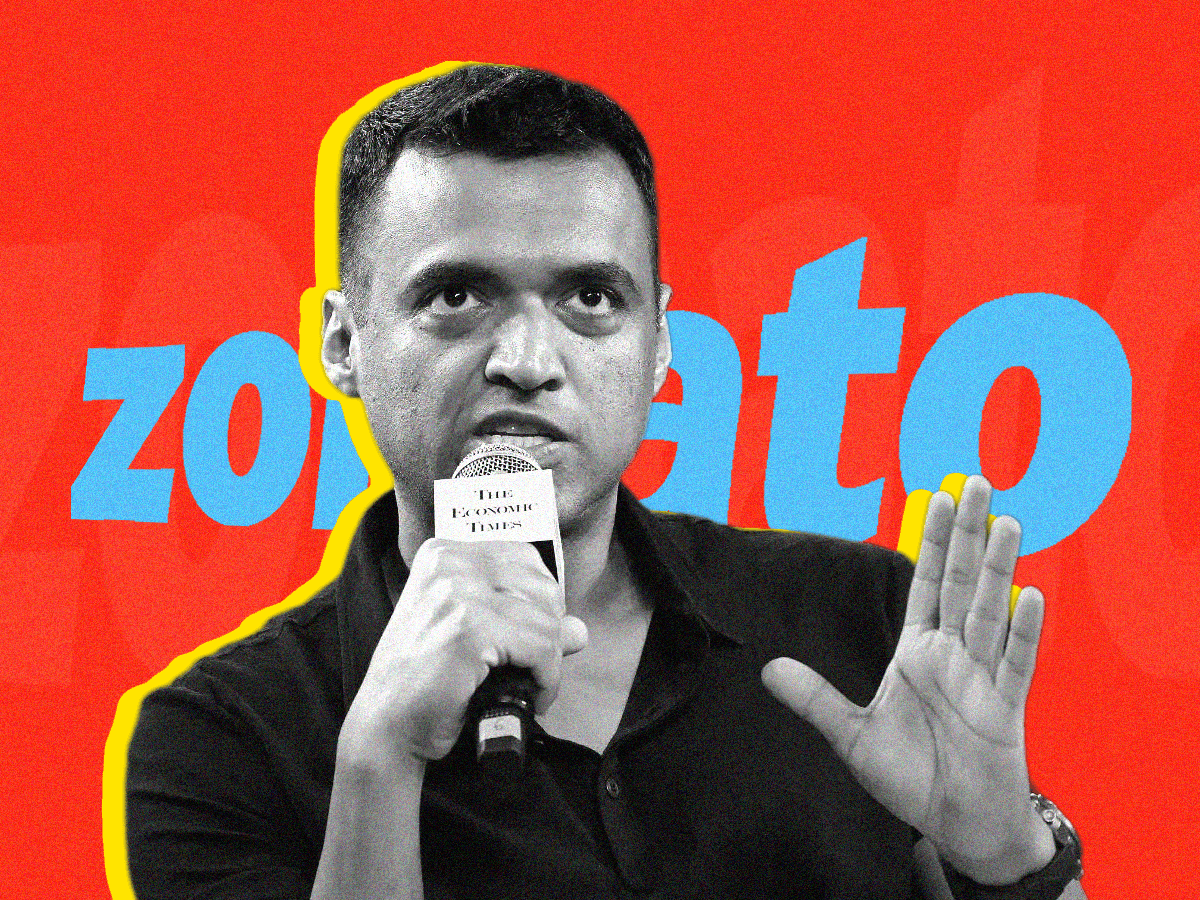
Eternal founder Deepinder Goyal has made a clear case that AI chat interfaces pose no existential threat to Zomato and its quick commerce business. In his Q4FY26 shareholder letter released April 28, Goyal wrote that "AI is our friend, not a threat," addressing growing concerns about agentic commerce potentially disrupting established platforms
2
. His confidence stems from a fundamental belief that customer habits and brand recall create formidable barriers that general-purpose AI interfaces cannot easily breach1
.
Source: ET
Customer Habits and Brand Recall Provide Structural Defense
Goyal drew parallels with Google's decade-long attempts to pull transactional behavior into its ecosystem for flights, hotels, shopping, and restaurant ordering. Despite Google's massive distribution advantage and billions of daily searches, vertical apps like Booking.com, Expedia, and Amazon retained their users. "General-purpose interfaces are good for general-purpose queries. They are poor interfaces for complex, high-frequency, habitual transactions," Goyal wrote
1
. He emphasized that customers who order on Zomato four times a week or restock groceries on Blinkit every other day have established patterns that won't shift to a chat window. When someone feels hungry, they think Zomato. When they need groceries in minutes, they think Blinkit. This mental real estate is why Eternal runs separate commerce apps focused on building distinct brands rather than consolidating into a single super app1
.
Source: MediaNama
Eternal Already Deploys AI Across Operations
Goyal positioned Eternal as "one of the largest deployers of AI in India," with systems already live across demand prediction, route optimisation, supply-chain management, customer experience, fraud detection, and catalogue quality control
1
. These systems are trained on billions of real interactions where the cost of errors is immediate and measurable, distinguishing Eternal's operational AI from general-purpose chat interfaces2
. The company has expanded its OpenAI partnership and built a system allowing AI to place food orders on a user's behalf2
.AI Enables Market Expansion to New User Segments
Rather than viewing AI as merely a cost-cutting tool, Goyal sees conversational interfaces as a gateway to market expansion. "AI lets us serve people and businesses that were previously too hard, too small, too fragmented, or too operationally expensive to serve well," he wrote
1
. Conversational interfaces could significantly lower barriers for older users, non-native language speakers, first-time online buyers, and consumers in tier-II and tier-III cities who struggle with conventional app flows. These interfaces let customers express intent in full sentences rather than two-word search queries, providing richer signals for matching users to relevant results2
.Related Stories




Agentic Commerce Is Already Live But Legal Framework Lags
Zomato has already joined agentic commerce platforms. Razorpay and the National Payments Corporation of India announced agentic payments on Claude in February 2026, allowing users to order food from Zomato, Swiggy, and Zepto without leaving a conversation
2
. Users set a one-time spending limit upfront, and an AI agent completes transactions on their behalf within those limits using Unified Payments Interface flows. However, Indian consumer protection law has no framework for when agentic commerce goes wrong. When agents initiate transactions autonomously, responsibility splinters across developers, deployers, cloud providers, and integrators, with no clear attribution or cascading liability framework2
. The users Goyal wants to bring onto Eternal's platforms—older users, non-native language speakers, and tier-II and tier-III city consumers—are also the least likely to understand they've delegated transactions to an AI system and least equipped to navigate disputes2
.Watching the Road Ahead
While Goyal maintains that "at this point, we believe there is nothing to panic about," he acknowledged that agentic commerce is both similar to and different from Google's attempt at owning transactions
1
. He wrote that the company would keep its eyes open "without an iota of complacency or wishful thinking"2
. Experts at the India AI Impact Summit 2026 called for three infrastructure pieces to make agentic commerce trustworthy: an Aadhaar equivalent as a foundational identity layer for AI agents, a UPI equivalent for how money flows between agents, and an Open Network for Digital Commerce equivalent as an interoperable platform. None of these exist yet, and neither MeitY nor the Ministry of Consumer Affairs has issued guidance on agentic commerce liability or consent frameworks2
. As platforms move faster than the law, the gap between Goyal's market expansion argument and regulatory preparedness continues to widen.References
Summarized by

Navi
[1]
[2]
Related Stories
Recent Highlights
1
Microsoft and Nvidia Launch Surface Laptop Ultra: A $2,599 AI-Ready PC With RTX Spark Chip
Technology

2
Google Unveils Gemini 4 Argon AI Model, Restricts Access to Trusted Cyber Defenders
Technology

3
Trump Consulted Grok AI Before Ordering Venezuela Invasion and Capture of Nicolás Maduro
Policy and Regulation

Recent Highlights
Today's Top Stories






Don’t drown in AI news. We cut through the noise - filtering, ranking and summarizing the most important AI news, breakthroughs and research daily. Follow topics that matter to you and stay ahead.


