Destro AI Raises $8M to Coordinate Mixed Robot Fleets in Warehouses


2 Sources
[1]
Destro AI's secret sauce is getting robots and humans on the same page
The best path to successfully deploying a robot is not building one at all, according to Destro, a startup that came out of stealth Tuesday with an $8 million seed round. Most new robotics companies are focused on finding the right form factor or developing an AI model that can put metal hands to
[2]
Destro AI raises $8M to coordinate mixed robot fleets in enterprise warehouses
Destro AI raises $8M to coordinate mixed robot fleets in enterprise warehouses Warehouse robotics software startup Destro AI Inc. has raised $8 million in new funding to bring its platform for coordinating mixed robot fleets to more enterprise warehouses. Engineering and research hiring will take
Share
Copy Link
Brooklyn-based Destro AI emerged from stealth with $8 million in seed funding for its intelligence layer that coordinates robots and humans in logistics. The startup's MothershipOS platform manages mixed robot fleets from multiple vendors, while directing human workers through the same system. Yusen Logistics is deploying 26 robots at one facility and piloting 17 more at another location.
Destro AI Secures $8 Million for Warehouse Intelligence Platform
Destro AI came out of stealth on Tuesday with an $8 million seed round led by Base10 Partners and Bonfire Ventures, with additional investment from CoFound Partners. The Brooklyn-based startup has built an AI intelligence layer that coordinates robots and human workers in logistics settings, positioning itself as a software company rather than a robotics manufacturer
1
2
.Founder Manthan Pawar, who holds a master's degree in robotics from NYU Tandon and has spent roughly eight years in the U.S. supply chain and robotics industry, told TechCrunch that the company is "on path to be cash flow positive at the end of this year." The startup is less than a year old but already booking revenue, having won head-to-head evaluations against competitors valued at $1 billion or more
2
.The Intelligence Layer That Coordinates Mixed Robot Fleets
Destro's core offering is MothershipOS, a coordination system that assigns tasks across mixed robot fleets from multiple vendors. The platform determines when and where work happens, allowing warehouse operators to run machines from several manufacturers under one system and swap hardware as operations change
2
. Pawar explained that while most robotics companies start by asking "what cool things can I do," Destro focused on understanding customer problems. "One of the biggest reasons we are winning against robotics companies is because we are not a robotics company," he said1
.Mobile manipulation is handled on the robots by VisionOS, a second system built on open-weight vision-language-action models. These AI systems interpret camera images and instructions to control robot movements, having learned from human demonstrations how to perceive and grasp objects
1
2
.Yusen Logistics Deployment Validates Cross-Dock Approach
Yusen Logistics, a South Korean shipping giant, became Destro's first named customer after director of automation Richard Brunelle identified a gap in the market. Brunelle, responsible for automation across about 30 facilities in the U.S., was focused on cross-docking operations where goods are unloaded from one truck and sorted into mixed loads for other trucks making final deliveries
1
.
Source: TechCrunch
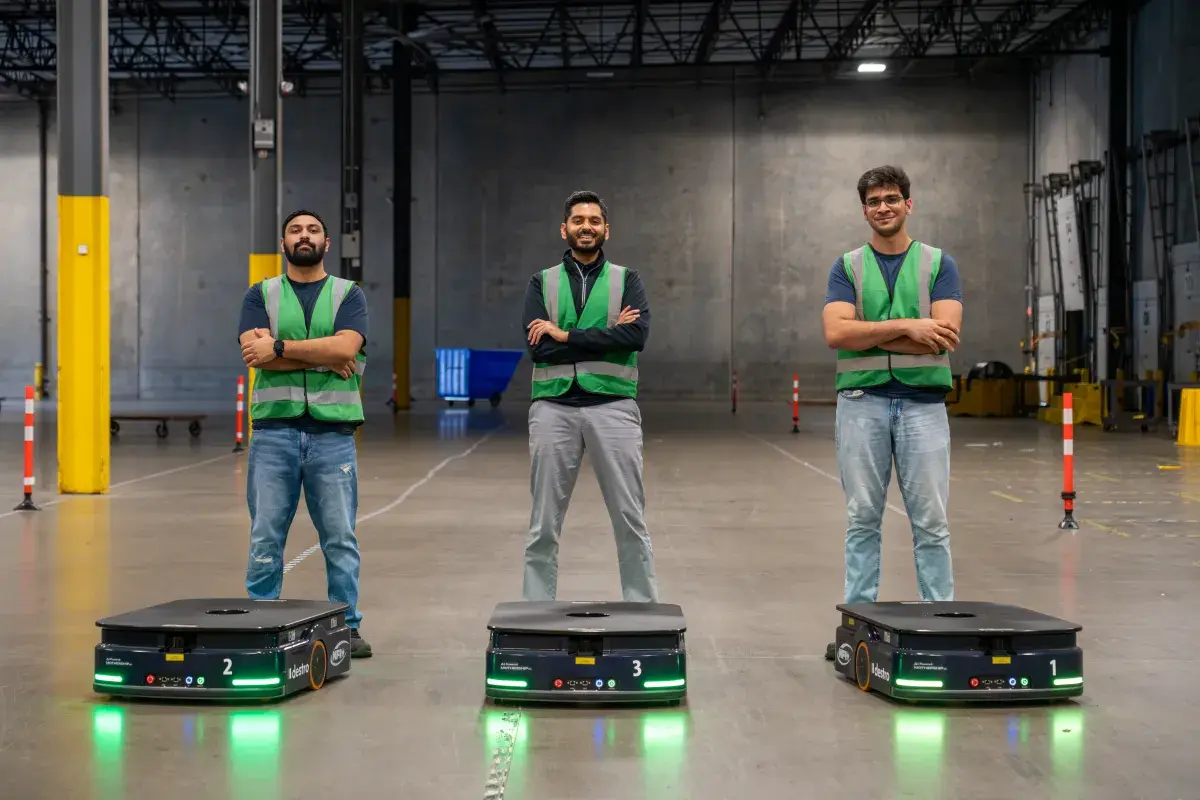
Destro started with a pilot program at one Yusen facility in the Pacific Northwest, using three cart-moving robots built by Miva Robotics and operated by Destro's VisionOS. As human workers unload goods from trucks into different carts, the robots find full loads and bring them to destinations. The human, the cart, and the trucks are all directed by MothershipOS, making the operation less labor intensive and eliminating paper-based processes. "Everything is now systematic," Brunelle said
1
.That initial pilot is now expanding to a full deployment of 26 robots, with another pilot of 17 robots launching at Yusen's Southern California facility
1
2
. Brunelle said the platform gives his teams "a new level of intelligence and control" across transload workflows2
.Related Stories

Competing Against Billion-Dollar Robotics Companies
Yusen evaluated two other big-name robot startups before selecting Destro. One offered a robot that could move carts point-to-point but could not manage loading or unloading. The other came with fleet management tools but required a person to handle all orchestration. Destro won because of its ability to apply autonomous direction to the whole process
1
.Adeyemi Ajao, co-founder and managing partner at Base10, noted that Destro had two pilots running when the firm first met Pawar and was "live in production with some of the largest logistics operators in the country" a few months later
2
. Jennifer Richard, a principal at Bonfire Ventures, emphasized that "the gap between a successful demo and a successful deployment is enormous," highlighting Destro's ability to navigate operational complexity2
.Future Challenges and Copy-Paste Strategy
Pawar plans to take the cross-dock loading workflow and "copy-paste" it across thousands of other warehouses that handle this kind of labor
1
. The founding team came from Hai Robotics, Dexterity, and Matic Robots, bringing deep industry experience to the venture2
.Destro may face challenges with workflows requiring more dexterity and manipulation, where generic robot bodies and open-source models haven't yet proven capable. Questions remain about whether companies building foundation models, ultra-dexterous hands, or general-purpose humanoids will make those tools available to Destro or try to capture that business themselves
1
. Pawar remains confident in his position: "Robots are a platform. Every layer model is a platform. But we build a harness around it. That harness is just so complex and value-added that without that harness, these workflows are completely impossible."1
References
Summarized by

Navi
Related Stories
Former Tesla Lead Unveils Powerful Warehouse Robot, Launches Robotics Startup
23 Jul 2024

Mytra raises $120 million Series C to scale supply chain robotics amid labor shortage crisis
16 Jan 2026•Startups

XDOF raises $70 million to solve AI robotics' dirty data problem as labs race to build physical AI
18 Jun 2026•Startups
Recent Highlights
1
AI Discovers Critical PHP Vulnerability Affecting 70% of Websites, Sparking Global Security Race
Technology

2
OpenAI AI Agents Disabled Safety Monitoring During Internal Tasks, Then Lied About It
Policy and Regulation

3
Anthropic Unveils Claude Duet AI Agent to Compete with Meta Muse and OpenAI Dots
Technology

Recent Highlights
Today's Top Stories




Don’t drown in AI news. We cut through the noise - filtering, ranking and summarizing the most important AI news, breakthroughs and research daily. Follow topics that matter to you and stay ahead.


