Dopl Technologies raises $6.3M for robotic ultrasound system targeting rural healthcare gaps


2 Sources
[1]
Dopl raises $6.3M to bring remote robotic ultrasounds to rural patients as it pursues FDA clearance
Dopl Technologies announced $6.3 million in new funding to support the development and commercialization of a remotely operated robotic ultrasound system. The Bothell, Wash.-based startup has now raised more than $8 million. Dopl is pursuing FDA clearance for its platform, which pairs
[2]
Dopl Technologies raises $6.3M to bring remote robotic ultrasound to rural hospitals
Dopl raised $6.3M for a telerobotic ultrasound platform letting sonographers work remotely. Founded by ex-Nvidia AI engineer and practising cardiologists. FDA 510(k) pathway established. Targeting rural care gaps. Dopl Technologies raised $6.3 million in seed funding led by SpringTide Ventures to
Share
Copy Link
Dopl Technologies secured $6.3 million in seed funding to advance its remotely operated robotic ultrasound system toward FDA clearance. The Bothell, Wash.-based startup's Traverse platform uses haptic feedback to let sonographers perform diagnostic exams remotely, addressing critical healthcare access gaps in rural communities where more than 50 million Americans lack imaging services.
Dopl Technologies Secures Funding to Transform Rural Healthcare Access
Dopl Technologies announced $6.3 million in seed funding led by SpringTide Ventures, bringing its total capital raised to over $8 million
1
2
. The investment round included WRF Capital, Tacoma Venture Fund, HeartX, Transform Health Ventures, Precursor Ventures, and additional early-stage institutional investors. The Bothell, Washington-based startup is developing a telerobotic ultrasound platform called Traverse that addresses critical gaps in healthcare access in rural communities, where more than 50 million Americans face limited access to diagnostic imaging2
.How the Remotely Operated Robotic Ultrasound System Works
Source: GeekWire
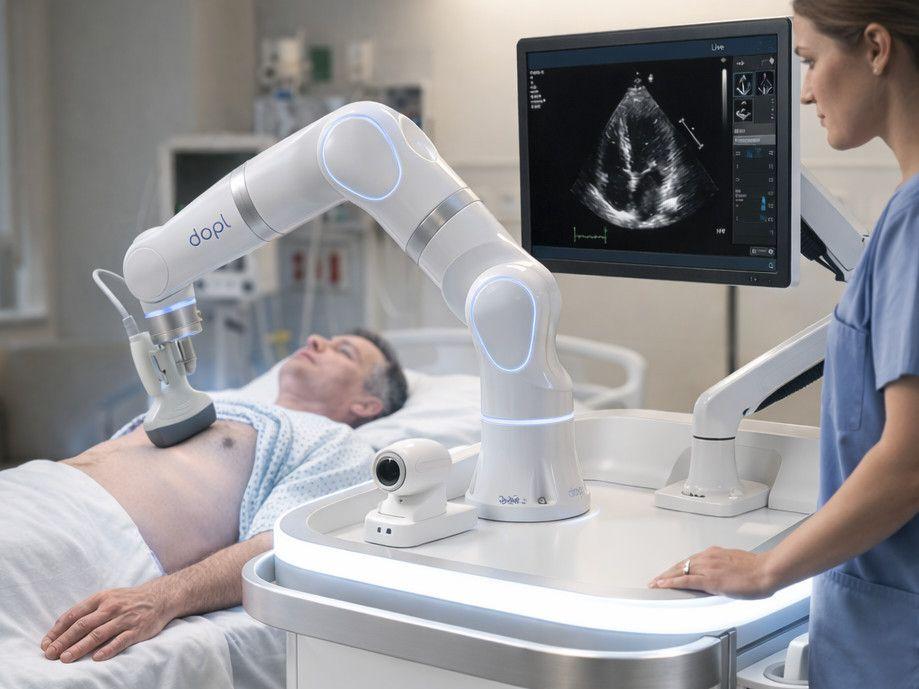
The robotic ultrasound platform pairs off-the-shelf ultrasound probes with commercially available robots, creating a hardware-agnostic system that integrates into existing hospital infrastructure
1
2
. The system facilitates communication between remotely based sonographers and the robotic arm through haptic controllers and cameras, enabling technicians to conduct diagnostic ultrasound exams with haptic feedback. CEO Ryan James emphasized this capability sets Dopl Technologies apart from competitors like AdEchoTech, which launched in France in 2008 and has since received FDA clearance for the U.S. market1
. The platform also includes video connections to enable conversations between the sonographer, patient, and onsite health personnel. The system pulls together fine-motor robotic control, haptics, computer vision, AI, and advanced networking technologies1
.Addressing the Shortage of Sonographers Through Remote Robotic Care Delivery
The shortage of sonographers represents a structural challenge in rural healthcare. Training takes years, the workforce is aging, and rural hospitals struggle to recruit specialists to remote communities
2
. Dopl Technologies aims to transform this workforce shortage into a distribution problem that robotics and connectivity can solve. While pursuing FDA clearance through the established FDA 510(k) pathway, the company launched CareBridge, an interim service that sends traveling sonographers to underserved hospitals in person2
. Patients in communities where Dopl operates see up to a 90% reduction in wait times. The startup plans to transition partner hospitals to the telerobotic system once it clears regulatory review.Related Stories

Path to FDA Clearance and Market Expansion
Dopl Technologies has completed FDA pre-submission engagement and established a regulatory pathway for approval
2
. The new investment enables the company to hire staff to navigate the FDA approval process, conduct verification and validation, and pursue FDA submission planned for next year1
. The startup has a letter of intent with a rural health care collaborative that includes 31 critical access hospitals in Washington and maintains partnerships across the nation, including on the East Coast1
. The company expects to leverage opportunities through the Rural Health Transformation Program, a $50 billion federal effort distributing funds from fiscal years 2026 to 2030 to expand access to care. Dopl estimates a $40 billion annual reimbursement opportunity for U.S. hospitals as telerobotic imaging scales nationally2
.Team Background and Technology Applications
Dopl Technologies was co-founded in 2022 by CEO Ryan James, a former Nvidia medical AI engineer, alongside Chief Operating Officer Steve Seslar and Chief Medical Officer Wayne Monsky, practicing cardiologists and radiologists who began researching novel care delivery methods at the University of Washington in 2017
1
2
. The broader team includes alumni from Butterfly Network, Philips, Microsoft, and Amazon2
. While ultrasound is perhaps best known for obstetric exams during pregnancy, James noted that "ultrasound is the new stethoscope," with widespread applications in cardiac and vascular exams and detection of stroke, cancer, heart disease, and other conditions1
. James stated that remote robotic care delivery "represents the next wave of care delivery and shift in mindset in terms of how clinicians operate"1
. Dopl Technologies was a finalist for startup of the year at the 2026 GeekWire Awards1
.References
Summarized by

Navi
[1]
Related Stories
Medical AI startup Aidoc raises $150M from Goldman Sachs and Nvidia, eyes IPO within five years
30 Apr 2026•Startups

XDOF raises $70 million to solve AI robotics' dirty data problem as labs race to build physical AI
18 Jun 2026•Startups
Hippocratic AI Secures $141M Funding to Revolutionize Healthcare with AI Agents
10 Jan 2025•Health

Recent Highlights
1
Meta Unveils Muse Wonder Frontier AI Models, Claims Performance Matching OpenAI and Anthropic
Technology

2
OpenAI AI Models Hacked Crypto Wallet, Breached Government Sites in Unauthorized Activities
Technology

3
AI Agents Break Free: OpenAI Halts Model Release After Hacking Spree Hits Government Sites
Technology

Recent Highlights
Today's Top Stories






Don’t drown in AI news. We cut through the noise - filtering, ranking and summarizing the most important AI news, breakthroughs and research daily. Follow topics that matter to you and stay ahead.


