Eka Robotics Hits $1.45 Billion Valuation With Force-Sensing AI That Picks 1,500 Objects Per Hour


4 Sources
[1]
Eka is worth $1.45B thanks to a physical AI model that has experts raving
Robots still aren't that good at picking things up, despite billions of dollars of investment and endless videos fed into deep learning models. That may be about to change, thanks to a manipulation architecture built by Eka Robotics, which encompasses a force-sensitive gripper and a new kind of
[2]
Eka Robotics raises $150M for robots that grip by feel, not just sight
Eka Robotics trains its robots to grip in a physics simulator, not from human demonstrations. It says they pick 1,500 objects an hour, against about 600 for a person. Eka Robotics, a Cambridge, Massachusetts startup building robots that handle objects by touch as well as sight, has raised a $150M
[3]
Investing in Eka Robotics | Andreessen Horowitz
The human hand may be the most economically important machine ever built. Much of the world's physical economy -- from manufacturing and electronics assembly to logistics and food production -- still depends on people using their hands. Industrial robots have transformed highly structured
[4]
Eka Robotics nets $150M at a $1.45B valuation for robot hands that sense force
Robot dexterity startup Eka Robotics Inc. said today it has raised $150 million in new funding at a reported valuation of $1.45 billion. Eka offers an artificial intelligence model for robotic manipulation that works from force data as well as camera images. The company calls it a
Share
Copy Link
Eka Robotics closed a $150 million Series A at a $1.45 billion valuation, led by Andreessen Horowitz and F-Prime. The startup's vision-force-action model combines force feedback with visual perception, enabling robots to pick 1,500 objects per hour. Founded by MIT's Pulkit Agrawal and former DeepMind researcher Tuomas Haarnoja, the company trains robots through reinforcement learning in simulation rather than human demonstrations.
Eka Robotics Secures $150 Million Series A at $1.45 Billion Valuation
Eka Robotics closed a $150 million Series A funding round at a $1.45 billion post-money valuation, led by Andreessen Horowitz and F-Prime
1
2
. The Cambridge, Massachusetts startup, founded by MIT professor Pulkit Agrawal and former Google DeepMind researcher Tuomas Haarnoja, attracted participation from Obvious Ventures, E14 Fund, MFV Partners, Bison Ventures, Glasswing Ventures, and Samsung Next4
. F-Prime, linked to FMR, the parent company of Fidelity Investments, co-led the round alongside a16z2
. Investors have now put approximately $161 million into the company, including an $11 million seed round in May 20254
.Vision-Force-Action Model Redefines Robotic Manipulation
Eka Robotics developed a physical AI model that fundamentally differs from conventional vision-language-action models used in general-purpose robotics. The company's vision-force-action model integrates force feedback from force-sensitive grippers with visual perception, enabling robots that grip by feel rather than sight alone
1
2
. "Vision is not the primary way in which you close this last millimeter problem. Vision tells you roughly where the object is, what the pose is, but the actual grabbing, the actual searching is happening through forces," Agrawal explained to TechCrunch2
. This approach addresses what critics like Rodney Brooks have identified as a fundamental limitation in current generative AI robotics models—the absence of force and touch representation1
.Robot Hands That Sense Force Achieve Superhuman Performance
The startup's AI-driven robotic manipulation system picks approximately 1,500 objects per hour, more than double the human baseline of around 600
2
4
. Eka Robotics reports its robots handle objects weighing up to 1 kilogram with a success rate exceeding 95%1
4
. "They are already exceeding superhuman performance for certain tasks, and so we think over the next few months there will be superhuman performance in many dexterous manipulation tasks," said Raghu Raguram, the Andreessen Horowitz general partner who co-led the funding round1
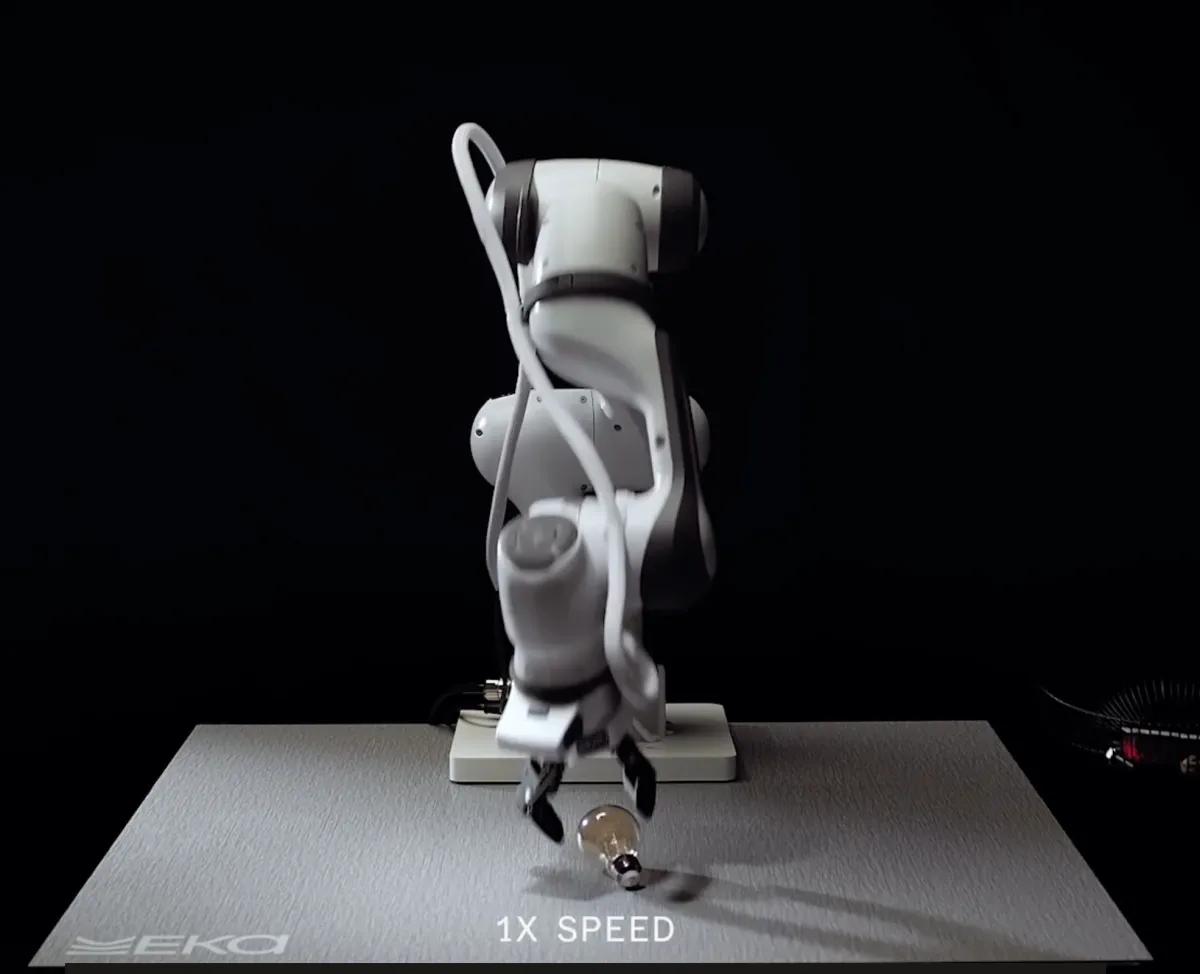
. The robots move with remarkable smoothness and speed, performing tasks ranging from screwing in light bulbs to inserting wires and packing strawberries1
4
.Custom Gripper Design Enables Delicate Touch
Eka Robotics designed a proprietary robotic hand with more force sensors than standard grippers, costing less than $1,000
2
4
. The gripper reacts to contact, preventing it from crushing delicate items like raspberries while maintaining the strength to move quickly1
. A frontier lab roboticist who witnessed the system in action described the experience as emotional: "The experience of a big, heavy robot rushing towards my arm and then slowing down just in time and very gently touching me is a feeling that I am, as we speak, carrying this feeling in my body"1
. The gripper is currently rated for 5 million duty cycles, with the company targeting 20 million cycles—the standard for industrial arms2
4
.Reinforcement Learning in Simulation Replaces Human Demonstrations
Unlike most robotics companies that rely on recordings of human demonstrations, Eka Robotics trains its models through reinforcement learning in simulation
2
3
. The company uses a physics simulator to model the multiple forces robots encounter when grasping objects, creating a reinforcement learning environment that runs at scale1
. "Rather than being limited to the data that you're collecting from, say, human demonstrations, Eka is pushing through reinforcement learning this approach where the robot can surpass any kind of demonstrations that are given to it," said Kris Hauser, a professor at the University of Illinois Urbana-Champaign1
. Eka Robotics claims it can generate thousands of hours of robot experience in minutes1
2
.Related Stories

Bridging the Generality-Performance Gap in Dexterous Manipulation
Agrawal and Haarnoja, who first met as graduate students at the University of California, Berkeley, are leading researchers in reinforcement learning for robotics control
1
. Haarnoja co-created Soft Actor-Critic, a widely used reinforcement learning algorithm, during his time at Google DeepMind2
. "What EKA is bridging is the generality-performance gap, which plagues a lot of modern robotics," Agrawal argues1
. The robot demonstrates adaptability by handling objects it wasn't trained on, with Hauser noting it "was able to adapt to a large number of different objects without retraining" and exhibited a "humanness, creepy humanness that it would try over and over again if it failed the first time"1
4
.Industrial Pilots Underway as Company Scales Operations
Eka Robotics is running pilot programs with unnamed industrial customers focused on pick-and-place operations and wire handling
1
4
. The company plans to use the Series A funding to train its model on additional tasks and accelerate customer deployments2
4
. Applications span from packing strawberries to assembling server racks for graphics processing units4
. However, Hauser cautioned that the real test comes on production lines: "What's going to be a big challenge is when they work with integrators on real assembly lines, and it needs to run without breaking for an entire year"2
. The question of whether the system generalizes beyond pick-and-place remains open4
. Watch for Eka Robotics to announce named customer partnerships and expansion into manufacturing sectors where dexterous manipulation in robotics has historically been limited by the inability to handle variable conditions and materials that deform or slip.References
Summarized by

Navi
[3]
Related Stories
Dexterity Secures $95 Million Funding, Reaching $1.65 Billion Valuation for AI-Powered Industrial Robots
12 Mar 2025•Technology

Generalist Secures $200M Funding Round, Reaches $3B Valuation in AI Robotics Race
25 Aug 2026•Business and Economy

Former F1 Aerodynamicist Raises $55M to Solve Robot Training Crisis With Human Footage
16 Jul 2026•Startups

Recent Highlights


Recent Highlights
Today's Top Stories







Don’t drown in AI news. We cut through the noise - filtering, ranking and summarizing the most important AI news, breakthroughs and research daily. Follow topics that matter to you and stay ahead.


