EU targets social media giants with new laws to protect children from addictive design


5 Sources
[1]
EU targets social media to protect children, von der Leyen says
BRUSSELS, May 12 (Reuters) - The European Union is working on regulations to reign in on social media's business models to protect children and youth, European Commission's President Ursula von der Leyen said on Tuesday. The many damages caused to children and youth by exposure to social media are
[2]
EU to crack down on TikTok, Instagram's 'addictive design' targeting kids on social media
The EU is clamping down on social media firms and plans to target "addictive design" features on TikTok and Instagram as governments worldwide look to protect children from the harms of social media. The region will take action against certain features on social media platforms later in the year,
[3]
Von der Leyen opens door to EU-wide social media ban for children
European Commission President Ursula von der Leyen said on Tuesday the EU could propose a bloc-wide social media ban for children as early as this summer, amid mounting pressure from member states to strengthen online protections for minors. Support for stricter controls has grown in recent
[4]
EU targets social media giants with new 'addictive design' law
Read the keynote address here and the Digital Fairness Act here. The European Commission has announced the Digital Fairness Act, (DFA) which seeks to address endless scrolling, AI-generated harmful content, and violations of age limits on TikTok, Meta, and X. The Act may also introduce a minimum
[5]

EU chief turns up heat on social media's 'addictive' design
BRUSSELS, May 12 (Reuters) - The European Union is working on new rules to protect children from the addictive designs of social media such as TikTok, Meta and X, EU Commission President Ursula von der Leyen said on Tuesday. "Sleep deprivation, depression, anxiety, self-harm, addictive behaviour,
Share
Copy Link
The European Union is advancing sweeping regulations to protect children from social media's addictive features. EU Commission President Ursula von der Leyen announced the Digital Fairness Act, targeting TikTok, Meta, and X for endless scrolling, autoplay, and push notifications. The bloc may also introduce a minimum age requirement for social media access as early as this summer.
EU Advances Comprehensive Framework to Protect Children Online
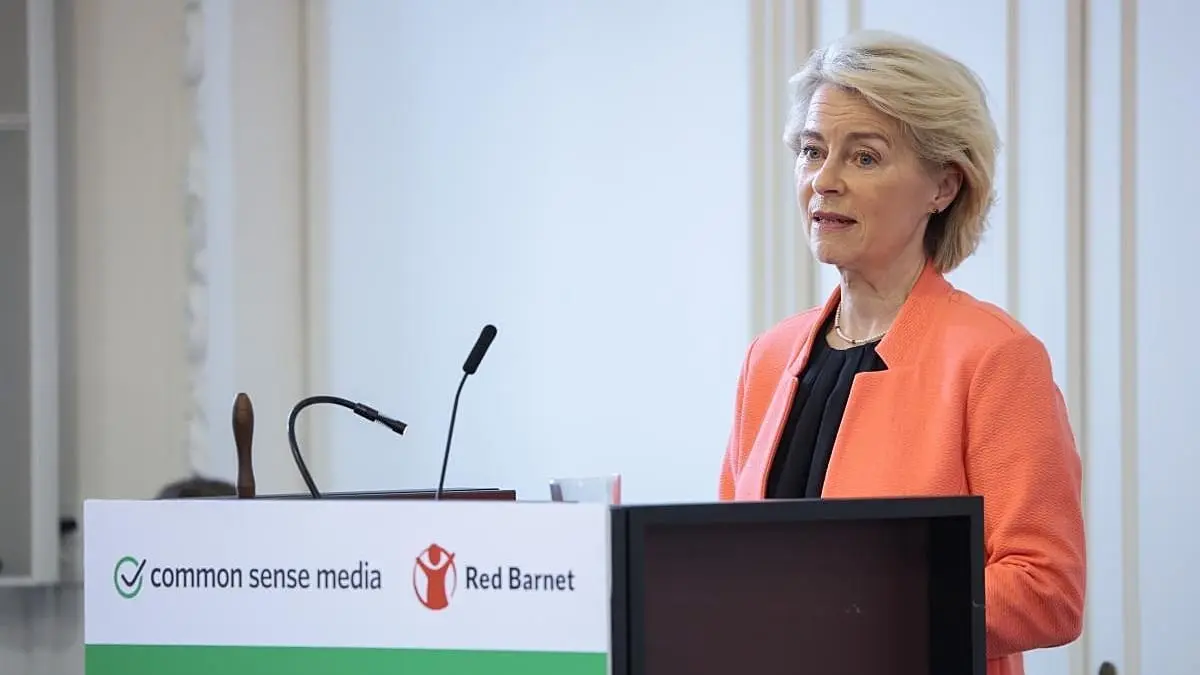
The European Union is moving forward with ambitious legislation aimed at curbing addictive and harmful design practices on major social media platforms. EU Commission President Ursula von der Leyen announced the Digital Fairness Act (DFA) at the European Summit on Artificial Intelligence and Children in Copenhagen, signaling a decisive shift in how Brussels intends to regulate platforms that EU targets social media giants like TikTok, Meta, and X
1
. The proposed legislation, expected before the end of 2026, will address features such as endless scrolling, autoplay, and push notifications that are designed to maximize engagement at the expense of children's wellbeing4
.
Source: Euronews
Ursula von der Leyen framed the issue as a matter of business models that treat children's attention as a commodity rather than accidental harm. "Sleep deprivation, depression, anxiety, self-harm, addictive behaviour, cyberbullying, grooming, exploitation, suicide—risks are multiplying fast," she stated, emphasizing that these risks are the direct result of profit-driven design choices
5
. This marks a fundamental change in EU social media regulation, shifting focus from content moderation to the structural design of platforms themselves.Active Investigations Under Digital Services Act Target Major Platforms
The European Commission is already conducting active investigations into three of the world's largest platforms under the Digital Services Act (DSA). The Commission issued preliminary findings on February 6, 2026, concluding that TikTok breached the DSA through its addictive design—the first instance of EU enforcement focusing specifically on harmful platform design rather than illegal content or data protection
4
. The Commission has determined that TikTok must fundamentally redesign its service by disabling infinite scroll over time, introducing mandatory screen-time breaks including during night hours, and overhauling its recommender system.Von der Leyen confirmed that the Commission is taking action against Meta because Instagram and Facebook are failing to enforce their own minimum age of 13
2
. Additionally, proceedings have been initiated against X regarding its Grok AI tool, which has been linked to the generation of sexual images of women and children1
. These investigations represent a coordinated crack down on TikTok, Instagram, and other platforms that have resisted implementing adequate online protections for minors.Digital Fairness Act to Ban Addictive Features and Regulate AI
The Digital Fairness Act will build on and significantly expand the Digital Services Act by introducing strict limits on the deployment of artificial intelligence, banning addictive design techniques, and establishing new requirements for children's privacy and online security
4
. The legislation will specifically target attention capture mechanisms, complex contracts, and subscription traps that keep users engaged beyond their intended usage1
.
Source: MediaNama
The Commission has cited scientific research showing that design features which continually reward users with new content can cause compulsive behaviour and reduce self-control, especially among minors and vulnerable adults
4
. This evidence-based approach positions the EU as a global leader in addressing the psychological mechanisms that make social media platforms particularly harmful to young users. The DFA represents a comprehensive attempt to protect children from AI-generated content and algorithmic systems that push users down "rabbit holes" of harmful content promoting eating disorders or self-harm2
.Related Stories
Age Verification System and Potential Bloc-Wide Social Media Ban for Children
The EU has developed its own age verification application modelled on the EU Digital COVID Certificate system, which von der Leyen described as meeting "the highest privacy standards in the world"
2
. Member states will soon be able to integrate this app into their digital wallets for platform enforcement. "No more excuses—the technology for age-verification is available," von der Leyen declared, addressing platforms' long-standing claims that technical barriers prevent effective age checks [2](https://www.cnbc.com/2026/05/12/tiktok-instagram-social-media-addictive-eu-crack-down.html
Source: Reuters
).
The Commission may propose a bloc-wide social media ban for children as early as this summer, based on recommendations from an independent expert panel on online child safety
3
. "The question is not whether young people should have access to social media, the question is whether social media should have access to young people," von der Leyen stated1
. This proposed timeline could allow Brussels to move ahead of new French legislation expected to come into force in September, which would require platforms to block users under the age of 153
.However, several governments have responded cautiously to the Commission's age verification app, and cybersecurity experts have raised concerns about potential technical vulnerabilities
3
. Support for stricter controls has grown in recent months, with France, Spain, Greece, and Denmark leading calls for measures to shield children from addictive online platforms3
. The challenge for Brussels remains maintaining a harmonised approach across the bloc's single market while several EU countries pursue national legislation.Global Movement and Timeline for Implementation
The EU is not alone in considering tougher restrictions on children's social media use. Australia and Indonesia have already introduced similar measures, while a US jury found Meta and YouTube liable for addictive design in March 2026
4
. This global movement suggests that platforms will face increasing pressure to redesign their services for younger users across multiple jurisdictions.Von der Leyen emphasized the urgency of action: "We all know that sustainable change does not happen overnight. But if we are slow and hesitant, it will be another entire generation of children that pays the price"
3
. The timeline for EU action includes TikTok's advertising-transparency strand closed via binding commitments in December 2025, preliminary findings on addictive design in February 2026, and the announcement of the Digital Fairness Act in May 20264
. Spokespeople for TikTok, Meta, and X did not immediately respond to requests for comment on the announced measures5
.References
Summarized by

Navi
[5]
Related Stories
EU Kids Act Restricts Social Media for Under-13s and Regulates AI Chatbots for Child Safety
24 Sept 2026•Policy and Regulation

EU Kids Act Proposes Sweeping Ban on AI Chatbots and Social Media for Children Under 15
15 Sept 2026•Policy and Regulation
European Parliament Proposes EU-Wide Minimum Age of 16 for AI Chatbots and Social Media Access
27 Nov 2025•Policy and Regulation

Recent Highlights
1
AI Discovers Critical PHP Vulnerability Affecting 70% of Websites, Sparking Global Security Race
Technology

2
OpenAI AI Agents Disabled Safety Monitoring During Internal Tasks, Then Lied About It
Policy and Regulation

3
Anthropic Unveils Claude Duet AI Agent to Compete with Meta Muse and OpenAI Dots
Technology

Recent Highlights
Today's Top Stories




Don’t drown in AI news. We cut through the noise - filtering, ranking and summarizing the most important AI news, breakthroughs and research daily. Follow topics that matter to you and stay ahead.


