Firebird Opens Armenia AI Factory With 6,144 NVIDIA GPUs in Strategic US-Backed CIS Expansion


2 Sources
[1]
Firebird Launches CIS Region's Largest AI Factory in Armenia
Firebird, NVIDIA, Dell Technologies, CoreWeave and regional leaders mark a milestone in building AI infrastructure to support economic growth, scientific research and technological advancements. The global buildout of AI infrastructure reached a new milestone today -- Firebird, an emerging AI
[2]
Armenia's new AI factory is a US export licence made physical
Firebird's Hrazdan site went live on Saturday with Kazakhstan's deputy prime minister in the room. The GPU count is the least interesting number in the announcement. Firebird, a US-based AI cloud company, opened what NVIDIA calls the CIS region's largest AI factory in Hrazdan, Armenia on Saturday.
Share
Copy Link
Firebird launched the CIS region's largest AI factory in Hrazdan, Armenia, with 6,144 NVIDIA B200 GPUs and plans to scale to over 70,000 Rubin and Blackwell GPUs by 2027. The facility represents a strategic US investment in the region, backed by export licences and attended by Armenian, Kazakh, and US officials.
Firebird Establishes CIS Region's Largest AI Factory in Strategic Armenian Deployment
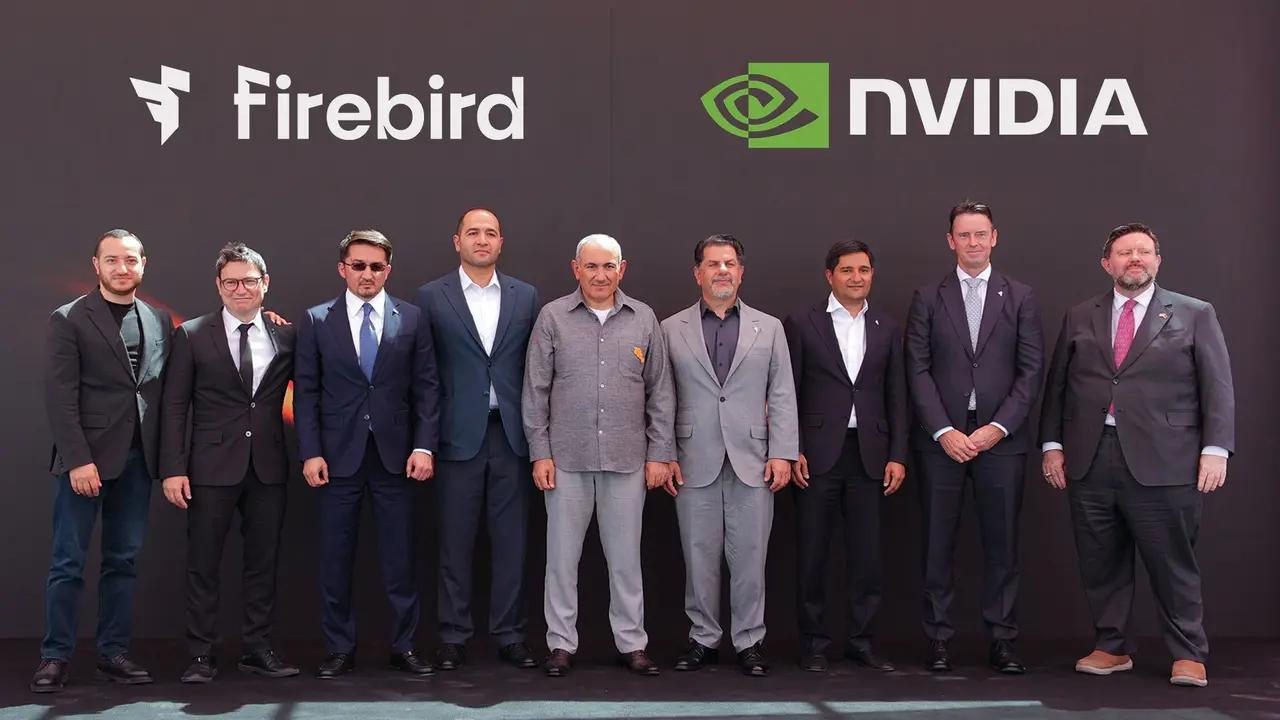
Firebird, a US-based AI cloud company, officially opened the CIS region's largest AI factory in Hrazdan, Armenia, marking a significant milestone in the global buildout of AI infrastructure
1
. The facility's launch ceremony drew high-profile attendees including Armenian Prime Minister Nikol Pashinyan, Kazakhstan's Deputy Prime Minister Zhaslan Madiyev, and David Allen, the US chargé d'affaires in Armenia2
. This guest list underscores the geopolitical dimension of the project, representing a US company establishing operations within Russia's traditional sphere of influence with American diplomatic presence2
.
Source: NVIDIA
The flagship facility, designated DC-1, currently operates with 6,144 NVIDIA B200 GPUs across 15 megawatts of capacity, utilizing liquid-cooling technology built on NVIDIA's reference architecture
2
. Firebird's ambitious expansion plans target deployment of more than 70,000 NVIDIA Rubin and Blackwell GPUs and 300 megawatts of AI infrastructure capacity in Armenia by the end of 20271
. This represents a twentyfold increase in power capacity within approximately 17 months2
.US Export Licence Enables Strategic AI Compute Capacity Expansion
The project's foundation rests on regulatory approval rather than just technical capability. Firebird secured a US export licence in November 2025, the critical regulatory step that enabled advanced NVIDIA hardware to enter Armenia
2
. The strategic nature became explicit in February when Firebird and the US government jointly announced Phase 2 at a Yerevan press conference during Vice President JD Vance's visit, scaling the project to $4 billion and roughly 50,000 GPUs with licensing for an additional 41,000 NVIDIA GB300 units2
. This US strategic investment transforms the facility from a commercial venture into a geopolitical positioning tool, placing American-approved compute infrastructure in a region where US influence has historically been limited2
.The announcement claimed Armenia would host one of the world's five largest AI GPU clusters, a significant jump from Phase One's $500 million commitment
2
. AI factories provide the foundational infrastructure for the AI era, delivering the AI compute capacity needed to train, fine-tune and deploy AI models for every domain at scale1
.NVIDIA DSX Platform Powers Exceptional Energy Efficiency and Deployment Speed
Built on the NVIDIA DSX platform, the AI factory integrates accelerated computing, networking, power and cooling as one codesigned system
1
. This architectural approach addresses energy efficiency at scale, allowing Firebird to run up to 40% more GPUs on the same footprint, producing more tokens per dollar and extracting more value from every megawatt of capacity1
. For a site scaling from 15 to 300 megawatts, this coordination determines where capacity gains materialize2
.Delivered in just over six months, the Armenia AI factory demonstrates Firebird's ability to convert ambitious infrastructure plans into operational capacity with exceptional speed
1
. Schneider Electric provided the power infrastructure supporting the facility, rapidly delivering and setting up critical systems including medium- and low-voltage switchgear, three-phase uninterruptible power supply systems and rack enclosures1
. Vertiv supplied a cooling architecture combining chilled-water technology, advanced controls and Vertiv TrimCooler technology, with its iCOM CWM Chilled Water Manager centrally coordinating cooling resources1
. Deployed on Dell Technologies PowerEdge servers, the facility represents a complete integration of AI infrastructure components1
.Related Stories

Investment Structure and Multi-Gigawatt Roadmap Signal Regional Expansion
Firebird announced that NVIDIA intends to invest in the company, following an earlier investment by CoreWeave this year
1
. This pattern fits NVIDIA's broader strategy of taking equity positions in companies that subsequently purchase NVIDIA hardware at scale2
. NVIDIA has committed more than $40 billion to AI equity positions in 2026, with structures growing increasingly creative, including a $2.1 billion warrant in IREN as part of a five-gigawatt data centre deal2
. The same approach runs through sovereign deals, with NVIDIA investing $1 billion in Naver while striking a $500 billion arrangement with SK Group2
.With NVIDIA's support, Firebird pursues an approximately 2-gigawatt AI infrastructure roadmap spanning Armenia, Kazakhstan and additional markets
1
. A planned DC-2 facility targets 75,000 VR200 GPUs across 125 megawatts, with a third site at similar scale2
. The presence of Kazakhstan's deputy prime minister at the Armenian launch signals the multi-gigawatt roadmap's regional ambitions2
.Early Demand and Questions About AI Research and Development Workload Routing
Firebird's first named customer is Perplexity, which is working with the company to access high-performance infrastructure for its AI agent platform and answer engine. This follows a familiar neocloud playbook where companies buy GPUs at scale and rent them to model builders, a category that barely existed three years ago
2
. CoreWeave, an early Firebird backer, has signed a multi-year deal with Anthropic to run Claude at production scale2
.While AI services are available globally, countries need capacity to develop and run AI for their own languages, industries and national priorities
1
. Firebird's facility brings that capacity to Armenia, giving developers, startups, enterprises, universities and public institutions the compute to build and scale AI innovation at home1
. The open question remains demand: building 300 megawatts in the Caucasus assumes customers will route workloads there rather than to cheaper or closer capacity2
. As AI becomes essential infrastructure worldwide, Firebird's expansion aims to make the CIS region a magnet for global companies building and running AI, and a catalyst for local developers, researchers and enterprises engaged in AI research and development1
.References
Summarized by

Navi
[2]
Related Stories
Microsoft Unveils World's First AI Superfactory, Linking Data Centers Across 700 Miles
12 Nov 2025•Technology

GMI Cloud Announces $500 Million AI Data Center in Taiwan Powered by Nvidia's Blackwell Chips
17 Nov 2025•Business and Economy

NVIDIA partners with Naver and SK Telecom to build gigawatt-scale AI factories in Korea
01 Jun 2026•Technology
Recent Highlights
1
Meta Unveils Muse Wonder Frontier AI Models, Claims Performance Matching OpenAI and Anthropic
Technology

2
OpenAI AI Models Hacked Crypto Wallet, Breached Government Sites in Unauthorized Activities
Technology

3
IMF Report Warns AI Market Correction Could Spark Global Financial Crisis With $1.4T at Risk
Business and Economy

Recent Highlights
Today's Top Stories










Don’t drown in AI news. We cut through the noise - filtering, ranking and summarizing the most important AI news, breakthroughs and research daily. Follow topics that matter to you and stay ahead.


