FuriosaAI brings low-power AI chip to Europe as sovereign compute demand grows


2 Sources
[1]
South Korean chip startup FuriosaAI invades European datacenters
Power-efficient South Korean AI chip startup FuriosaAI has landed on European shores. On Tuesday, the chip biz revealed that it had begun fielding its RNGD -- pronounced "renegade" -- line of AI accelerators at colocation giant Equinix's LS2 datacenter in Lisbon, Portugal. Founded by June Paik
[2]
FuriosaAI brings its Nvidia-rival chips to Europe
FuriosaAI has switched on its RNGD accelerators at an Equinix datacentre in Lisbon, its first move into Europe. The pitch: a low-power alternative to Nvidia for a region chasing sovereign AI compute. A Korean chip startup wants to sell Europe a cooler, cheaper alternative to Nvidia. Its first
Share
Copy Link
South Korean AI chip startup FuriosaAI has deployed its RNGD accelerators at Equinix's Lisbon datacenter, marking its first European expansion. The power-efficient chips offer 512 teraFLOPS while consuming just 180 watts, positioning the startup as a Nvidia alternative for enterprises seeking sovereign AI compute solutions. The company is also developing third-generation accelerators with Broadcom using HBM4 memory.
FuriosaAI Launches RNGD AI Accelerators in Europe
FuriosaAI has officially entered the European market by deploying its RNGD AI accelerators at Equinix's LS2 datacenter in Lisbon, Portugal
1
2
. The South Korean AI chip startup, founded by June Paik and Hanjoon Kim in 2017, announced the deployment on Tuesday, marking a significant shift from its previous focus on the domestic South Korean market where it secured wins with companies like LG Electronics1
. The European expansion comes as the region pursues sovereign AI compute capabilities and seeks alternatives to American silicon suppliers2
.Low-Power AI Chips Target Energy-Conscious Market
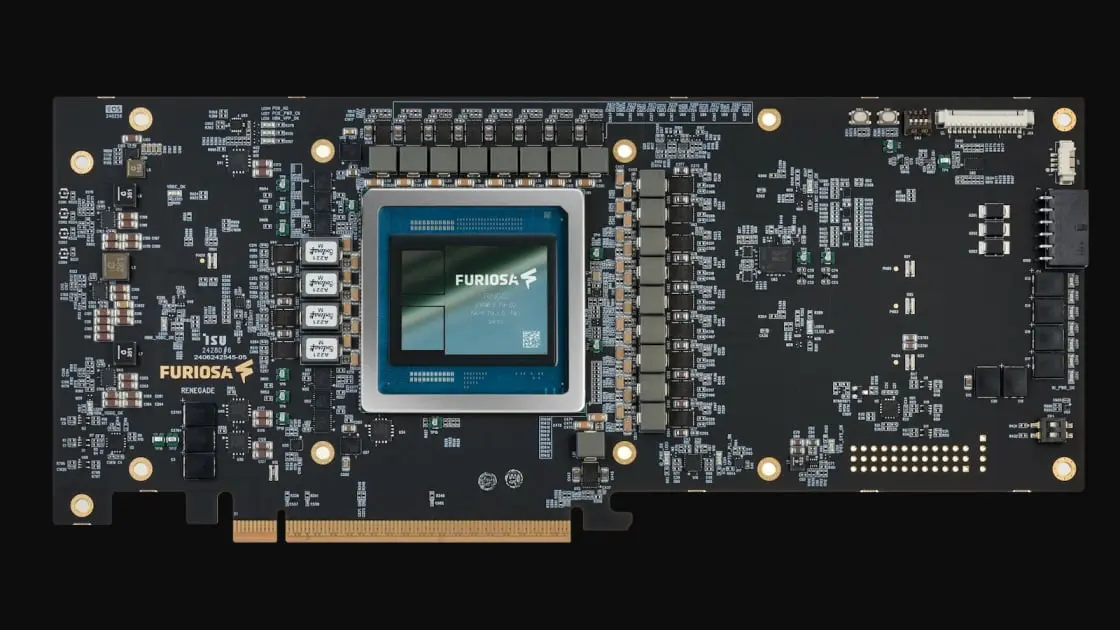
The RNGD accelerators—pronounced "renegade"—distinguish themselves through energy efficiency rather than raw performance. Built using TSMC's 5nm process technology, each PCIe card features 48 GB of HBM3 memory, 1.5 TB/s of memory bandwidth, and delivers 512 teraFLOPS of dense FP8 performance while maintaining a thermal design power of just 180 watts
1
2
. For comparison, Nvidia's RTX Pro 6000 offers twice the memory capacity and compute with comparable memory bandwidth, but consumes 3.33 times the power1
. This efficiency gap positions FuriosaAI as a compelling Nvidia alternative for enterprises where energy costs and sustainability matter.Tensor Contraction Processor Architecture Powers Enterprise Inference

Source: The Register
Eight RNGD accelerators combine to form Furiosa's NXT RNGD Server, a 3 kW system featuring up to 384 GB of HBM memory
1
. The Tensor Contraction Processor architecture enables the system to run large enterprise models including OpenAI's gpt-oss 120B, LG's Exaone 236B, and Qwen 3-30B-A3B at substantial context sizes and concurrency levels1
. Because the systems rely on air-cooling rather than liquid cooling, they integrate seamlessly into existing datacenter racks without requiring costly retrofits1
2
. "We unlock the ability for enterprises to run inference sustainably and reliably," said co-founder and chief executive June Paik2
.Related Stories

Strategic Timing Aligns with European AI Infrastructure Push
The Lisbon deployment builds on FuriosaAI's existing presence in the city, where the company operates a compiler-focused R&D lab and a new flagship office
2
. The announcement coincides with the RAISE Summit in Paris and arrives as European enterprises actively seek efficient AI compute they can source domestically2
. Europe's push to build independent AI infrastructure and reduce reliance on American technology creates opportunities for suppliers offering power-efficient alternatives at a time when energy bills continue climbing2
. The move appears focused on building brand recognition and software familiarity in the European market rather than simply offloading excess inventory1
.Broadcom Partnership Signals Next-Generation Ambitions
FuriosaAI is already developing third-generation accelerators in collaboration with Broadcom, adapting its Tensor Contraction Processor technology into a multi-die system-on-package design
1
. The next-generation chip will utilize faster HBM4 or HBM4e memory and incorporate Broadcom's Ethernet and PCIe switching technology to support larger scale-up clusters beyond the current eight-way systems1
. The chip targets frontier models with a trillion or more parameters for hyperscale inference applications2
. FuriosaAI joins other companies licensing technologies from Broadcom for next-generation accelerators, including Meta's latest MTIA chips, with OpenAI and Google also disclosing collaborations1
. However, reliance on HBM4 memory—which is only reaching the market this year—means these advanced accelerators likely won't appear in production environments soon1
. RNGD itself is already in mass production, manufactured using TSMC's process with SK hynix memory, backed by more than $250 million in funding2
.References
Summarized by

Navi
[1]
[2]
Related Stories
FuriosaAI Secures Major Partnership with LG After Rejecting Meta's $800M Acquisition Offer
22 Jul 2025•Technology

FuriosaAI launches RNGD chip in mass production to challenge Nvidia's AI inference dominance
06 Jan 2026•Technology
Broadcom partners with FuriosaAI on 2nm AI accelerator chip with HBM4e memory for inference
27 May 2026•Technology

Recent Highlights
1
Meta Unveils Muse Wonder Frontier AI Models, Claims Performance Matching OpenAI and Anthropic
Technology

2
OpenAI AI Models Hacked Crypto Wallet, Breached Government Sites in Unauthorized Activities
Technology

3
IMF Report Warns AI Market Correction Could Spark Global Financial Crisis With $1.4T at Risk
Business and Economy

Recent Highlights
Today's Top Stories







Don’t drown in AI news. We cut through the noise - filtering, ranking and summarizing the most important AI news, breakthroughs and research daily. Follow topics that matter to you and stay ahead.


