General Robotics Slashes Robot Setup Time from a Month to Just 2 Hours Using AI Platform


3 Sources
[1]
General Robotics, led by Microsoft vets, says its AI has cut robot setup from a month to hours
A Redmond, Wash., robotics software startup founded by former Microsoft researchers says its platform can now handle much of the work of getting a robot up and running in a factory, warehouse or other industrial setting, a job that used to take a team of engineers. General Robotics said Wednesday
[2]
General Robotics GRID Becomes First Robot Intelligence Platform to Auto-Engineer Entire Development and Deployment Lifecycle
Accelerates skill creation, AI training, testing and evaluation, moving customers from pilot to production faster REDMOND, Wash.--(BUSINESS WIRE)--September 9, 2026-- General Robotics, a company building the intelligence layer for physical AI, today announced a major milestone for GRID, its robot
[3]
General Robotics' GRID platform engineers itself, cutting robot setup to hours
General Robotics' GRID platform engineers itself, cutting robot setup to hours General Robotics Technology Inc. said today that its GRID robot intelligence platform now automates its own engineering work, cutting the time needed to get a new robot into production from about a month to as little as
Share
Copy Link
General Robotics announced its GRID robot intelligence platform now auto-engineers the entire robot deployment lifecycle, cutting setup time from a month to as little as 2 hours. Founded by Microsoft vets, the company has raised nearly $34 million and serves major enterprises across manufacturing, logistics, energy and defense with its agent-first platform.
General Robotics Transforms Robot Deployment with Auto-Engineering
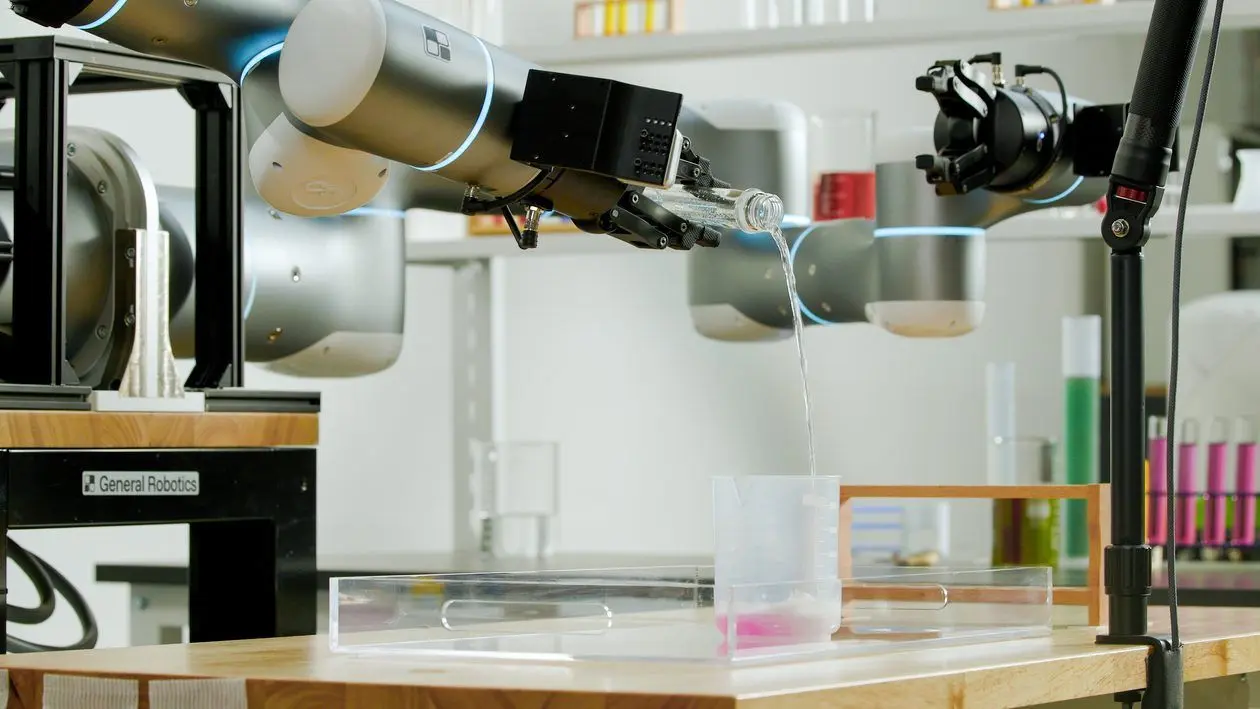
General Robotics announced a major breakthrough in its GRID robot intelligence platform, revealing that advances in auto-engineering have reduced robot deployment time from approximately one month to as little as two hours
1
2
. The Redmond, Washington-based startup, founded by Microsoft vets in 2023, has fundamentally changed how robots are brought into production across industrial settings including factories, warehouses, and other operational environments.The GRID platform now auto-engineers its own processes from robot onboarding to skill deployment, marking what the company describes as the first robot intelligence platform to handle the entire development and deployment lifecycle autonomously
2
. CEO and co-founder Ashish Kapoor explained that before this advancement, deploying robots required a team of experts working on behalf of customers—a process that was clearly non-scalable, expensive, and time-consuming1
.
Source: GeekWire
How Knowledge Graphs Power Compounding Intelligence
At the core of GRID's capabilities lies a sophisticated system of knowledge graphs that converts every deployment into structured, reusable intelligence
2
. Each robot onboarded, task performed, model ingested, and failure encountered feeds back into the AI platform, creating what General Robotics calls "intelligence that compounds." This approach ensures that every engineering effort contributes to a shared knowledge layer while maintaining strict protection of customer data and intellectual property3
.The platform's recent evolution has delivered dramatic improvements across the entire robotics development stack. Model ingestion time has dropped from three days to as little as 20 minutes. Skill transfer across different robot form factors now takes approximately 1.5 hours compared to the previous three days. New skill creation and deployment can be achieved in as little as two days
2
. These metrics represent a fundamental shift in how quickly organizations can move from pilot projects to production-ready systems.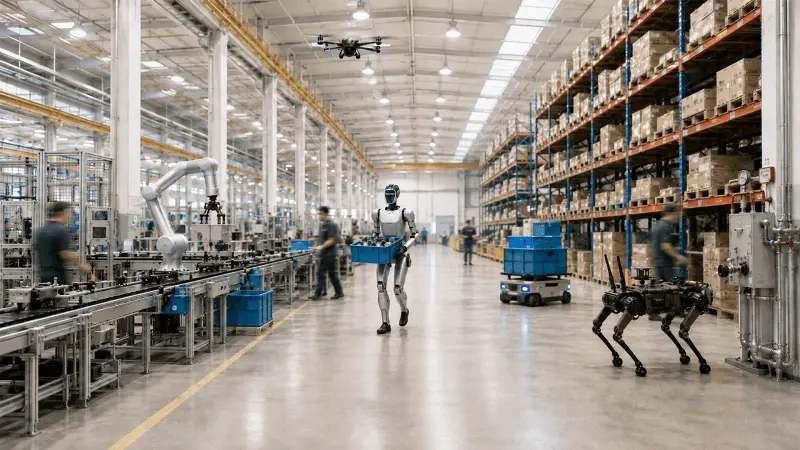
Source: SiliconANGLE
Addressing Critical Industry Bottlenecks in Manufacturing and Beyond
The robotics industry faces two significant constraints that GRID directly addresses: the scarcity of specialized talent needed to engineer intelligent systems, and the deeply fragmented nature of the robotics development stack requiring bespoke integrations for each distinct robot solution
2
. Kapoor emphasized that people have been attempting to deploy advanced robotic systems the same way for 50 years, and with rapid advances in AI, it's time to rethink the approach2
.General Robotics has grown to approximately 50 employees, primarily engineers, and has raised nearly $34 million in funding
1
. The most recent round in April was led by Construct Capital with participation from Khosla Ventures, Accenture Ventures, Nvidia, and Valo Ventures, with PitchBook estimating the round size at $25 million1
. The company reports roughly a dozen customers—large enterprises across manufacturing, logistics, energy, and defense—with revenue in the millions of dollars1
.Related Stories

Major Industry Players Adopt GRID for Frontier Physical AI
GRID's customer base spans global top five companies in automotive manufacturing, port operations, energy generation, and food and beverage production, along with multiple government agencies including HTX, Singapore's Ministry of Home Affairs science and technology agency
1
2
. The platform supports various robot types including industrial arms, humanoids, quadrupeds, wheeled robots, and drones1
.Fanuc, a leader in heavy industrial robots, has designated General Robotics as an authorized system integrator. Ryan Patterson Jr., General Manager at Fanuc America Corporation's Robotics Division, stated the partnership is "advancing frontier physical AI across the FANUC portfolio—unlocking new AI-driven use cases and greater value for customers"
2
. Galaxea Dynamics founder and CEO Gao Jiyang confirmed they are working with GRID to accelerate deployment of advanced robotics for global customers across automotive, pharmaceutical, consumer packaged goods, and apparel sectors2
.What This Means for the Future of Industrial Automation
Hans Peter Brondmo, former VP at Google X and CEO at Everyday Robots, provided perspective on the significance of this development, noting there's no single ChatGPT moment coming for robotics—just deployment-by-deployment progress built on real-world data that most companies aren't set up to capture
2
3
. GRID treats this data capture problem as the product itself, performing what Brondmo called "the unglamorous work that compounds."The company operates in a competitive and well-funded sector where Physical Intelligence has raised more than $2 billion for building foundation models for robots, and Nvidia—an investor in General Robotics and maker of the Isaac Sim simulation software built into GRID—is developing its own robot models and deployment tools
1
. Watch for how quickly General Robotics can scale its customer base and whether the compounding intelligence model delivers sustained competitive advantages as more robots connect to the platform. The shift from month-long deployments to hours could fundamentally alter adoption curves for advanced robotics across industries that have struggled with the expertise and integration challenges of traditional approaches.References
Summarized by

Navi
[1]
[2]
Related Stories
Generalist's GEN-1 robotics model achieves 99% reliability, masters complex physical tasks
07 Apr 2026•Technology

Generalist AI raises $400M at $2B valuation to scale general intelligence for robotics
04 Jun 2026•Startups
Generalist Secures $200M Funding Round, Reaches $3B Valuation in AI Robotics Race
25 Aug 2026•Business and Economy

Recent Highlights



Recent Highlights
Today's Top Stories









Don’t drown in AI news. We cut through the noise - filtering, ranking and summarizing the most important AI news, breakthroughs and research daily. Follow topics that matter to you and stay ahead.


