Generative AI Revolutionizes Robot Training: MIT's LucidSim Enhances Real-World Performance


2 Sources
[1]
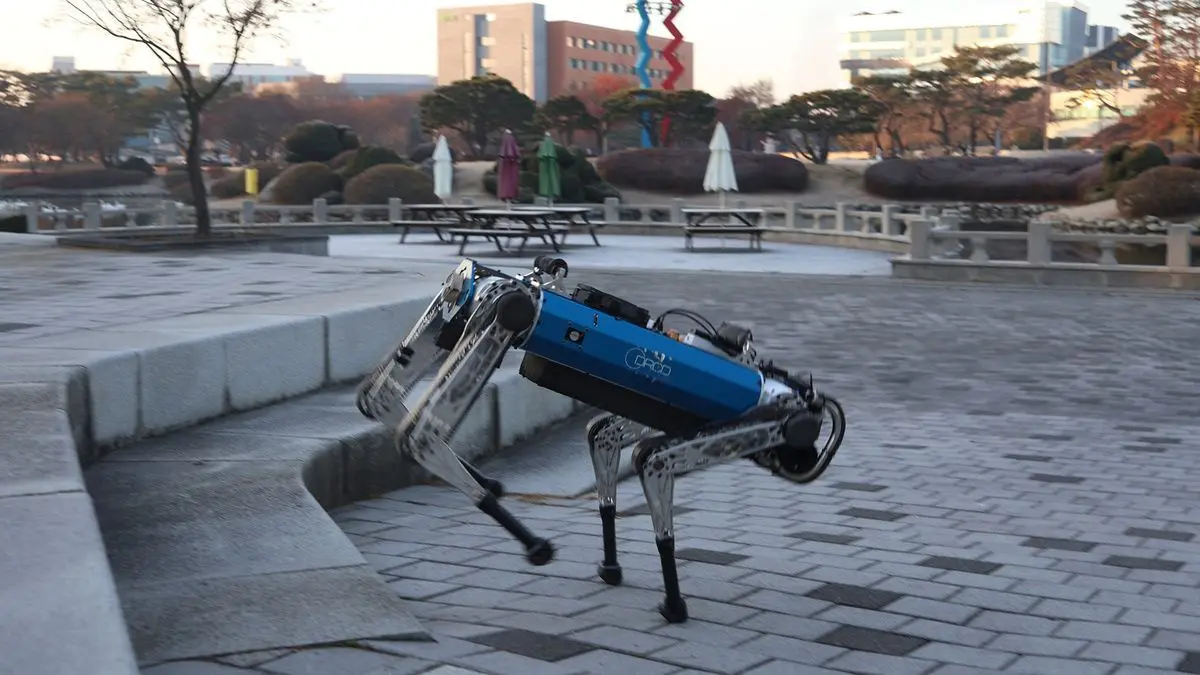
Generative AI taught a robot dog to scramble around a new environment
Now, there's potentially a better option: a new system that uses generative AI models in conjunction with a physics simulator to develop virtual training grounds that more accurately mirror the physical world. Robots trained using this method worked with a higher success rate than those trained
[2]
Virtual training uses generative AI to teach robots how to traverse real world terrain
A team of roboticists and engineers at MIT CSAIL, Institute for AI and Fundamental Interactions, has developed a generative AI approach to teaching robots how to traverse terrain and move around objects in the real world. The group has published a paper describing their work and possible uses for
Share
Copy Link
MIT researchers develop LucidSim, a novel system using generative AI and physics simulators to train robots in virtual environments, significantly improving their real-world performance in navigation and obstacle traversal.

MIT Researchers Develop LucidSim: A Breakthrough in Robot Training
Researchers at MIT's Computer Science and Artificial Intelligence Laboratory (CSAIL) have introduced LucidSim, a groundbreaking system that leverages generative AI to enhance robot training for real-world applications. This innovative approach combines generative AI models with physics simulators to create virtual training environments that more accurately reflect real-world conditions
1
.The LucidSim System
LucidSim utilizes a multi-step process to generate comprehensive training data:
- ChatGPT is prompted to create thousands of diverse environment descriptions, including various weather conditions, times of day, and lighting scenarios.
- These descriptions are fed into a 3D mapping system that incorporates AI-generated images and physics data.
- The system produces short videos mapping the robot's trajectory, providing crucial information about the dimensions and characteristics of obstacles
2
.
Impressive Real-World Performance
The researchers tested LucidSim using a four-legged robot equipped with a webcam. The robot was tasked with various challenges, including:
- Locating specific objects (traffic cone, soccer ball)
- Climbing over boxes
- Navigating stairs
LucidSim-trained robots consistently outperformed those trained using traditional simulation methods:
- 100% success rate in locating a traffic cone (vs. 70% for traditional methods)
- 85% success rate in reaching a soccer ball (vs. 35%)
- 100% success rate in stair-climbing trials (vs. 50%)
1
Related Stories

Implications for Robotics and AI
Ge Yang, a postdoc scholar at MIT CSAIL, describes this development as part of an "industrial revolution for robotics." The research team believes that LucidSim could pave the way for training robots entirely in virtual worlds, potentially transforming the field of robotics
1
.Phillip Isola, an associate professor at MIT involved in the research, suggests that future iterations of LucidSim could achieve even better results by directly incorporating sophisticated generative video models
1
.Expert Opinion and Future Prospects
Mahi Shafiullah, a PhD student at New York University specializing in AI-based robot training, commends the novel approach of LucidSim. Shafiullah, who was not involved in the project, believes this research will inspire further interesting developments in the field
1
.As generative AI continues to evolve, systems like LucidSim could revolutionize robot training methodologies, enabling machines to adapt more effectively to complex, real-world environments. This breakthrough has significant implications for various industries, from manufacturing and logistics to search and rescue operations.
References
Summarized by

Navi
[1]
Related Stories
MIT Develops Novel AI Technique for Training General-Purpose Robots
29 Oct 2024•Science and Research

Robot dog learns to switch gaits like animals, tackling forests and stairs with new AI framework
16 Jul 2026•Science and Research
Genesis Project: Revolutionizing Robotics Training with AI-Powered Simulations
20 Dec 2024•Technology

Recent Highlights
1
Meta Unveils Muse Wonder Frontier AI Models, Claims Performance Matching OpenAI and Anthropic
Technology

2
IMF Report Warns AI Market Correction Could Spark Global Financial Crisis With $1.4T at Risk
Business and Economy

3
OpenAI Releases 722 AI-Generated Math Solutions, Triggering Existential Crisis in Mathematics
Technology

Recent Highlights
Today's Top Stories









Don’t drown in AI news. We cut through the noise - filtering, ranking and summarizing the most important AI news, breakthroughs and research daily. Follow topics that matter to you and stay ahead.


