Robot dog learns to switch gaits like animals, tackling forests and stairs with new AI framework


2 Sources
[1]
Robot dog can climb stairs, navigate a forest and bound over logs thanks to new, rapid AI training technique
Researchers used reinforcement learning to train a quadrupedal robot to adapt to different environments using two different pre-learned gaits. A four-legged robot has learned to change the way it runs while navigating forests, staircases and obstacle courses. -- seamlessly switching between a
[2]
Robot dog learns animal-like movement to tackle forests, rocky trails
Researchers from Korea have developed an AI framework that enables a four-legged robot to autonomously switch between different motor skills while moving across complex terrain. The system allows the robot to adapt its gait in real time to navigate forests, climb stairs, and jump over obstacles
Share
Copy Link
Researchers from KAIST have developed a quadrupedal robot that seamlessly switches between trotting and bounding gaits while navigating complex terrain. The 100-pound HOUND robot uses a novel AI training framework that combines pretrained motor skills with real-time decision-making, reaching speeds up to 6 meters per second across forests, staircases, and obstacle courses without human intervention.
Quadrupedal Robot Masters Natural Movement Transitions
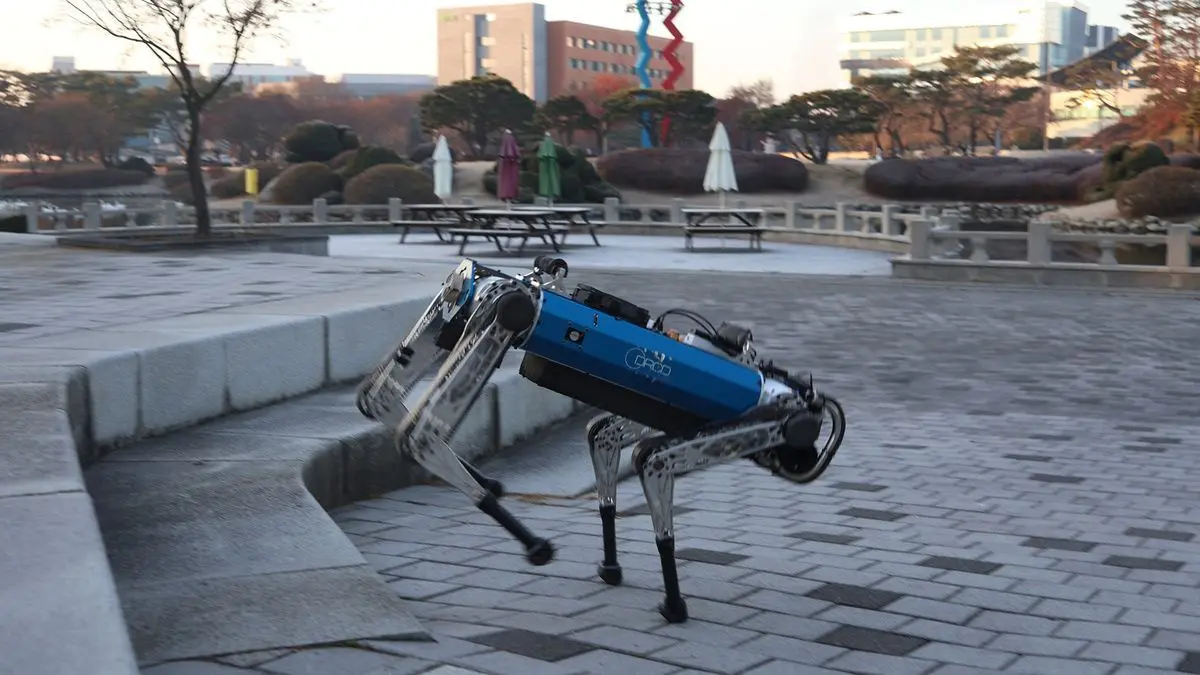
A 100-pound quadrupedal robot called HOUND has demonstrated the ability to autonomously switch between motor skills while traversing challenging environments, from forest trails to staircases. Developed by researchers at KAIST (Korea Advanced Institute of Science and Technology) in collaboration with Korea University, the Agency for Defense Development, and DIDEN Robotics, the robot dog learns animal-like movement patterns that allow it to adapt its gait based on terrain and speed
1
2
. The breakthrough was detailed in Science Robotics on July 15, showcasing how HOUND can seamlessly transition between a steady trot and a faster bounding gait without instructions from human operators1
.
Source: Live Science
Action Pretrained Transformer-Based Reinforcement Learning Powers Adaptive Behavior
The AI training framework behind HOUND's capabilities is called Action Pretrained Transformer-based Reinforcement Learning (APT-RL), which addresses a longstanding challenge in robotics: the lag that occurs when robots transition between specialized movement systems
1
. The system trains the robot through three distinct stages, beginning with a simple two-dimensional computer model where trajectory optimization generates 180,000 short trotting and bounding sequences representing 15.5 hours of movement—produced in just eight minutes1
2
. These motion patterns form reusable locomotion skills that the robot can adapt and modify. During reinforcement learning, the AI system learns to select and adjust these skills while negotiating simulated obstacles including stairs, stepping stones, hurdles, gaps, and rough ground1
.Real-Time Adaptive Movement Across Diverse Terrains
HOUND uses onboard sensors—a depth camera and 2D LiDAR scanner—to scan the ground ahead and select appropriate gaits, eliminating the need for external motion-capture systems
1
2
. The depth camera provides detailed information about nearby obstacles, while the LiDAR detects terrain several meters ahead, giving the robot time to plan movements at high speed . In outdoor tests, the robot successfully crossed a 0.7-mile university campus route and a 0.3-kilometer forest trail strewn with roots, logs, and slippery leaves1
. During indoor testing, HOUND bounded across an obstacle 60 centimeters high while briefly achieving 15 km/h, and jumped down a three-step staircase, reaching 6 meters per second before landing1
2
.Related Stories
Transformer-Based Pattern Recognition Enables Unprecedented Versatility
The robot demonstrated sophisticated decision-making by automatically selecting different gaits depending on terrain and commanded speed. It generally chose trotting at lower speeds on irregular ground, while bounding became more common at higher speeds or when encountering larger steps, hurdles, or gaps
1
. The AI system capable of selecting either gait performed more consistently across different simulated environments than versions restricted to trotting or bounding alone [1](https://www.livescience.com/technology/robotics/robot-dog-can-climb-stairs-navigate-a-forest-and-bound-over-logs-thanks to-new-rapid-ai-training-technique). Researchers compared APT-RL with existing reinforcement learning and hierarchical control methods, finding that it consistently achieved better success rates, smoother gait transitions, improved energy efficiency, and faster learning2
.Implications for Search-and-Rescue and Disaster Zones
The researchers suggest this technology could eventually help robots navigate complex terrains in disaster zones, search-and-rescue missions, construction sites, or other places inaccessible for wheeled machines
1
2
. The robot adapted to previously unseen terrain without requiring retraining, demonstrating that pretrained movement skills can be reused in new situations2
. However, the current framework only allows two gait choices and mainly handles forward movement. Future work will expand the system to include additional gaits such as galloping and crawling, support more agile turning and sideways motion, and adapt the same learning framework to humanoid robots and other legged machines1
2
.References
Summarized by

Navi
[1]
[2]
Related Stories
Animal-Inspired AI Robot 'Clarence' Learns to Navigate Unfamiliar Terrain Autonomously
12 Jul 2025•Science and Research

Generative AI Revolutionizes Robot Training: MIT's LucidSim Enhances Real-World Performance
13 Nov 2024•Technology

Six-Legged Robot Masters Walking by Learning from Stick Insect in Just One Hour
28 Aug 2026•Science and Research

Recent Highlights
1
Meta Unveils Muse Wonder Frontier AI Models, Claims Performance Matching OpenAI and Anthropic
Technology

2
IMF Report Warns AI Market Correction Could Spark Global Financial Crisis With $1.4T at Risk
Business and Economy

3
OpenAI Releases 722 AI-Generated Math Solutions, Triggering Existential Crisis in Mathematics
Technology

Recent Highlights
Today's Top Stories









Don’t drown in AI news. We cut through the noise - filtering, ranking and summarizing the most important AI news, breakthroughs and research daily. Follow topics that matter to you and stay ahead.


