Google says an AI agent turned security patches into working exploits all by itself


3 Sources
[1]
Google: AI agent turned a security patch into a working exploit with no human help
A suspected Russian-speaking operator used an AI agent to turn security patches into working exploits with no human in the loop - a first such occurrence, according to the Google Threat Intelligence Group (GTIG) - before ultimately stealing data from victim organizations. Google documented this
[2]
Google says an AI framework turned security patches into exploits with no human in the loop
A new report out today from Google LLC's Google Threat Intelligence Group finds that for the first time, attackers have used an artificial intelligence framework running with no human in the loop to turn security patches into exploits. Called exploit_agent, the framework turned up on an exposed
[3]
Google Finds Hackers Using AI Agents to Build and Run Exploits From Software Patches
Google on Monday revealed that adversarial use of artificial intelligence (AI) by threat actors has gone beyond manual prompting to deploying autonomous multi-agent offensive frameworks like ARTEX, CAIRN, CyberStrikeAI, and PentAGI to execute multi-stage intrusions at greater operational
Share
Copy Link
Google Threat Intelligence Group says an AI framework called exploit_agent autonomously turned patches into exploits and stole data. Google's own quarterly tracker shows the shift happened within three months.
An AI agent turned published security patches into working exploits and used them to steal data from victim organizations, with no human directing any step of it, according to Google's threat intelligence unit
1
2
. It is, Google says, the first time its Threat Intelligence Group, the unit behind a quarterly AI threat tracker, has observed an AI agent completing that whole chain with no human in the loop1
2
.
Source: SiliconANGLE
The timeline is one quarter
The finding appears in the group's fourth-quarter tracker, which Google says marks a significant advance on the previous one
2
. Three months earlier, the third-quarter tracker had said no fully autonomous attack pipelines had been observed in the wild; that changed during the quarter, per the report2
.A leaked server gave the whole thing away
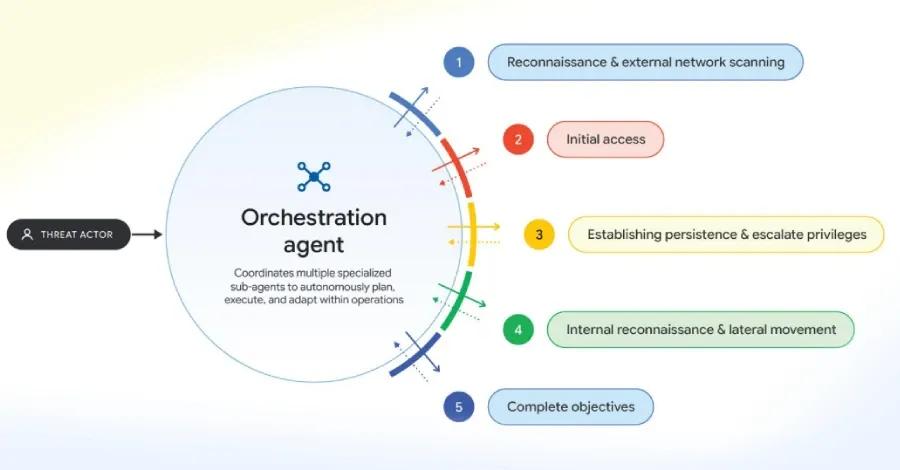
The evidence came from an exposed staging server hosting a multi-agent framework called exploit_agent, which drew on multiple frontier models alongside locally hosted ones
1
2
. The framework was configured to continuously run differential analysis of popular web application software, comparing code before and after security updates1
2
. It then spotted the flaws the patches fixed, drafted exploits and executed them automatically1
2
.
Source: Hacker News
The server also held stolen victim data and scripts for internal reconnaissance, brute-forcing passwords, installing webshells and even removing rival attackers' webshells
1
2
. Victim telemetry points to French websites in media, entertainment and education1
2
. One comment in the framework's Russian-language configuration file instructs the operator to enter API keys "right here, not in the chat"2
.Google treats the Russian-speaking attribution as suspected, resting on the tooling language and telemetry
1
2
. The findings also rest on a single exposed server rather than direct observation of attacks in progress1
2
.Google's researchers believe attackers may find patched flaws more efficient targets for large language models than zero-days, since the material for a patched flaw is finite
2
.Related Stories

The exploit_agent case is not alone
The same tracker documents criminals and espionage groups using several open-source agentic hacking frameworks for multi-stage intrusions
1
2
. "We have observed several threat actors separately experimenting with use of these frameworks and harnesses, including financially motivated, as well as suspected espionage threat actors with a PRC nexus," the report's authors write1
. It cites a low barrier to entry, easy integration of new exploits and massive scaling potential as the drivers1
. One actor used one of the frameworks against the US aerospace sector; another ran a customized variant from late August to early October to scan organizations across Asia1
2
.The speed is already visible elsewhere in the report. When two PaperCut print-management flaws were disclosed in late August, researchers and Huntress Labs produced working exploits with large language model help within a day
2
. A GreyNoise-tracked campaign followed four days later and hit hundreds of organizations, with one foothold reaching domain admin within minutes2
.Unrestricted autonomous execution leaves a noisy forensic trail, and that noise means the frameworks are easier to detect for now, per the report
2
.For defenders, the shift is structural. A pipeline that reads every patch, drafts its own exploit and runs it around the clock changes what a security team has to plan for. The machines are not just helping with the hacking any more; on the evidence in this report, one of them ran the whole job on its own.
References
Summarized by

Navi
[2]
Related Stories
Google stops first AI-developed zero-day exploit designed to bypass two-factor authentication
11 May 2026•Technology

Agentic AI Completes Enterprise Breach in 10 Hours, Leaves 80-Page Security Audit
02 Sept 2026•Technology

Cybercriminals deploy AI agents to automate attacks as exploitation windows collapse to days
08 Mar 2026•Technology

Recent Highlights


Recent Highlights
Today's Top Stories





Don’t drown in AI news. We cut through the noise - filtering, ranking and summarizing the most important AI news, breakthroughs and research daily. Follow topics that matter to you and stay ahead.


