13 Sources
[1]
The Gemini-powered Google Home Speaker arrives on June 25 for $100
Good things take time, but not all things that take time are good. The jury is still out on the Google Home Speaker, but it certainly took a while to arrive. After announcing its new speaker last August, Google finally has a release date. The company's first new smart home speaker in years will launch on June 25, and you can preorder it today for $99.99. The generically named Google Home Speaker is Google's first home audio device in almost six years. The last one was the Nest Audio, which debuted back in September 2020. The new device is small and round -- an oblate spheroid, technically. It's covered in a partially recycled fabric available in four colors: hazel, porcelain, jade, and berry (jade and berry are limited to the US). Google says the device produces "360-degree sound" for a uniform listening experience anywhere in a room. Previous Google speakers included Assistant-style illuminated lights, but the Google Home Speaker features a light ring around the bottom that glows when the device is listening, "thinking," or responding. This is becoming a trend with Google. The company will require a similar glowing lightbar embellishment on the upcoming Googlebook laptops. There are three far-field microphones distributed around the speaker that will pick up your speech, and there's a mute switch when you don't want it listening for the "OK Google" trigger. Inside, the speaker has a quad-core A55-based processor clocked at 2GHz with a dedicated NPU. It runs local AI models for better sound isolation, allowing it to filter out background noise better than past smart speakers. Smart speakers have an annoying tendency to mishear, so the Google Home Speaker could be less frustrating in that way. If you don't want to talk to the speaker, there are capacitive touch controls on the top to control media playback. Interestingly, the new device may not be an upgrade on all fronts. The Nest Audio had a 75 mm woofer and a 19 mm tweeter, but the Google Home Speaker has only a single 58 mm full-range driver. Google tells Ars that the new speaker's audio quality will fall between the Nest Audio and the smaller Nest Mini. Despite the apparent drop in audio quality, the Google Home Speaker does have some utility beyond talking to Gemini. If you have a Google TV Streamer, up to two Home Speakers can pair with it for "Immersive" audio output. It also integrates with any other Nest speakers and displays on your local network. Buying the Google Home Speaker also gets you six months of Google Home Premium. This adds various AI features to the Home app, which you may or may not want. It also enables Gemini Live on the speaker, allowing you to have a back-and-forth conversation with Google's AI. Even if you want this feature, you may not need the new speaker, as Gemini is also available on Google's other speakers. Your old speaker may not have the local processing and noise filtering capabilities of the new model, but Gemini lives in the cloud -- the Google Home Speaker is just a new way to interact with it, and it can be yours for a hundred bucks.
[2]
Google bets on Gemini to reinvent the smart home speaker
After years of incremental updates, Google is betting that its Gemini AI can reinvent its smart speaker. On Wednesday, the company introduced its first audio device built specifically for Gemini with the $99.99 Google Home Speaker. The new Google Home device is the first standalone smart speaker from the tech giant since the Nest Audio in September 2020. That older device arrived at a time when smart speakers were thought of largely as handy controllers for your smart home and music-playing systems. They lacked the smarts of today's AI chatbots, as commands often had to be phrased correctly to get things to work. The Google Home Speaker is changing that, as you'll be able to speak using natural language requests and even make multi-step requests using the phrasing you'd like. For instance, you could tell the speaker to "turn off all the lights except for my bedside lamp," or "dim the kitchen lights, play some relaxing music, and set a timer for 20 minutes." You can also make corrections mid-sentence as you speak instead of having to try requests again, and Gemini will understand. That means you could say something like "turn off the coffee maker...I mean, turn it on!" and the AI will respond appropriately, Google points out. Plus, the device will ship with 10 new voices that can have two-way conversations with you about topics that aren't limited to smart home tasks or other simple commands. You can ask more nuanced questions and dive deeper into topics you want to learn about, as you could when speaking with Gemini on your smartphone. The speaker's microphone can also remain on briefly when using the "Continued Conversation" feature, so you can more naturally ask follow-up questions without having to say "OK, Google" again. The device itself looks similar to older versions, with its 3D-knit textile wrapping and rounded 3.4 x 4.2-inch design. In the U.S., the speaker comes in Jade and Berry colors in addition to the Hazel and Porcelain options available in the rest of the world. A new ring light at the bottom will indicate if the speaker is listening, thinking, or responding. But not all of the new device's AI smarts will be free. Instead, Google will sell Google Home Premium subscription plans for $10 per month (or $100 per year) if you want to take advantage of more powerful AI features. This includes being able to have more free-flowing conversations with Gemini Live, which you kick off by saying "Hey Google, let's chat." Home Premium can also help you ask about and make sense of activity captured on your home's Nest cameras, or offer summaries of what happened in the home while you were out. Whether those capabilities are compelling enough to justify another monthly subscription remains to be seen, particularly when many of the device's Gemini features are available without paying. Google will try to get you used to the advanced features by offering them for free for six months before pushing you to subscribe, however. If successful, Google will have reinvigorated the smart speaker lineup with generative AI and found a way to get some customers to pay for those technological advances. The device is available for pre-order now and will ship later this month.
[3]
I Tried Google's New Smart Speaker. It's One of the Best at $100
To unlock more advanced AI features, you'll need at least a $10 subscription, which doesn't offer a lot of value for the price Google's last smart home speaker was the 2020 Nest Audio. Much has changed in the years since, both in hardware quality and the rise of Google Gemini AI. Now Google has dropped the Nest brand name for its new 2026 Google Home Speaker ($100). It still looks like a grown-up version of the Nest Mini, but there's a new focus on Gemini for Home. I pitted the Google Home Speaker against similar-sized speakers from Amazon and Apple to see what it's got, and ran the new voice assistant through many tests to see what it could do. The audio quality impresses, even compared to models like the HomePod mini, but while Gemini for Home is an improvement, it still needs some work. Here's what I thought. Google dropped the Nest name, but similarities remain You can clearly see the Nest Mini and Nest Audio DNA in the Google Home Speaker, so I don't know what prompted the name change. (Google continues to use the Nest name for its latest security cameras, which makes the change even more confusing.) Perhaps the product team wants more of a focus on the Google Home app and related Gemini features for this new line. While not as spherical as similar speakers, the Google Home Speaker is still rounded and edgeless, a few inches high and several inches across. An LED ring at the bottom tells you when the speaker is activated, listening, thinking and other processes, based on its color and movement. There aren't visible controls on the top, but two LED dot capacitive controls do appear on either side of the speaker when tapped, letting you control volume and playback this way. It's not especially intuitive, especially since it's hard to guess where the dots are, but they do make a pleasing bloot sound when pressed. On the base is a manual button to mute the microphones on demand. Inside, the speaker houses an omnidirectional, 58-millimeter full-range driver, which called for more in-depth experiments. Audio to beat for a speaker at this size and price I tested the Google Home Speaker's audio chops alongside two similar smart home speakers in size: the Amazon Echo Dot 5 and the Apple HomePod mini. Gemini for Home proved quick to recognize my Spotify connection. It responded to, "Play Lady Gaga" by bringing up Die With a Smile. I experimented with a number of other tracks from Gaga, metal bands and other genres, streaming at around 256kbps. The HomePod mini is one of the best comparisons I can make here, but while Apple's speaker packs a lot of clear sound into a small package, Google's model was just a bit better. The Google Home Speaker had similar clarity but stronger bass, making it a worthy option to fill a small to medium-sized room with music. The Echo Dot meanwhile, has acceptable sound considering its $50 price, but it can't compete with the other two despite being around the same size. When I get my hands on an Echo Dot Max ($100) to compare, it may be closer to the other two in terms of sound. The Google Home Speaker can also connect to other streamers, both music apps and video streaming like Netflix or Disney Plus if you want it to add sound to your TV. Basically, it's a great time to look for a $100 music speaker, but Google pulls a bit ahead of the competition on purely audio grounds. App controls and more with Google Home The Google Home app, where the Google Home Speaker is set up and managed, has also seen improvements in the past year. I like the app's approach, which is now quite streamlined, though individual settings can be a bit hard to find. There's now a universal Ask Gemini for Home bar at the top to help out, too. Since I've been using Google Home for a long time, setting up the speaker only required a QR code; no need to create an account or add my Wi-Fi. I also didn't need to sign back in to the various streaming services I tried, a plus compared to Alexa, which seems to drop them with every update. The Google Home Speaker options aren't extensive in the app, but you can make some scant audio tweaks, turn settings like continued conversations on or off, link new services and change which voice Gemini for Home uses. That brings me to everything I tried with this amped-up voice assistant. Gemini for Home improves but still missteps Gemini for Home is a version of Google's LLM AI, trained specifically for smart home controls but also able to answer any kind of questions based on data pulled from the internet. Pay a bit more with Google Home Premium (starting at $10), and Gemini for Home becomes conversational, letting you interrupt it or ask it to revisit complex topics. Pay even more, and it can offer you daily summaries and answers about what Nest security cameras have seen. Google is placing huge emphasis on the Gemini parts of the Google Home Speaker. I'm not sure it's warranted. While Gemini for Home is a step up from the old Google Assistant, it does flounder at times. Take smart home controls: When I asked the speaker to adjust my connected lights to various colors and brightness, it had no problem. But when I asked it about my Nest thermostat temperatures, Gemini for Home said, "I don't have access to your thermostat settings." That's not true, which I immediately proved by going to my Nest Hub Max and asking it to show and adjust my thermostat controls. Conversations were also hit or miss. "Hey Google, explain Starlink like I'm five," proved entertaining, with Gemini for Home handling interruptions and requests for clarification well, although it sometimes took the voice assistant a few seconds to process a change. That could make the Google Home Speaker handy for verbal brainstorming if you like talking things out. But other requests didn't fare as well. When I tried, "Hey Google, what's a nearby Thai place that doesn't need a reservation?" Gemini recommended a random Thai food truck in an RV camping lot instead of the many Thai options that were both better and closer to my location. I suspect the low number of reviews gave the truck an artificially high Google review score, which seemed to be the most important factor in Gemini's decision. This is another example of how LLMs can be misled or gamed by what information they are fed, which is why it always pays to be careful. The AI video descriptions also functioned well in my tests, if you find value in asking your voice assistant if you got any packages, if it noticed any strangers knocking at the door or if it could give a summary of activity that happened over the weekend. I'm not sure those abilities are worth the $20 Advanced subscription it requires, though. Overall, I prefer Alexa Plus for its capabilities, especially its latest third-party integrations with apps such as Uber and Ticketmaster. Gemini for Home is pushed hard on Google's speaker for a voice assistant that doesn't really match up to alternatives. While basic commands work fine, I'd like to see improvement in other responses. Take Gemini with a grain of salt if you plan on using it a lot. Final thoughts on the Google Home Speaker Google's new speaker is here to challenge other $100 smart home audio devices, and it puts on quite a show. Nest is all grown up now, and the hardware impresses with sound that even surpasses the HomePod mini. Like Google's app, the speaker has a streamlined design that's simple to set up and use, especially if you're already comfortable with Google Home. Speaking of being comfortable, I'm still not sure how to feel about Gemini for Home. It's an improvement on Google Assistant, but still struggles with some tasks that should be easy for it. Paying $10 to $20 for more advanced AI features is also a tough sell, especially when the speaker's best features are all free. But if you don't have a problem with Google's ecosystem and don't already have a smart speaker, this new Google Home model is highly competitive in terms of performance. It's also an easy way to have an animated conversation with an AI chatbot in the privacy of your own home, as long as you don't take what it says too seriously.
[4]
I've Been Using Google's New Gemini Speaker, and It's a Big Leap Forward
The Google Home Speaker succeeds the $99.99 Nest Audio, a much taller smart speaker from 2020 built around Google Assistant. It ditches the Nest branding in favor of a name that harkens back to the original Google Home from 2016. It runs a version of Google's generative AI called Gemini for Home, and works with the Google Home app (available for Android and iOS). Available in Berry (soft red), Hazel (dark gray), Jade (light green), or Porcelain (gray), the speaker looks more like an inflated version of the Nest Mini than the Nest Audio. The mostly spherical design also resembles its main rival, the Echo Dot Max, but while Amazon's speaker offers touch controls on a small concave plastic panel on the front, the Google Home Speaker hides them under a colorful, mesh surface to maintain a uniform look on the upper part of the device. You tap the middle of the top to play or pause music, or tap the left/right sides of the top to lower/raise the volume, respectively. Small white lights shine through the fabric to guide your taps. These controls proved responsive throughout my testing, but were sometimes overly sensitive. I had trouble picking up the speaker without accidentally changing the volume, which isn't a problem on the Echo Dot Max since its controls are visible. The Jade version I received for testing offers a nice pop of color that's visually interesting yet understated enough to blend into most rooms. The speaker's design is simple and elegant. Underneath the mesh fabric, the speaker has a flat, plastic base with a physical mute switch on one side near the attached power cord. The bottom part of the base features an LED ring that illuminates when you're interacting with the speaker. It shines white when it's listening, cycles through blues and purples as it's thinking, and turns orange if the mic is muted. Measuring 4.2 inches in diameter by 3.4 inches tall and weighing 0.9 pounds, the Google Home Speaker feels a bit like a softball. Google says the speaker is made of 37% recycled materials, and the fabric is produced through a 3D knitting process designed to reduce waste. Under the surface, the Google Home Speaker connects to the internet through Wi-Fi 6 and pairs with your phone via Bluetooth 5.4. It's Google's first smart speaker with a Thread border router, so it can act as a hub for Matter devices. Matter is a smart home protocol that enables devices to work across platforms. The Home Speaker works with Matter, as do most of Google's other devices. The border router feature allows it to act as a bridge to the cloud for smaller sensors and devices that lack an integrated Wi-Fi antenna. You can also use the speaker and its app to set up compatible third-party devices. You can do the same with the Echo Dot Max, which also serves as a border router and goes a few steps further than the Google Home Speaker with integrated light, temperature, and presence detectors, so it can double as a smart home sensor itself.
[5]
Google's New Smart Home Speaker Is Here, a Challenger to the HomePod Mini
Expertise Smart home | Smart security | Home tech | Energy savings | A/V Google's latest smart speaker -- called the Google Home Speaker -- has arrived, starting at $100. It's the first new speaker line Google has introduced since 2019, offering a more affordable alternative to Apple's HomePod and competing with Amazon's smaller Echo speakers and the $100 HomePod mini. The Google Home Speaker has dropped the Nest name, for reasons I don't really understand, but it looks like a Nest Mini all grown up, measuring about 3.5 inches tall and 4 inches wide. It houses a 58-millimeter, full-range driver for 360-degree sound (specs similar to the HomePod mini). Google says the speaker delivers 2.5 times more bass than the tiny Nest Mini and can pair with Google TV streamers if you prefer a home theater setup. Those aren't specs that can compete with something like an Echo Studio or Wiim Sound, but Google has different goals in mind with its Home Speaker. Equipped with a Quad Core A55 2.0 GHz processor, the speaker is designed for Gemini for Home, Google's AI reframed for smart home spaces. The free version promises richer, better answers than the old Google Assistant, although my own experience with Gemini for Home has been mixed so far (the voice assistant struggles with some simple tasks and answers compared to Alexa Plus, and we'll have to see what Siri AI brings to the table). But if you upgrade to a Google Home Premium subscription, starting at $10 per month, you can unlock more powerful Gemini for Home features, including deeper interactions, continued conversations without awkward wake word pauses and various activity summaries if you use Nest security cameras. It's nice, but I'm not entirely convinced it's worth the extra cost. The pricing for these AI features is currently a gray area, and each company has its own approach. Amazon is giving out Alexa Plus for free if you have a Prime subscription, but it's incredibly expensive otherwise. Apple is hedging, saying some future Siri AI features may require a bigger iCloud subscription, but the company has been very light on details so far. To me, $10 a month to enable a slightly more advanced AI doesn't seem worthwhile, but Google is offering a deal that makes it easier to try out Gemini for Home's full capabilities. Buy a Google Home Speaker within the next few months, and you'll get six months of a Google Home Premium subscription for free, so you can get a lengthy trial of these features before committing. On a side note, I do like the changes Google has made to the Google Home app over the past year, and this speaker should be able to control most connected home devices, even without a subscription. In addition to all the smarts, the speaker has an LED ring at the bottom to indicate its status and capacitive touch controls for manual adjustments (including a mic-off button for privacy). And if you like color, the smart speaker comes in more options than the Nest ever did, such as berry, jade and hazel. I'll be trying the speaker out in the coming weeks and will report back on how it compares-- and whether it deserves a spot on your table, with or without Gemini.
[6]
Google Home Speaker review: A modest update for the Gemini era - Engadget
Of course, this speaker is not just for playing music. Like its predecessors, the Google Home Speaker has three far-field microphones to let you chat with Gemini. It also has a stylish light ring around the bottom that lights up and changes color when you talk to it, when it is thinking and when it responds. It's very much like the light ring on older Amazon Echo speakers, and I prefer it to the new lights on the latest Echos or the four lights that lit up on the front of the Nest Audio. It's a nice visual touch for sure. The speaker does have familiar touch controls on top -- tapping the left or right sides adjusts volume, while tapping the middle pauses and resumes media playback. So far, the microphones have no trouble picking up my voice across the room or over the din of music or conversation, either. While the hardware itself is an unassuming, logical update, that's only half the story. Google's previous speakers were designed with the Google Assistant in mind, but this one is the first explicitly meant to work with the new Gemini for Home voice assistant. As the name suggests, it bakes in Gemini AI features, but there are some wrinkles beyond that. Google is also offering two different subscription options for managing your home, the $10/month (or $100/year) Standard plan and the $20/month ($200/year) Advanced option. Standard gives you 30 days of "event-based" video history from cameras or doorbell cams; Gemini Live for more interactive conversations with the virtual assistant; alerts for things like familiar faces on cameras, garage door and package notifications; and smoke and CO2 alarm notifications. The Premium plan doubles the event-based video history to 60 days and adds 10 days of 24/7 history for cameras and wired doorbells. It also includes video history search, more detailed notifications and event descriptions and daily summaries of recorded events. It sounds to me like unless you're really invested in a video security setup that the Standard plan will work for most people. Plus, the Google Home Speaker comes with a six-month trial. If you don't want to pay a monthly subscription, you'll still have access to Gemini for Home which can do basic voice-activated tasks like playing music, setting timers and controlling smart home devices. However, you'll need the subscription for Gemini Live to get the more conversational, back-and-forth experience for asking your speaker all of the random thoughts that might pop into your head. I know that people have had loads of trouble with Google's transition from the Google Assistant to Gemini, specifically around smart home automation. The Google Home subreddit is absolutely littered with complaints from unreliable execution to features ending up behind paywalls. I've had the Google Home Speaker for less than a week, and I also don't have the smartest home, so I can't say for sure how well this will perform for people with complex setups. But I was able to use the Google Home Speaker and Gemini to control a few speakers I had connected to the Google Home app as well as my RoboRock vacuum and a TV that runs Android. I also chatted with Gemini Live about the World Cup schedule and the weather in various locations where games are being played. Gemini followed my questions about who was playing today, who was playing tomorrow, how teams did in their prior matches, what the forecast was for during the match and so forth. I was also able to use my voice to start creating an automation that would run my vacuum and put on a specific YouTube Music playlist every morning, though I had to jump into the Google Home app to fix some details it didn't get right. It's unfortunate, but not entirely unexpected, that Google is locking some features behind a subscription. It had a previous subscription, Nest Aware, that also had two tiers that broke down similarly to these new Google Home plans. But putting things like Gemini Live and the ability to build a routine just by telling the speaker what you wanted to do behind the paywall is definitely a bummer.
[7]
Google Home Speaker arrives at $99, but Gemini costs extra
The $99 Google Home Speaker lands on June 25, but the AI features that make it worth buying sit behind a Google Home Premium paywall. Google has finally made a new smart speaker, its first in roughly six years. The more interesting thing it has made is a reason to pay it every month. The Google Home Speaker costs $99.99, opens for preorder today and ships on June 25. It is the first audio device built around Gemini for Home, Google's replacement for the ageing Assistant. On paper it is a tidy upgrade: 360-degree sound from a single 58mm driver, roughly 2.5 times the bass of the old Nest Mini, four colours and a chip with enough local processing to filter out background noise. The free speaker that isn't quite free Here is the catch. The $99 buys you conversation, quick answers and smart-home control. The features Google spent the launch talking up do not come with it. Gemini Live's free-flowing chat, Camera History Search for your Nest cameras, and Home Briefs that summarise what happened at home all require Google Home Premium, which costs $10 a month, or $20 for the tier with 24/7 camera recording. Every speaker comes with six months of Premium free, which is generous. After that, the device most people actually wanted becomes a subscription. Selling an assistant it's still fixing There is a trust problem too. Gemini for Home has been in early access since October, and some users complained it handled simple commands worse than the Assistant it replaces. Google says it has made more than 2,500 fixes since, and that 3.5 million homes have opted in. The pitch is that Gemini can now handle messy, real speech, the kind where you say "turn off the coffee maker, I meant turn it on" and it keeps up. Everyone is doing this Google is not alone in turning the smart speaker into a subscription funnel. Amazon's revamped Echo line runs on Alexa Plus, free for Prime members but pricey otherwise, and Apple is readying a Siri-powered HomePod mini. The cheap speaker is becoming the easy part. The recurring AI bill behind it is the real product, and Google is betting you will not mind paying once the six months run out.
[8]
The first Google Home Speaker in years has Gemini, costs $99, and arrives soon
Google's first smart speaker in years is finally here. Or, it will be when it launches on June 25, anyway. Google finally gave us all the details on the new Google Home Speaker, which it says is the first smart speaker in its portfolio that was built with Gemini AI commands in mind. The device costs $99 and comes in four colors: Hazel, Porcelain, Jade, and Berry. The news from Google also confirms a leak from earlier this month, though now we have additional details and photos. As expected, since Google first teased the product last year, this is very similar to the old Nest line of smart speakers in appearance, but it is now a Gemini-powered device. That means it can (theoretically) take natural-language commands that are more complex than what the old Google Assistant devices could do. One example given in Google's press release was "turn off all the lights except my bedside lamp." You'll also be able to string multiple commands together in one sentence. The main problem with all of this is that $99 doesn't get you access to everything this speaker can do. If you want all the tricks, you'll need a Google Home Premium subscription (which starts at $10/mo) in order to access conversations with Gemini Live or to ask about things happening on any Nest cameras you have installed. There's also a Home Brief feature that can catch you up on anything that happened around the house while you've been gone, but that seems to be locked behind Home Premium, too. On the plus side, users who already have a subscription to Google AI Pro or Ultra subscription plans will automatically get access to Google Home Premium at no extra cost. If you're on the more expensive AI Ultra plan, you'll additionally get access to Google Home Premium Advanced, also at no extra cost. One potential issue here is the efficacy of AI voice commands. Last year, users of previous Google Home products complained about Gemini being worse at taking commands than Google Assistant was. It's been a year, and this is a new generation of more powerful hardware, so that doesn't necessarily mean the new Home Speaker will succumb to these same problems. However, Google may need to earn back some goodwill with the new speaker
[9]
Google's new $99 Home Speaker packs 360-degree audio and lets you talk to Gemini
However, its most advanced AI-based features are locked behind a monthly subscription. After six years of waiting, Google has finally released a new smart speaker. The $99 Google Home Speaker is available for pre-order starting today and hits shelves on June 25, 2026. At the core of the speaker is Google's conversational AI assistant: Gemini. With Gemini, you can now hold natural, multi-step conversations with the speaker rather than issuing individual commands. It understands natural phrasing and logic, so you can speak more naturally without phrasing everything like a voice command. What does the Google Home Speaker actually sound like? Beyond the Gemini AI layer, the smart speaker produces 360-degree output from a 58mm full-range driver, firing audio in all directions. The driver is twice as large as the one in the Nest Mini, along with more prominent bass. Recommended Videos You can pair two speakers together to create a stereo setup or link them with a Google TV Streamer to create a spatial surround sound home theater arrangement. A light ring beneath the speaker glows to show when Gemini is listening, thinking, or responding, replacing the four hidden dots that the Nest Audio used. The speaker doubles as a Matter controller, meaning it can directly manage and connect smart home devices more without extra hubs. It also features a privacy switch at the bottom for disabling the microphones. You can buy the speaker in four colors: Porcelain, Hazel, Jade, and Berry. Two of those finishes, Jade and Berry, are exclusive to the US. What AI features require a subscription? This is the more complicated part. While the free version of Gemini on the Home Speaker handles conversation, smart home control, and general questions, the features that differentiate this one from other smart speakers on the market are locked behind a monthly subscription. These include Gemini Live for free-flowing conversations, Camera History Search for asking what your Nest cameras captured, and Home Briefs for a daily summary of activity around your house. All of these features require a Google Home Premium subscription, which starts at $10 per month for the Standard plan or $20 per month for the Premium plan. Every Home Speaker purchase includes a six-month trial of Home Premium Standard, a meaningful addition at launch, but a recurring cost to factor in after the trial ends.
[10]
Google's Gemini-Enabled Home Speaker Is Officially Available for Preorder
This speaker will directly compete wth Amazon Echo, notably the company's Alexa+ assistant. Good news, Gemini fans: Google's chatbot is fully integrated into its newest smart speaker, known as the Google Home Speaker, and it's almost here: You can preorder it today for $99.99, and it will officially launch on Thursday, June 25 If you were thinking of picking up an Amazon speaker with Alexa+ this Prime Day, Google may have just given you something to think about. The Google Home Speaker is all about Gemini The Google Home Speaker is the company's first smart speaker to ship with Gemini built in. That makes sense, seeing as the company's last smart speaker was the second-gen Google Nest Mini, which came out back in 2019 -- three years before ChatGPT kicked off the current generative AI craze. Fast forward six years, and tech (not to mention the world) looks a lot different. As such, much of Google's advertising for its new speaker focuses on its Gemini-centered capabilities, which are quite advanced compared to the company's past digital assistant. The core benefit is the generative AI's contextual awareness: You can ask Gemini questions with logic (e.g. "Turn off all the lights except for the lamp on my nightstand"), string together multiple requests at once ("Dim the living room lights, play a jazz station, and set a timer for 15 minutes"), and make corrections to things you just said ("Turn off the lights in the kitchen; oops, I mean turn them on.") Google also encourages users to ask Gemini "complex" questions, like "What's the weather like for my favorite team's next game?" Gemini should be able to intuitively determine when and where the game will take place and return relevant weather results. The AI also has "short-term memory," which means you don't need to repeat yourself when asking follow-up questions. Google's "Continue Conversation" feature keeps the mic live after a response, too, anticipating follow-ups, so you don't need to say "OK Google" after every interaction. You can also use Gemini Live mode to have a true back-and-forth conversation about whatever you want. Like Amazon's Echo speakers, the Google Home has a new "light ring" that will glow whenever it's "speaking" or "thinking," offering visual feedback. (You can still use a physical switch to disable the mic.) Google Home Speaker audio and design According to Google's tech specs, this new speaker comes with a 58mm full-range driver with "omni-directional sound." In other words, it has "balanced, 360º audio" that plays in every direction. Like other small smart speakers, the idea is to deliver a good sound experience wherever you place the speaker in your room. And, like Amazon's Echoes and Apple's HomePod minis, you can now pair two Google Home Speakers together -- the speakers can route through Google TV Streamer for surround-sound audio, but can also connect to Home and Nest speakers so you can play music in multiple rooms. The Google Home Speaker supports Wi-Fi 6, Bluetooth 5.4, and Thread 1.3. It has 1GB of RAM, a 4GB built-in memory card, and a quad-core A55 2.0 GHz chip with an NPU, which likely powers Gemini's on-device processes. It looks similar to the Nest Mini, though a bit taller. Gone are the days of Google's "squished" speaker design. In addition to that new light ring, the speakers come in four colors: Hazel, Porcelain, Jade, and Berry. In short, it looks solid, but we'll have to wait for hands-on testing before we know how these speakers stand up to Google's claims -- or other options on the market. Google Home Speaker has some stiff competition Google's newest smart speaker returns to a tech landscape that is very different than the one the Google Nest mini entered back in 2019. Google's main competition is still Amazon, though now, Echo devices are powered by Alexa+ rather than Alexa. Amazon has also heavily invested in its generative AI assistant, and, in many ways, the efforts appear to have paid off -- especially for Prime users who don't have to pay Amazon's subscription costs. Like all tech ecosystems, users invested in Amazon's platforms may naturally find themselves gravitating towards its speakers and services. But for platform agnostics out there, will Google Home Speaker with Gemini tempt them away from something like the Echo Dot Max, which costs the same $99.99? Both platforms offer conversational assistants with contextual awareness, but Amazon has the luxury of heavily discounting its first-party offerings for Prime Day. And don't discount the other potential player in this space: Apple. While the HomePod mini is priced right, it's a very different product, since Siri's abilities pale in comparison to Gemini's or Alexa+'s. But that could change once Siri AI drops, or if the rumors are correct and Apple soon releases a smart home display. In short, at this point, the AI-powered smart speaker market is still up for grabs.
[11]
Google kills two smart speakers because of Gemini's insatiable thirst for world domination
The Nest Home Mini and Nest Audio have been discontinued to make way for our AI smart speaker overlord The launch of the new Google Home smart speaker earlier this week means the end of the road for a pair of legacy models getting a little long in the tooth. Google has confirmed the Nest Home Mini and Nest Audio have been discontinued and will no longer be available for sale. The reasoning, it appears, is quite simple. The company doesn't want to be offering any products that get in the way of its Gemini Artificial Intelligence Skynet-ing the bejesus out of the entire planet. Thankfully, for owners of those six-plus-year-old speakers (aside: remember when buying a speaker was a once in two-decades event?) Google will continue to support both the Nest Home Mini and Nest Audio speakers. In a statement to Engadget, the company says: "Existing Nest Mini and Nest Audio devices will continue to be fully supported with regular software updates, security patches and customer care." Cannot say fairer than that. Especially considering these were speakers Google billed as being suitable to have in multiple different places around the house. They were cheap, but if you're having to replace loads of them that'd soon add up. As for the successor, as you'd expect, it was build specifically for Gemini. It possesses the conversational AI that'll battle the Amazon Echo range with Alexa+ for supremacy in the smart speaker realm. It's also a Matter hub, making it easy to control all of your smart home devices through voice or the Nest app. Interestingly, it'll offer an audio description of what your Nest camera has just seen if you're unable to access the live feed in that moment. The new Google Home speaker costs $100/£100 and is available to pre-order now with orders shipping on June 25.
[12]
The long-awaited Google Home Speaker could be the smartest upgrade your home gets this year
Conversational assistant will get you chatting more to your tech It's been six long years since Google loyalists were last treated to a new smart speaker, but that wait will soon be over: the new Google Home Smart Speaker is finally up for pre-order, and devices will start shipping as early as next week. The compact speaker, which was built from the ground up for Google's smarter Gemini voice assistant, was first revealed back in October. In that time the firm has been hard at work on adding conversational AI that can compete with Amazon's Alexa+ and better integrating the assistant with its other hardware. Each compact, almost-spherical speaker will of course work with Google Home to control any connected smart gadgets. It can also act as a Matter hub. But now it'll be able to provide a spoken summary of what your Nest camera just saw and let you "Go Live with Gemini" for a more interactive, back-and-forth experience rather than the voice activated kitchen timers and light switches many of us use our smart speakers for right now. Google reckons early access users speak to Gemini for Home twice as often as they did Google Assistant. There'll be multiple voice 'personas' to pick from, a bit like how there is on the latest Google Pixel smartphones. More powerful internals promise to speed up thinking time, while three far-field microphones should clearly pick up your voice from across the room. There's of course a mute switch for privacy. A light ring at the base of the speaker then indicates when it's listening, thinking or responding. A lot of features will be locked behind one of two Google Home Premium subscriptions, which are partly geared towards Nest camera owners. A standard membership includes Gemini Live and 30 days of event video history for £8 per month, while premium subscribers get a searchable 60 days of video history and a daily recap of recorded events for £16 per month. A six month trial of the standard tier is being thrown in with every Google Home Speaker until September 30, while anyone already signed up to Google's top-level AI bundles have them included already. The Google Home Speaker's single 58mm full-range driver promises omni-directional listening, courtesy of a downward-firing design. You'll be able to add multiple Home Speakers to speaker groups, either as stereo pairs or as part of a wider multi-room setup. New is the ability to pair one - or two - with a Google TV Streamer, for spatial audio conversion that claims to do a convincing impression of full surround sound. The Google Home Speaker is launching at $100/£100/€120 in Berry, Porcelain, Hazel and Jade colours; the latter two are US exclusives. Each one is made from 37% recycled materials, including a yarn wrap made using a 3D knitting process that reduces fabric waste. Pre-orders are open right now via the Google store, with speakers shipping from June 25.
[13]
Google Home Speaker with Gemini for Home announced
Google has announced the Google Home Speaker, its first smart speaker built around the Gemini for Home voice assistant. The Google Home Speaker is powered by Gemini for Home, which brings advanced natural language understanding and reasoning to voice interactions. Instead of relying on fixed commands, users can speak naturally, make logic-based requests, issue multiple commands in a single sentence, and even correct themselves mid-command. Gemini can also handle complex, multi-step questions by combining contextual information. It maintains short-term conversational memory for natural follow-up questions, while Continued Conversation allows users to keep speaking briefly after a response without repeating the wake phrase. This feature is now available across all supported languages. Gemini for Home includes: * 10 natural-sounding voice options * Logic-based voice requests * Multi-command support in a single request * Mid-sentence command correction * Context-aware follow-ups * Complex multi-step responses * Continued Conversation support across languages Google is also introducing additional AI features through Google Home Premium, including: * Gemini Live for free-flowing conversational AI with interruptions and topic switching * Camera History Search to review Nest camera activity, including familiar faces and pets * Home Briefs, which summarize activity around the home while users are away The Google Home Speaker delivers balanced 360-degree audio for music and podcasts, with adaptive microphone processing that adjusts to the environment for improved voice recognition. It also supports pairing up to two speakers with a Google TV Streamer for spatial surround sound. The speaker features a sustainably built design wrapped in a custom 3D-knit fabric exterior. It includes an underglow light ring that shows status during listening, thinking, and responding, along with a dedicated microphone mute switch for privacy control. Quick Specs - Google Home Speaker * Product dimensions: 3.4-inch height × 4.2-inch diameter * Power cable length: 59.1 inches (captive cable) * Weight: 0.9 lbs (speaker + cable, excludes power adapter) * Power adapter: 30W USB Type-C (USB-PD PPS) * Adapter output (PDO): 5V/3A, 9V/3A, 15V/2A, 20V/1.5A * PPS support: Up to 11V/2.73A, 16V/1.88A, 21V/1.43A * Adapter dimensions: 2.3 × 1.1 × 2.2 inches * Adapter weight: 0.1 lbs * Memory: 1 GB LPDDR4 * Storage: 4 GB eMMC * Processor: Quad-core A55 @ 2.0 GHz with NPU * Audio: Omni-directional sound with 58 mm full-range driver * Microphones: 3 far-field microphones * Controls: 3 capacitive touch areas, 2-stage hardware mute switch * AI platform: Gemini for Home * Voice tech: Voice Match support * Connectivity: Wi-Fi 6 (2.4/5 GHz), Bluetooth 5.4, Thread 1.3 * Smart home support: Google Home, Matter support, Matter hub capability * OS support: Android, iOS (Google Home app) * Sustainability: 37% recycled materials (by product weight) * Packaging: 100% plastic-free * In the box: Speaker, power adapter, 59.1-inch captive cable, quick start guide, warranty document Pricing and availability The Google Home Speaker is available for pre-order now and will go on sale from June 25 at USD 99.99 (Rs. 9,450 approx.). It will be available in Hazel and Porcelain, while Jade and Berry colour options will also be offered in the US.
Share
Copy Link
Google releases its first new smart speaker in nearly six years, the $99.99 Google Home Speaker, powered by Gemini AI. Available for preorder now and shipping June 25, the device promises natural language processing and advanced voice interactions. But its premium AI features require a $10 monthly subscription, raising questions about whether generative AI can justify recurring costs in the smart home market.
Google has set a June 25 launch date for the Google Home Speaker, marking the tech giant's first standalone audio device since the Nest Audio arrived in September 2020
1
. Priced at $99.99 and available for preorder now, the device represents a significant shift in how Google approaches smart home controls, moving beyond the limitations of Google Assistant to embrace Gemini AI as its core intelligence2
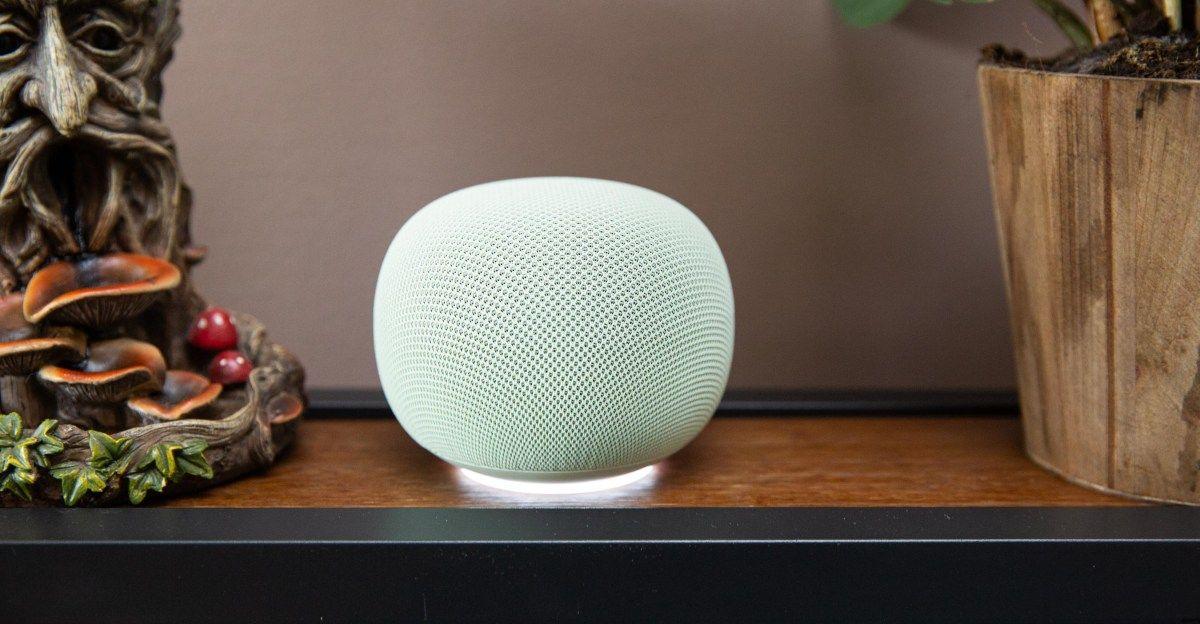
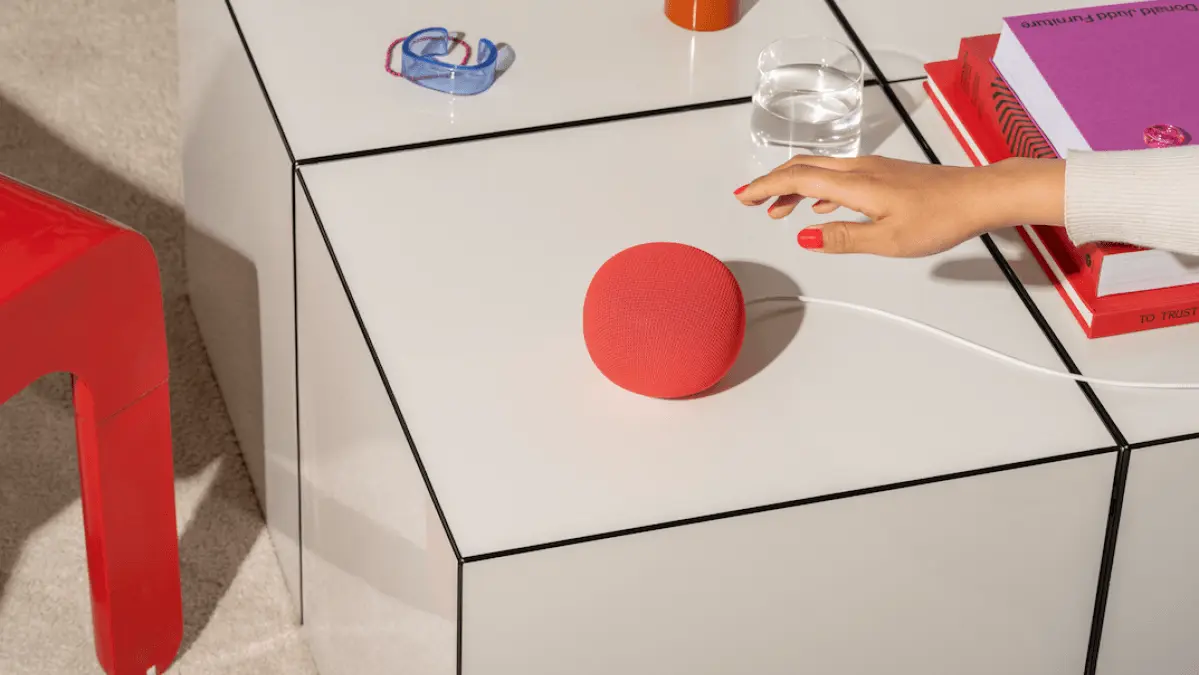
.The small, rounded design—technically an oblate spheroid—measures 4.2 inches in diameter by 3.4 inches tall and comes wrapped in partially recycled 3D-knit fabric
1
4
. Available in hazel, porcelain, jade, and berry colors, the speaker resembles a grown-up version of the Nest Mini, though Google has dropped the Nest branding entirely3
. A distinctive LED ring at the bottom glows to indicate when the device is listening, thinking, or responding, replacing the Assistant-style illuminated lights of previous models1
.
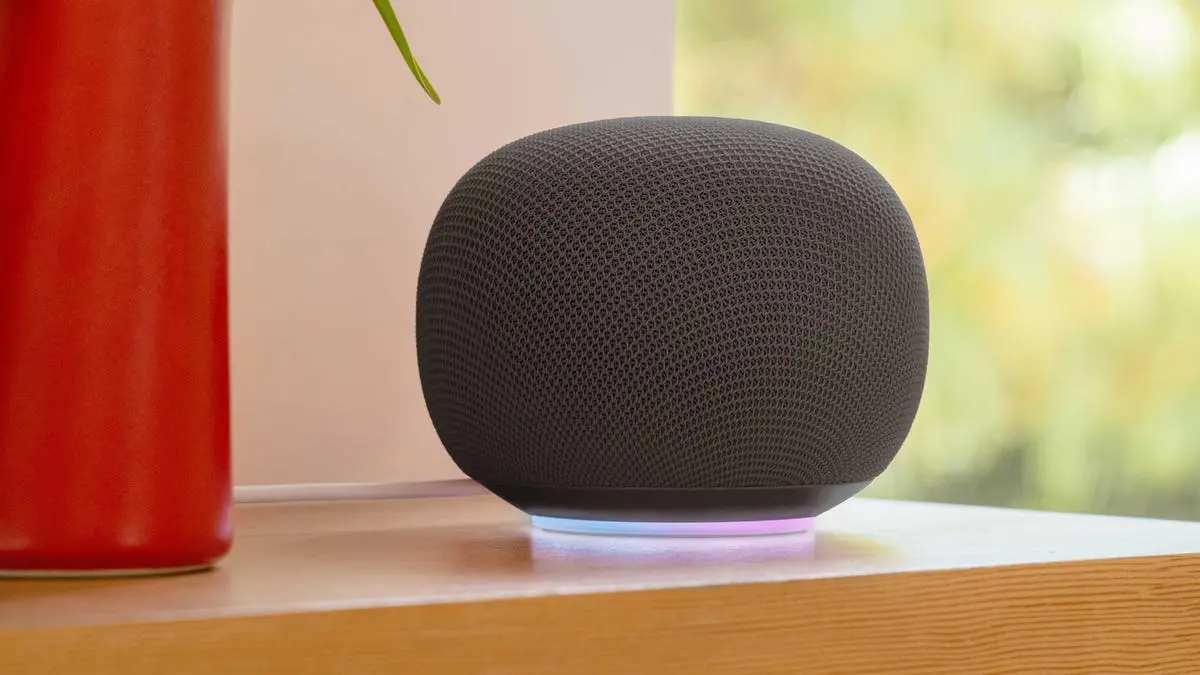
Source: CNET
The Nest Audio successor is built specifically for Gemini for Home, Google's generative AI adapted for smart home environments
2
. Unlike older speakers that required precisely phrased commands, users can now speak using natural language and make multi-step requests like "turn off all the lights except for my bedside lamp" or "dim the kitchen lights, play some relaxing music, and set a timer for 20 minutes"2
.The device ships with 10 new voices capable of two-way conversations on topics beyond simple smart home tasks
2
. Users can ask nuanced questions and dive deeper into subjects, similar to interacting with Gemini AI on smartphones. The speaker also supports mid-sentence corrections—saying "turn off the coffee maker...I mean, turn it on!" will prompt Gemini AI to respond appropriately2
.
Source: CNET
Powering these AI-driven features is a Quad Core A55 processor clocked at 2.0 GHz with a dedicated neural processing unit
1
5
. Three far-field microphones distributed around the speaker pick up voice commands, while local AI models improve sound isolation and filter background noise more effectively than past smart speakers1
.Despite housing only a single 58-millimeter full-range driver—compared to the Nest Audio's 75-millimeter woofer and 19-millimeter tweeter—the Google Home Speaker delivers impressive 360-degree sound
1
5
. Google acknowledges the audio quality falls between the Nest Audio and the smaller Nest Mini1
.However, hands-on testing reveals the speaker holds its own against competitors. When compared to the Apple HomePod mini and Amazon Echo Dot, the Google Home Speaker demonstrated similar clarity to Apple's device but with stronger bass, making it capable of filling small to medium-sized rooms with music
3
. The Amazon Echo Dot couldn't compete with either device despite similar sizing3
.Capacitive touch controls on top allow manual adjustments for volume and playback, though they can be overly sensitive
4
. The speaker also integrates with Google TV Streamer for immersive audio output when paired with up to two units, and connects with other Nest speakers and displays on local networks1
.Related Stories
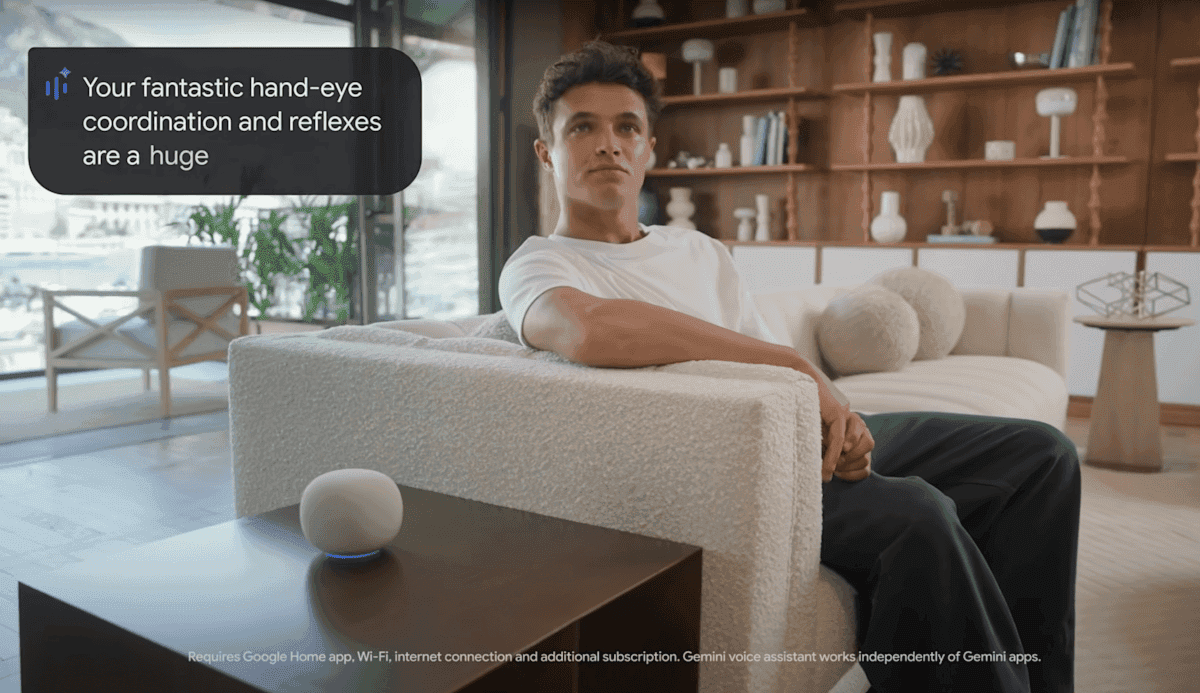
While basic Gemini for Home features come free, Google is betting users will pay for advanced capabilities through a Google Home Premium subscription starting at $10 per month or $100 annually
2
5
. Premium unlocks Gemini Live, enabling free-flowing conversations initiated by saying "Hey Google, let's chat"2
.The subscription also enables continued conversation features, allowing the microphone to remain on briefly so users can ask follow-up questions without repeating "OK Google"
2
. Additional benefits include activity summaries from Nest security cameras and the ability to query what happened in the home while away2
.Google is offering six months of Google Home Premium free with speaker purchases to encourage adoption
1
5
. Whether these AI-driven features justify recurring costs remains uncertain, particularly since many Gemini capabilities work without paying and older Google speakers can access cloud-based Gemini features1
.
Source: Mashable
Beyond audio and AI, the Google Home Speaker serves as Google's first smart speaker with a Thread border router, allowing it to act as a hub for Matter devices
4
. Matter is a smart home protocol enabling devices to work across platforms, and the border router feature lets the speaker bridge smaller sensors and devices lacking integrated Wi-Fi antennas to the cloud4
.The device connects via Wi-Fi 6 and Bluetooth 5.4, and is constructed from 37% recycled materials
4
. Setup through the Google Home app is streamlined, requiring only a QR code scan for existing users, with no need to re-authenticate streaming services3
.While the Amazon Echo Dot Max offers similar Thread border router functionality plus integrated light, temperature, and presence detectors, the Google Home Speaker focuses primarily on audio quality and AI interactions
4
. As smart speaker pricing enters a gray area with AI features, Google's approach differs from Amazon's Alexa Plus—free with Prime subscriptions but expensive otherwise—and Apple's vague hints about requiring larger iCloud subscriptions for future Siri AI capabilities5
.Summarized by
Navi
[2]
25 Jun 2026•Technology

18 Dec 2025•Technology

29 Oct 2025•Technology

1
Technology

2
Policy and Regulation

3
Policy and Regulation