7 Sources
7 Sources
[1]
Google Cloud Pushes Hard on AI Agents and Hardcore Computing
Google is going all-in on agentic AI. At Google's Cloud Next conference on Wednesday, the tech giant announced a slew of updates aimed at helping its enterprise customers automate their business processes with AI agents. Google Cloud reports that 75% of its customers use AI in their businesses, but given how inescapable AI has become in Google products like Docs, Sheets and Gmail, that high figure isn't surprising. But Google is still doubling down, writing in a blog post that it's chasing the idea of the "agentic enterprise." Agentic AI is the tech that runs agents, or bots, that can autonomously complete tasks, with little human babysitting needed. It's transforming AI, particularly for coding and workplace tasks. Tech companies have embraced agents this year, placing big bets that tools like OpenClaw, Claude Code and OpenAI's Codex will fulfill AI's promise of automating big swaths of tasks. Now, Google is giving its business tech the same agentic makeover. Google Cloud CEO Thomas Kurian told reporters that agentic AI is where the company sees AI tech going in the future. The company focused this year's updates on making sure customers have AI processes that are secure, connected to internal systems and "optimize performance, scale and cost of how agents run," he said. The Gemini enterprise agent platform is the new, behind-the-scenes tech that businesses can use to oversee all their AI agents. Employees can create and use agents through the Gemini enterprise app, which includes a new agent designer that can be used to schedule tasks to run across different applications. Google is also announcing two new, eighth-generation TPUs, the 8T and 8I. These are not your mother's computer processors; they're advanced chips solely meant for tech companies doing heavy-compute tasks, like developing AI. The 8T chip is meant to make training more efficient, with Google saying it has three times the processing power compared with Google's seventh-gen Ironwood. The 8I is specifically for inference. Google says it has an 80% improvement in the amount of memory you get with SRAM, and it has about 11,152 chips in a single system.
[2]
Google Releases New AI Agents to Challenge OpenAI and Anthropic
Alphabet Inc.'s Google unveiled a slew of tools to build AI agents aimed at helping companies automate tasks in the tech giant's latest attempt to take on OpenAI and Anthropic PBC in the burgeoning market. At an annual conference in Las Vegas, Google's cloud computing unit on Wednesday showcased a set of tools that can create AI agents and track their work within companies, including a dedicated inbox for the virtual bots to post information and progress reports. Google also introduced updates across its Workspace productivity suite and offered up a vision in which AI agents dramatically overhaul the day to day routines of the average worker. The company's researchers invented much of the technology that touched off the current AI boom, but now Google is in a tight race with leading AI agent makers to win business from corporate customers clamoring for the technology to boost productivity. With the company pouring as much as $185 billion into capital expenditure this year alone, investors are hoping that it can drum up enough new business to justify the steep investment in AI. Get the Morning & Evening Briefing Americas newsletters. Get the Morning & Evening Briefing Americas newsletters. Get the Morning & Evening Briefing Americas newsletters. Start every morning with what you need to know followed by context and analysis on news of the day each evening. Plus, Bloomberg Weekend. Start every morning with what you need to know followed by context and analysis on news of the day each evening. Plus, Bloomberg Weekend. Start every morning with what you need to know followed by context and analysis on news of the day each evening. Plus, Bloomberg Weekend. Plus Signed UpPlus Sign UpPlus Sign Up By continuing, I agree to the Privacy Policy and Terms of Service. The search giant is hoping that its combination of chips, AI models and developer tools will give it an edge. It's poised to announce a new generation of custom-designed chips, including one dedicated to inference, or running AI models after they've been trained. With this push, Google will further challenge market leader Nvidia Corp. in a fast-growing category for semiconductors that's fueled by surging adoption of AI software. "This isn't about offering individual services that can be cobbled together; it is about providing a comprehensive backbone for innovation," Google Cloud CEO Thomas Kurian said in a blog post. A particular focus for Google is AI coding, a market where company leaders are growing increasingly worried that they have fallen behind. Many engineers in Silicon Valley toggle between Anthropic's Claude Code and OpenAI's Codex to see which program will give them the best results, but Google often isn't in the conversation, startup founders told Bloomberg News. In a bid to court developers, Google said its Gemini Enterprise Agent Platform would include new features such as Memory Bank and Memory Profile to help agents to remember past interactions with users, a weakness of some early AI tools. Another new feature, Agent Simulation, will help developers more thoroughly test how the tools work before launch. Anthropic has begun to turn its attention to workers in other sectors with its Cowork product, and Google is chasing that business too. Google said workers could use its Gemini Enterprise app, which it framed as the "front door for AI for every employee," to create agents without writing a line of code. The company also announced Projects, a collaboration platform designed for workers to collaborate with their colleagues as well as agents. Google said the tool brings together information from sources such as Workspace, Microsoft Corp.'s OneDrive and company chats to help agents operate with the proper context. Other offerings by the company are intended to help clients make sure that agents can operate in fields with compliance issues. Google also unveiled new cybersecurity agents that it said clients could use to protect their systems. AI models are identifying a torrent of bugs, but questions are mounting about how they could be exploited without proper safeguards.
[3]
Google puts AI agents at heart of its enterprise money-making push
LAS VEGAS, April 22 (Reuters) - Alphabet CEO Sundar Pichai is deepening a push into enterprise software, signaling to investors at Google's annual cloud conference that AI agents -- human-like digital assistants -- are a lynchpin of its strategy to monetize artificial intelligence. At the three-day conference in Las Vegas that starts Wednesday, Pichai and key Google executives will seek to position the company's AI tools as production-ready infrastructure for enterprise customers who are emerging as the industry's most reliable revenue stream. Other top AI companies including OpenAI and Anthropic have aggressively shifted resources to business customers in recent months. Mountain View, California-based Google announced on Wednesday that it was unifying a set of AI products under the name "Gemini Enterprise." Most notably, this involves rebranding and bulking up Vertex AI, a tool that allows cloud customers to select from a variety of AI models to use for business purposes. Google also announced a set of new governance and security features for AI agents. Agents are powerful digital assistants that can plan, decide, and act autonomously, a fast-growing field that has sparked worries over safety, reliability and oversight. "There's definitely a strategic shift as the models become much more sophisticated," Google Cloud CEO Thomas Kurian told Reuters in an interview. The primary use case of Vertex AI recently shifted from "old-style machine learning" to a sudden explosion in users building their own custom AI agents, Kurian said. Google is seeking to outflank both its traditional cloud rivals and AI upstarts as pressure mounts to prove returns on massive generative AI spending. Google Cloud, once seen as a laggard to rivals such as Amazon (AMZN.O), opens new tab and Microsoft (MSFT.O), opens new tab, has gained traction with enterprise customers, powered by massive bets on AI and years of heavy investment in data centers, custom chips, and networking gear. At GE Appliances, that shift is already tangible. Marcia Brey, a senior executive and Google customer, told Reuters that Google's suite of tools and the enterprise data already stored in Google Cloud allowed her logistics and distribution team to deploy AI faster compared to other products the company had tested. AGENTS OVER CODING In addition to traditional enterprise providers and other hyperscalers, a new class of competitors are quickly emerging in enterprise AI: model providers. So far, coding assistants and plug-ins that connect AI models to existing enterprise software have emerged as lucrative channels for AI revenue and payback on their heavy investments. After early success powered by the raw strength of their models, OpenAI and Anthropic are now pushing downstream, marshalling resources into applications that utilize those models to perform specialized tasks, including agent-building tools. But while rivals are pushing hard on their coding products, Google, by contrast, kept coding largely out of the spotlight at its cloud conference. Kurian instead cast the AI battleground as one defined by agents, governance and enterprise deployment, saying that some coding announcements were being held back for its I/O developer conference in May. "Some people are using the models to write code. They can use Gemini and also other tools like Claude," he said. "But in other cases, we have unique things. There's capability in the platform that nobody else offers." The long-term bet to build out a vast suite of in-house offerings, from models to chips, rather than relying on third-party vendors has given Google an edge over other large cloud providers. This has helped Google to grow its overall cloud market share to 14% at the end of 2025, though it still trails rivals Amazon (AMZN.O), opens new tab and Microsoft, according to data from Synergy Research. Reporting by Kenrick Cai; Editing by Sayantani Ghosh and Shri Navaratnam Our Standards: The Thomson Reuters Trust Principles., opens new tab * Suggested Topics: * Artificial Intelligence Kenrick Cai Thomson Reuters Kenrick Cai is a correspondent for Reuters based in San Francisco. He covers Google, its parent company Alphabet and artificial intelligence. Cai joined Reuters in 2024. He previously worked at Forbes magazine, where he was a staff writer covering venture capital and startups. He received a Best in Business award from the Society for Advancing Business Editing and Writing in 2023. He is a graduate of Duke University.
[4]
Google unifies Gemini Enterprise, debuts new chips
Why it matters: Google is in a pitched battle with Amazon and Microsoft to be the cloud provider of choice for AI workloads. Driving the news: Google announced its eighth-generation Tensor Processing Unit (TPU), which will come in two flavors -- one for training new models and the other for near-real-time answers to user queries. * Google also announced its Gemini Enterprise Agent Platform, incorporating what had been Vertex AI (including access to Gemini and third-party models), plus new security, governance and orchestration features. * It's pitching Gemini Enterprise as more ready for the needs of large businesses than Anthropic's Cowork and other agentic software. * The announcements came as the company kicks off its Cloud Next conference in Las Vegas. The big picture: Most of the major AI players are either already creating their own chips or standing up efforts to do so, with Google and Amazon several generations in.
[5]
Google Puts AI Agents at Heart of Its Enterprise Money-Making Push
LAS VEGAS, April 22 (Reuters) - Alphabet CEO Sundar Pichai is deepening a push into enterprise software, signaling to investors at Google's annual cloud conference that AI agents -- human-like digital assistants -- are a lynchpin of its strategy to monetize artificial intelligence. At the three-day conference in Las Vegas that starts Wednesday, Pichai and key Google executives will seek to position the company's AI tools as production-ready infrastructure for enterprise customers who are emerging as the industry's most reliable revenue stream. Other top AI companies including OpenAI and Anthropic have aggressively shifted resources to business customers in recent months. Mountain View, California-based Google announced on Wednesday that it was unifying a set of AI products under the name "Gemini Enterprise." Most notably, this involves rebranding and bulking up Vertex AI, a tool that allows cloud customers to select from a variety of AI models to use for business purposes. Google also announced a set of new governance and security features for AI agents. Agents are powerful digital assistants that can plan, decide, and act autonomously, a fast-growing field that has sparked worries over safety, reliability and oversight. "There's definitely a strategic shift as the models become much more sophisticated," Google Cloud CEO Thomas Kurian told Reuters in an interview. The primary use case of Vertex AI recently shifted from "old-style machine learning" to a sudden explosion in users building their own custom AI agents, Kurian said. Google is seeking to outflank both its traditional cloud rivals and AI upstarts as pressure mounts to prove returns on massive generative AI spending. Google Cloud, once seen as a laggard to rivals such as Amazon and Microsoft, has gained traction with enterprise customers, powered by massive bets on AI and years of heavy investment in data centers, custom chips, and networking gear. At GE Appliances, that shift is already tangible. Marcia Brey, a senior executive and Google customer, told Reuters that Google's suite of tools and the enterprise data already stored in Google Cloud allowed her logistics and distribution team to deploy AI faster compared to other products the company had tested. AGENTS OVER CODING In addition to traditional enterprise providers and other hyperscalers, a new class of competitors are quickly emerging in enterprise AI: model providers. So far, coding assistants and plug-ins that connect AI models to existing enterprise software have emerged as lucrative channels for AI revenue and payback on their heavy investments. After early success powered by the raw strength of their models, OpenAI and Anthropic are now pushing downstream, marshalling resources into applications that utilize those models to perform specialized tasks, including agent-building tools. But while rivals are pushing hard on their coding products, Google, by contrast, kept coding largely out of the spotlight at its cloud conference. Kurian instead cast the AI battleground as one defined by agents, governance and enterprise deployment, saying that some coding announcements were being held back for its I/O developer conference in May. "Some people are using the models to write code. They can use Gemini and also other tools like Claude," he said. "But in other cases, we have unique things. There's capability in the platform that nobody else offers." The long-term bet to build out a vast suite of in-house offerings, from models to chips, rather than relying on third-party vendors has given Google an edge over other large cloud providers. This has helped Google to grow its overall cloud market share to 14% at the end of 2025, though it still trails rivals Amazon and Microsoft, according to data from Synergy Research. (Reporting by Kenrick Cai; Editing by Sayantani Ghosh and Shri Navaratnam)
[6]
Google puts AI agents at heart of its enterprise money-making push
At the three-day conference in Las Vegas that starts Wednesday, Pichai and key Google executives will seek to position the company's AI tools as production-ready infrastructure for enterprise customers who are emerging as the industry's most reliable revenue stream. Alphabet CEO Sundar Pichai is deepening a push into enterprise software, signaling to investors at Google's annual cloud conference that AI agents - human-like digital assistants - are a lynchpin of its strategy to monetize artificial intelligence. At the three-day conference in Las Vegas that starts Wednesday, Pichai and key Google executives will seek to position the company's AI tools as production-ready infrastructure for enterprise customers who are emerging as the industry's most reliable revenue stream. Other top AI companies including OpenAI and Anthropic have aggressively shifted resources to business customers in recent months. Mountain View, California-based Google announced on Wednesday that it was unifying a set of AI products under the name "Gemini Enterprise." Most notably, this involves rebranding and bulking up Vertex AI, a tool that allows cloud customers to select from a variety of AI models to use for business purposes. Google also announced a set of new governance and security features for AI agents. Agents are powerful digital assistants that can plan, decide, and act autonomously, a fast-growing field that has sparked worries over safety, reliability and oversight. "There's definitely a strategic shift as the models become much more sophisticated," Google Cloud CEO Thomas Kurian told Reuters in an interview. The primary use case of Vertex AI recently shifted from "old-style machine learning" to a sudden explosion in users building their own custom AI agents, Kurian said. Google is seeking to outflank both its traditional cloud rivals and AI upstarts as pressure mounts to prove returns on massive generative AI spending. Google Cloud, once seen as a laggard to rivals such as Amazon and Microsoft, has gained traction with enterprise customers, powered by massive bets on AI and years of heavy investment in data centers, custom chips, and networking gear. At GE Appliances, that shift is already tangible. Marcia Brey, a senior executive and Google customer, told Reuters that Google's suite of tools and the enterprise data already stored in Google Cloud allowed her logistics and distribution team to deploy AI faster compared to other products the company had tested. Agents over coding In addition to traditional enterprise providers and other hyperscalers, a new class of competitors are quickly emerging in enterprise AI: model providers. So far, coding assistants and plug-ins that connect AI models to existing enterprise software have emerged as lucrative channels for AI revenue and payback on their heavy investments. After early success powered by the raw strength of their models, OpenAI and Anthropic are now pushing downstream, marshalling resources into applications that utilize those models to perform specialized tasks, including agent-building tools. But while rivals are pushing hard on their coding products, Google, by contrast, kept coding largely out of the spotlight at its cloud conference. Kurian instead cast the AI battleground as one defined by agents, governance and enterprise deployment, saying that some coding announcements were being held back for its I/O developer conference in May. "Some people are using the models to write code. They can use Gemini and also other tools like Claude," he said. "But in other cases, we have unique things. There's capability in the platform that nobody else offers." The long-term bet to build out a vast suite of in-house offerings, from models to chips, rather than relying on third-party vendors has given Google an edge over other large cloud providers. This has helped Google to grow its overall cloud market share to 14% at the end of 2025, though it still trails rivals Amazon and Microsoft, according to data from Synergy Research.
[7]
Google puts AI agents at heart of its enterprise money-making push
LAS VEGAS, April 22 (Reuters) - Alphabet CEO Sundar Pichai is deepening a push into enterprise software, signaling to investors at Google's annual cloud conference that AI agents -- human-like digital assistants -- are a lynchpin of its strategy to monetize artificial intelligence. At the three-day conference in Las Vegas that starts Wednesday, Pichai and key Google executives will seek to position the company's AI tools as production-ready infrastructure for enterprise customers who are emerging as the industry's most reliable revenue stream. Other top AI companies including OpenAI and Anthropic have aggressively shifted resources to business customers in recent months. Mountain View, California-based Google announced on Wednesday that it was unifying a set of AI products under the name "Gemini Enterprise." Most notably, this involves rebranding and bulking up Vertex AI, a tool that allows cloud customers to select from a variety of AI models to use for business purposes. Google also announced a set of new governance and security features for AI agents. Agents are powerful digital assistants that can plan, decide, and act autonomously, a fast-growing field that has sparked worries over safety, reliability and oversight. "There's definitely a strategic shift as the models become much more sophisticated," Google Cloud CEO Thomas Kurian told Reuters in an interview. The primary use case of Vertex AI recently shifted from "old-style machine learning" to a sudden explosion in users building their own custom AI agents, Kurian said. Google is seeking to outflank both its traditional cloud rivals and AI upstarts as pressure mounts to prove returns on massive generative AI spending. Google Cloud, once seen as a laggard to rivals such as Amazon and Microsoft, has gained traction with enterprise customers, powered by massive bets on AI and years of heavy investment in data centers, custom chips, and networking gear. At GE Appliances, that shift is already tangible. Marcia Brey, a senior executive and Google customer, told Reuters that Google's suite of tools and the enterprise data already stored in Google Cloud allowed her logistics and distribution team to deploy AI faster compared to other products the company had tested. AGENTS OVER CODING In addition to traditional enterprise providers and other hyperscalers, a new class of competitors are quickly emerging in enterprise AI: model providers. So far, coding assistants and plug-ins that connect AI models to existing enterprise software have emerged as lucrative channels for AI revenue and payback on their heavy investments. After early success powered by the raw strength of their models, OpenAI and Anthropic are now pushing downstream, marshalling resources into applications that utilize those models to perform specialized tasks, including agent-building tools. But while rivals are pushing hard on their coding products, Google, by contrast, kept coding largely out of the spotlight at its cloud conference. Kurian instead cast the AI battleground as one defined by agents, governance and enterprise deployment, saying that some coding announcements were being held back for its I/O developer conference in May. "Some people are using the models to write code. They can use Gemini and also other tools like Claude," he said. "But in other cases, we have unique things. There's capability in the platform that nobody else offers." The long-term bet to build out a vast suite of in-house offerings, from models to chips, rather than relying on third-party vendors has given Google an edge over other large cloud providers. This has helped Google to grow its overall cloud market share to 14% at the end of 2025, though it still trails rivals Amazon and Microsoft, according to data from Synergy Research. (Reporting by Kenrick Cai; Editing by Sayantani Ghosh and Shri Navaratnam)
Share
Share
Copy Link
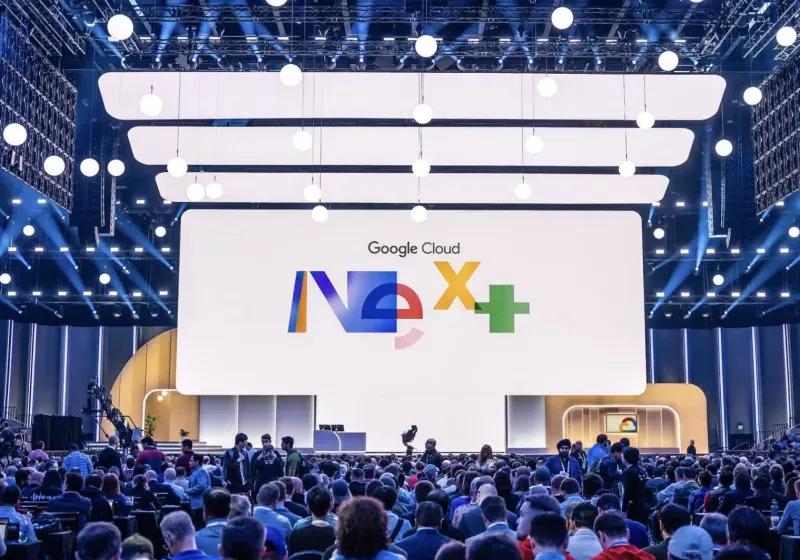
Google unveiled its Gemini Enterprise Agent Platform and eighth-generation TPUs at Cloud Next 2026, positioning AI agents as central to its enterprise strategy. With 75% of customers already using AI, Google aims to automate business processes while competing against OpenAI, Anthropic, Microsoft and Amazon in the fast-growing enterprise market.
Google is placing AI agents at the center of its enterprise money-making push, announcing a comprehensive suite of tools at its Cloud Next conference in Las Vegas designed to help businesses automate tasks and build autonomous digital assistants
1
3
. CEO Sundar Pichai and Google Cloud CEO Thomas Kurian are positioning the company's AI tools as production-ready infrastructure for enterprise customers, who represent the industry's most reliable revenue stream3
.
Source: Reuters
The tech giant reports that 75% of its customers already use AI in their businesses, but the company is doubling down with what it calls the "agentic enterprise" vision
1
. Agentic AI refers to technology that runs bots capable of autonomously completing tasks with minimal human oversight, transforming how businesses approach coding and workplace automation1
.At the heart of Google's announcement is the Gemini Enterprise Agent Platform, which unifies what was previously known as Vertex AI along with new security, governance and orchestration features
4
. This enterprise agent platform serves as behind-the-scenes technology that businesses can use to oversee all their AI agents, with employees able to create and use agents through the Gemini Enterprise app1
.
Source: Axios
Vertex AI, which allows cloud customers to select from a variety of AI models for business purposes, has seen its primary use case shift dramatically from "old-style machine learning" to a sudden explosion in users building their own custom AI agents, according to Thomas Kurian
3
5
.The platform includes new features such as Memory Bank and Memory Profile to help agents remember past interactions with users, addressing a weakness of some early AI tools
2
. Agent Simulation will help developers test how tools work before launch, while the new agent designer can schedule tasks to run across different applications1
2
.Google also announced two new eighth-generation TPUs—the 8T and 8I—advanced Tensor Processing Units designed specifically for companies handling heavy AI workloads
1
4
.
Source: CNET
The 8T chip targets AI model training with three times the processing power compared to Google's seventh-generation Ironwood chip
1
.The 8I chip is specifically designed for inference—running AI models after they've been trained to provide near-real-time answers to user queries. It delivers an 80% improvement in SRAM memory and includes about 11,152 chips in a single system
1
4
. With this push, Google further challenges market leader Nvidia in the fast-growing semiconductor category fueled by surging adoption of AI software2
.Related Stories
Google faces intense competition from OpenAI and Anthropic, who have aggressively shifted resources to business customers in recent months
3
. The company is particularly focused on AI coding, a market where leaders are growing increasingly worried they've fallen behind. Many Silicon Valley engineers toggle between Anthropic's Claude Code and OpenAI's Codex, but Google often isn't in the conversation, startup founders told Bloomberg News2
.While rivals push hard on coding products, Google kept coding largely out of the spotlight at the Google Cloud Next conference. Kurian instead cast the AI battleground as one defined by agents, governance and enterprise deployment, saying some coding announcements were being held for its I/O developer conference in May
3
5
.Google is pitching Gemini Enterprise as more ready for the needs of large businesses than Anthropic's Cowork and other agentic software
4
. The company also unveiled new cybersecurity agents that clients can use to protect their systems, as AI models identify a torrent of bugs but questions mount about how they could be exploited without proper safeguards2
.With the company pouring as much as $185 billion into capital expenditure this year alone, investors are hoping Google can drum up enough new business to justify the steep investment in AI
2
. Google Cloud, once seen as a laggard to rivals such as Amazon and Microsoft, has gained traction with enterprise customers, powered by massive bets on AI and years of heavy investment in data centers, custom chips, and networking gear3
.This has helped Google grow its overall cloud market share to 14% at the end of 2025, though it still trails rivals Amazon and Microsoft, according to data from Synergy Research
3
5
. At GE Appliances, the shift is already tangible. Marcia Brey, a senior executive and Google customer, told Reuters that Google's suite of tools and the enterprise data already stored in Google Cloud allowed her logistics and distribution team to deploy AI faster compared to other products the company had tested3
.Kurian emphasized that Google's approach isn't about offering individual services that can be cobbled together, but rather providing a comprehensive backbone for innovation
2
. The long-term bet to build out a vast suite of in-house offerings, from models to chips, rather than relying on third-party vendors, has given Google an edge over other large cloud providers in the battle for enterprise software dominance3
5
.Summarized by
Navi
Yesterday•Technology

10 Apr 2025•Technology
06 Aug 2025•Technology

1
Policy and Regulation

2
Technology

3
Technology