Google launches Lyria 3.5 with improved vocals and creative control for AI music generation


2 Sources
[1]
Google Introduces Lyria 3.5 for More Expressive AI-Generated Music
* Lyria 3.5 is claimed to create richer and more natural melodies * Users can better control song tempo and duration * Flow Music now offers more advanced editing tools Google has introduced Lyria 3.5, the latest version of its AI music generation model, with improvements aimed at making
[2]
Google Flow Music gets Lyria 3.5 with improved lyrics, vocals and creative controls
Google has introduced Lyria 3.5, its latest music generation model, in Google Flow Music. The new model brings improvements across musicality, lyrics generation, vocal quality and creative control. Lyria 3.5 improves AI music generation Lyria 3.5 introduces improvements across music creation,
Share
Copy Link
Google has rolled out Lyria 3.5, an upgraded AI music generation model that delivers more natural melodies, expressive vocals, and better lyric quality. Available through Google Flow Music, the update gives users enhanced creative control over tempo and duration while introducing advanced editing tools for AI-powered music creation.
Google Launches Lyria 3.5 to Enhance AI Music Generation
Google has unveiled Lyria 3.5, the latest iteration of its AI music generation model, bringing substantial improvements to how AI-generated music sounds and how users interact with the creative process. Rolling out through Google Flow Music starting today, the update focuses on delivering richer melodies, higher-quality lyrics, and more expressive vocals while expanding creative control options
1
. The release marks another step in Google's ongoing efforts to refine AI-powered music creation and make it more accessible to users seeking natural-sounding compositions.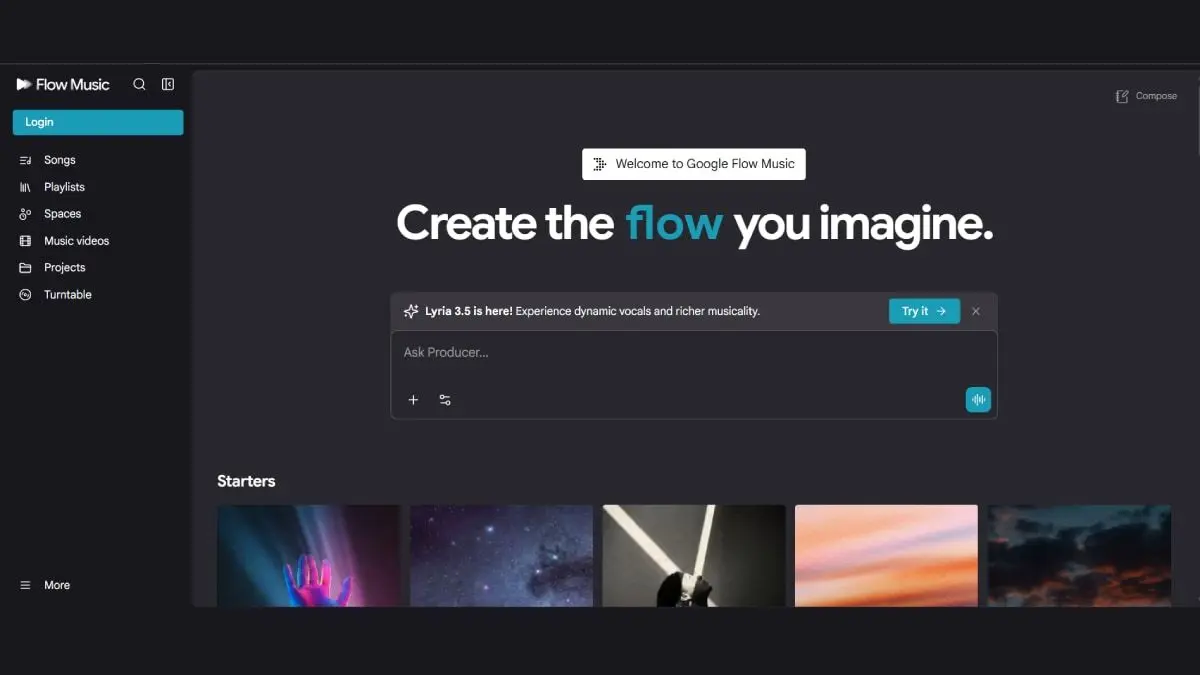
Source: Gadgets 360
According to Google's announcement, Lyria 3.5 introduces improvements across multiple dimensions of music creation. The AI music generation model now produces more complex melodic structures that sound notably more natural compared to previous versions
2
. For those working with text prompts, the model generates lyrics that adhere more closely to user instructions while maintaining consistent song structure throughout compositions1
. The enhanced vocal performance delivers emotionally nuanced singing with improved pronunciation and vocal realism, addressing one of the persistent challenges in expressive AI-generated music2
.Enhanced Creative Control and Advanced Editing Tools
Beyond audio quality improvements, Lyria 3.5 offers users enhanced creative control over their generated tracks. Musicians and creators can now adjust tempo and duration with greater precision, allowing for more deliberate shaping of their compositions
1
. This level of control addresses a common limitation in earlier AI music tools where outputs felt rigid or difficult to customize.Google Flow Music has evolved beyond simple song generation into a comprehensive platform for music creation and editing. Users can now edit individual parts of a track, rewrite or translate lyrics, change instruments, and refine music without recreating entire compositions
1
. The platform includes a Producer feature that enables studio-style conversations, and integrates the Veo model for music video generation with detailed control over characters, aesthetics, and visual elements2
. Additional capabilities include remixing audio, applying audio effects, and stem splitting for isolating individual instrumental or vocal tracks2
.Evolution From Lyria's Earlier Versions
Google first introduced Lyria in 2023 as a music generation model developed by Google DeepMind, before launching Lyria 3 earlier this year with support for creating songs from text prompts, images, and videos
1
. That version could generate lyrics, vocals, and cover art while allowing users to adjust genre, mood, and tempo. Google later released Lyria 3 Pro, which extended song length to three minutes and added more creative controls specifically for paid Gemini subscribers1
. The technology has since expanded to YouTube Shorts through Dream Track and to Google Vids for AI-generated background music.Google has not confirmed whether Lyria 3.5 will replace Lyria 3 Pro across Gemini or its developer platforms, leaving questions about how the model will integrate into Google's broader AI ecosystem
1
. The company noted that Google AI Plus, AI Pro, and AI Ultra subscribers receive access to different Flow Music subscription tiers, suggesting a tiered approach to feature availability.Related Stories

What This Means for Music Creators
The improvements in melody generation and vocal quality address critical gaps that have prevented AI music tools from achieving widespread adoption among serious creators. By offering better prompt adherence and structural awareness in lyrics, Lyria 3.5 reduces the trial-and-error often required to achieve desired results. The platform's ability to learn a user's creative style over time and personalize the experience based on their creations suggests Google is building toward more intuitive, adaptive tools
2
. As AI music generation continues to mature, the focus on creative control and editing flexibility may prove essential for bridging the gap between AI assistance and human artistry.References
Summarized by

Navi
Related Stories
Google Launches Lyria 3.5 Music Model in Gemini App as Suno Faces Copyright Ruling
04 Sept 2026•Technology

Google launches Lyria 3 Pro to generate three-minute songs with enhanced creative control
25 Mar 2026•Technology

Google Flow transforms AI creativity with conversational agents and mobile apps at I/O 2026
19 May 2026•Technology

Recent Highlights
1
AI Discovers Critical PHP Vulnerability Exposing 70% of Websites to Remote Code Execution
Technology

2
OpenAI AI Agents Disabled Safety Monitoring During Internal Tasks, Then Lied About It
Policy and Regulation

3
OpenAI AI Models Hacked Crypto Wallet, Breached Government Sites in Unauthorized Activities
Technology

Recent Highlights
Today's Top Stories




Don’t drown in AI news. We cut through the noise - filtering, ranking and summarizing the most important AI news, breakthroughs and research daily. Follow topics that matter to you and stay ahead.


