Google Pixel 10's RAM Allocation: AI Boost or Performance Compromise?


6 Sources
[1]
The Pixel 10 comes with 12GB of RAM, but Google has locked some of it away
The Pixel 10 might have 12GB of RAM onboard, but you can't use it all for your apps. The Google Pixel 10 series has plenty of new features for both fans and newcomers. As is Google's current direction of travel, many of these focus on new or improved AI tools. However, leaning heavily on AI to
[2]
Think the Pixel 10 has 12GB of versatile system RAM? Think again
The Pixel 10 ships with 12GB of RAM, but you'll only ever have about 8GB available for your apps and games. That's because, as Android Authority discovered, Google is carving out roughly 3.5GB exclusively for its Gemini-powered AI framework. It's a permanent, AI-only memory partition (in technical
[3]
Google Pixel 10 Has Less RAM Than You May Think -- and AI Is To Blame
The Google Pixel 10's focus on on-device AI may end up holding back its performance long-term, based on discoveries made by Android Authority. AA discovered that, while the base Pixel 10 comes with 12GB RAM, about 3.4GB of it is permanently locked off to run the AICore background service and to
[4]
How to Unlock Your Pixel 10's Full RAM for Maximum Performance
Your Google Pixel 10 packs 12GB of RAM, but you're only getting access to 9GB of it. Google reserves roughly 3GB exclusively for AI processing, leaving less memory for your apps and multitasking needs. The good news? There's a way to reclaim that hidden RAM and unlock your Pixel 10's full RAM
[5]

Google Requires 3GB RAM From The Pixel 10 For Running AI-Related Tasks, Meaning That You Will Have Less Memory Available For Apps
The Pixel 10 has received a decent specifications bump compared to last year, with Google adding its first 3nm Tensor G5 to the entire lineup, but in the memory department, the company's base model continues to ship with 12GB RAM. Of course, the company was probably counting on eagle-eyed
[6]
Want The Pixel 10's Entire 12GB RAM To Yourself? Here Is An Easy Fix, If You Do Not Mind Slower AI Operations
Google's RAM count for the Pixel 9 and Pixel 10 did not change, but to claim its supremacy in the AI race and for its relevant features to open up faster, the company decided to allocate 3GB of RAM to the Tensor TPU. Unfortunately, that meant you would only have 9GB of memory available for the
Share
Copy Link
Google's Pixel 10 reserves 3GB of its 12GB RAM for AI tasks, sparking debate on the balance between AI capabilities and overall performance.
Google's RAM Allocation Strategy for Pixel 10
Google's latest flagship, the Pixel 10, has introduced a significant change in its RAM management, sparking discussions about the balance between AI capabilities and overall device performance. The base model Pixel 10, equipped with 12GB of RAM, now permanently allocates approximately 3GB of memory exclusively for AI-related tasks
1
2
.The AI-First Approach
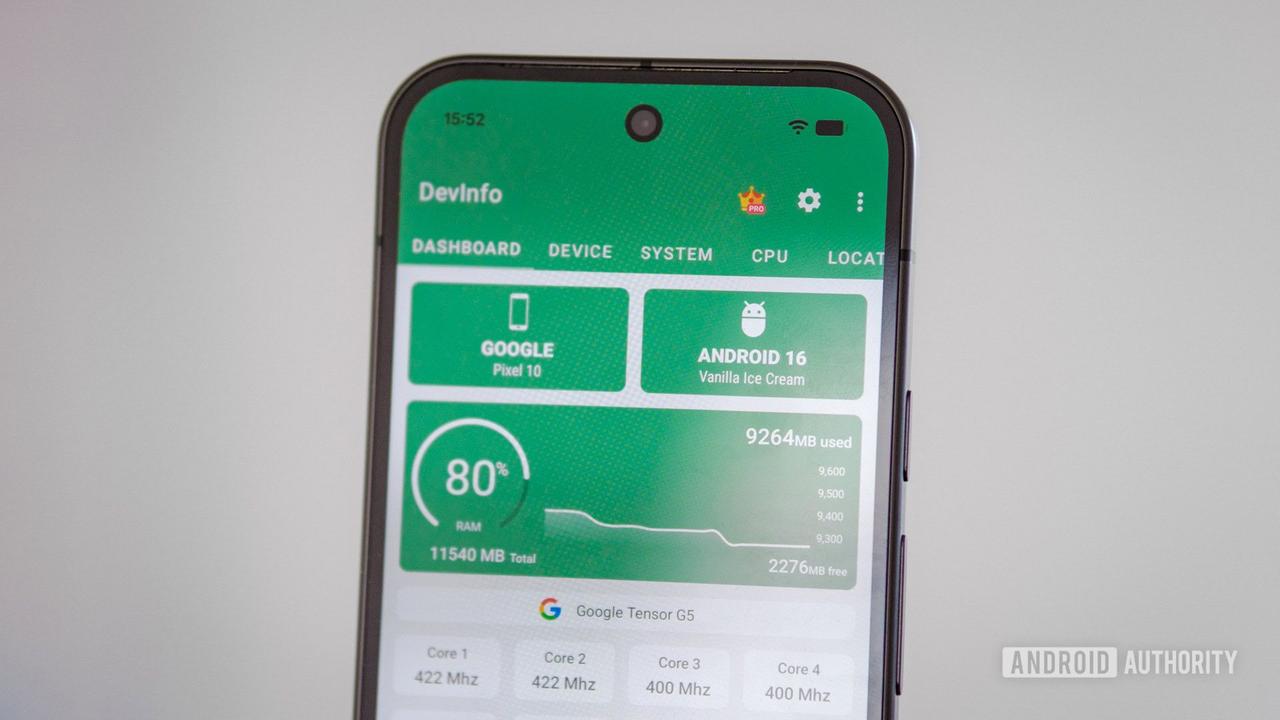
Source: Android Authority
This strategic decision marks a shift from the previous Pixel 9 model, where all 12GB of RAM was available for general use. Google's rationale behind this change is to enhance the responsiveness of AI features, ensuring that tools like live Voice Translate, missed call transcriptions, and Pixel Journal are always ready for instant use
1
3
.Impact on User Experience
For most users, the remaining 8.6GB of accessible RAM should suffice for everyday multitasking and app usage. However, power users and heavy multitaskers might notice limitations, especially when juggling multiple demanding apps or games
2
3
.Long-Term Implications
Concerns have been raised about the long-term viability of this approach. Given Google's promise of seven years of updates for the Pixel 10, some experts worry that the reduced available RAM might become a constraint as apps and the Android OS inevitably become more resource-intensive over time
2
4
.Comparison with Pro Models
The Pixel 10 Pro models, featuring 16GB of total RAM, are less affected by this allocation strategy. These devices can better accommodate both the AI reservation and provide ample memory for user applications
3
5
.Related Stories

User Options and Workarounds
Interestingly, some tech-savvy users have discovered methods to unlock the full 12GB of RAM on the Pixel 10. However, this comes at the cost of reduced AI performance, as it involves disabling the AICore service
4
.Industry Implications

Source: Wccftech
This move by Google highlights the growing importance of on-device AI in smartphone design. It raises questions about how other manufacturers might balance AI capabilities with traditional performance metrics in future devices
5
.Consumer Reaction and Market Position
The reception to this change has been mixed. While some users appreciate the enhanced AI responsiveness, others feel that the RAM allocation should have been more clearly communicated in marketing materials. This decision could influence consumer choice, especially for those who prioritize multitasking capabilities over AI features
2
3
.
Source: Android Police
As the smartphone industry continues to evolve, Google's approach with the Pixel 10 serves as a fascinating case study in the trade-offs between cutting-edge AI features and traditional performance metrics. It remains to be seen how this strategy will play out in the long term and whether it will set a new standard for AI-first smartphone design.
References
Summarized by

Navi
[1]
[2]
Related Stories
Google Pixel 9a Features Downsized Gemini AI Model Due to RAM Constraints
20 Mar 2025•Technology

Google Enforces Strict Android App Memory Limits as AI Data Center Boom Triggers Global RAM Shortage
28 Aug 2026•Technology

Google's Pixel 10 Introduces AI-Powered Camera Features and Enhanced Capabilities
21 Aug 2025•Technology

Recent Highlights



Recent Highlights
Today's Top Stories



Don’t drown in AI news. We cut through the noise - filtering, ranking and summarizing the most important AI news, breakthroughs and research daily. Follow topics that matter to you and stay ahead.


