Google launches Gemini Embedding 2, its first natively multimodal embedding model for enterprise AI


5 Sources
[1]
Google's Gemini Embedding 2 arrives with native multimodal to cut costs and speed up your enterprise data stack
Yesterday amid a flurry of enterprise AI product updates, Google announced arguably its most significant one for enterprise customers: the public preview availability of Gemini Embedding 2, its new embeddings model -- a significant evolution in how machines represent and retrieve information across
[2]
Gemini Embedding 2: Our first natively multimodal embedding model
Today we're releasing Gemini Embedding 2, our first fully multimodal embedding model built on the Gemini architecture, in Public Preview via the Gemini API and Vertex AI. Expanding on our previous text-only foundation, Gemini Embedding 2 maps text, images, videos, audio and documents into a
[3]
Gemini Embedding 2 Is Google's First AI Model to Map Text and Media
Google released its first fully multimodal embedding model on Tuesday. Dubbed Gemini Embedding 2, the artificial intelligence (AI) model maps text, images, audio, and videos into a single, unified embedding space. This means it uses an architecture to understand concepts whether they are written as
[4]
Google rolls out Gemini Embedding 2 for multimodal AI applications
Google has released Gemini Embedding 2, a multimodal embedding model built on the Gemini architecture. The model expands beyond earlier text-only embedding systems by mapping text, images, videos, audio, and documents into a single unified embedding space. It captures semantic meaning across more
[5]

Google unveils Gemini Embedding 2, its first multimodal embedding model
The model aims to simplify complex AI pipelines for RAG and semantic search. Google has officially unveiled its first-ever multimodal embedding model, the Gemini Embedding 2. While AI started with being limited to text-only, with the help of Gemini Embedding 2, Google is planning to map text,
Share
Copy Link
Google unveiled Gemini Embedding 2, marking a shift in how AI systems process information. The natively multimodal embedding model maps text, images, videos, audio, and documents into a single unified embedding space, eliminating the need for separate processing systems. Available through Gemini API and Vertex AI, the model reduces latency by up to 70% for some customers while cutting costs for enterprises using AI powered by their own data.
Google Unveils First Natively Multimodal Embedding Model
Google has released Gemini Embedding 2, its first fully natively multimodal embedding model built on the Gemini architecture, now available in public preview through the Gemini API and Vertex AI
1
2
. This release represents a significant evolution in how machines represent and retrieve information across different media types, moving beyond the text-only limitations of previous embedding models1
. The new model maps text, images, videos, audio, and documents into a single unified embedding space, capturing semantic intent across more than 100 languages2
3
.
Source: Google
For enterprise customers, the impact is immediate and measurable. The model reduces latency by as much as 70% for some customers and cuts total costs for enterprises that use AI models powered by their own data to complete business tasks
1
. This efficiency gain stems from eliminating the need to convert different media types into text before processing—a step that previous systems required.Understanding Embeddings and Why They Matter
Embeddings serve as the invisible engine behind modern AI applications, from search engines to recommendation systems
1
. An embedding model takes complex data—whether a sentence, a photo, or a podcast snippet—and converts it into a long list of numbers called a vector. These numbers represent coordinates in a high-dimensional map where semantically similar items sit close together1
.Large companies deploy these models for Retrieval-Augmented Generation (RAG), where an AI assistant searches through internal PDFs to answer employee questions accurately
1
4
. The market currently includes major players like OpenAI with its text-embedding-3 series, Google with Gemini and previous Gecko models, and Anthropic and Cohere providing specialized models for enterprise search1
.Native Multimodal Processing Changes the Game
Most leading models remain "text-first," requiring video libraries to be transcribed into text before embedding
1
. Gemini Embedding 2 breaks this pattern by understanding audio as sound waves and video as motion directly, without converting them to text first1
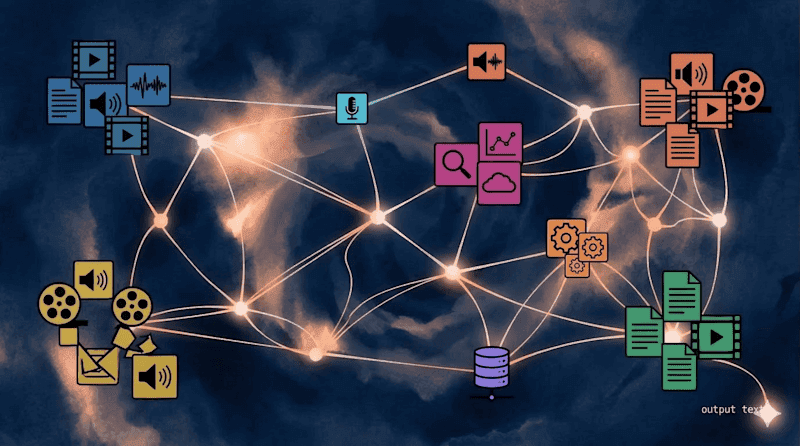
. This approach reduces translation errors and captures nuances that text alone might miss.The model can process text, images, videos, and audio into the same 3,072-dimensional space, eliminating the need for separate systems for image search and text search
1
. Developers can now perform cross-modal retrieval—using a text query to find a specific moment in a video or an image that matches a particular sound. As Logan Kilpatrick of Google DeepMind noted, developers can "bring text, images, video, audio, and docs into the same embedding space"1
.
Source: VentureBeat
Technical Capabilities and Interleaved Input Processing
Gemini Embedding 2 supports interleaved multimodal inputs, allowing developers to combine multiple media types within a single request
2
3
. A developer can send a request containing both an image of a vintage car and the text "What is the engine type?" The model processes them as a single, nuanced concept rather than treating them separately1
.The model offers specific technical specifications: it supports up to 8,192 input tokens for text, processes up to six images per request in PNG and JPEG formats, handles up to 120 seconds of video input in MP4 and MOV formats, and can embed PDFs up to six pages long
3
4
. Notably, it can natively process and map audio data without requiring text transcriptions3
.Matryoshka Representation Learning Optimizes Performance
One technical feature that sets Gemini Embedding 2 apart is Matryoshka Representation Learning (MRL)
1
4
. Named after Russian nesting dolls, this technique nests the most important information in the first few numbers of the vector. Enterprises can choose to use the full 3,072 dimensions or reduce the size to manage storage and performance requirements4
. Recommended output dimensions include 3,072, 1,536, and 7684
.Related Stories


Applications That Simplify AI Pipelines
The model enhances a wide variety of multimodal downstream tasks, from semantic search to sentiment analysis and data clustering
2
5
. By creating a singular, unified map for different types of digital content, Google aims to simplify complex pipelines that previously required multiple specialized systems3
5
.Developers can access the model through integrations with popular frameworks and vector databases including LangChain, LlamaIndex, Haystack, Weaviate, Qdrant, and ChromaDB
4
. This broad integration support suggests Google is positioning the model for rapid adoption across existing AI development workflows.What Enterprises Should Watch
The shift toward native multimodal processing signals where AI infrastructure is heading. Enterprises currently managing separate systems for different media types should evaluate how consolidating into a unified embedding space might reduce complexity and costs. The 70% latency reduction reported by some customers indicates substantial performance gains are possible, particularly for organizations processing large volumes of mixed-media data
1
. As competitors like OpenAI and Anthropic respond, the embedding model landscape will likely see accelerated innovation in multimodal capabilities and efficiency improvements.References
Summarized by

Navi
[1]
Related Stories
Recent Highlights



Recent Highlights
Today's Top Stories












Don’t drown in AI news. We cut through the noise - filtering, ranking and summarizing the most important AI news, breakthroughs and research daily. Follow topics that matter to you and stay ahead.


