Google bets on AI agents with Gemini 3.5 Flash, Spark, and Omni at I/O 2026


52 Sources
[1]
Google announces agent-optimized Gemini 3.5.Flash and a do-anything model called Omni
At last year's I/O event, Google was still talking about the 2.5 branch of Gemini, and what a difference a year makes. We've gone through the 3.0 and 3.1 families since then, and now it's on to version 3.5. Gemini 3.5 Flash is rolling out across a wide range of Google products starting today, and
[2]
Google updates its Gemini app to take on ChatGPT and Claude at IO 2026 | TechCrunch
At its annual Google I/O event on Tuesday, Google announced that the Gemini app is getting a series of new updates, including a "Daily Brief" feature, a redesigned interface, access to a new AI video model called Gemini Omni, and new personal AI agent called Gemini Spark. The updates signal
[3]
With Gemini 3.5 Flash, Google bets its next AI wave on agents, not chatbots | TechCrunch
Google launched on Tuesday Gemini 3.5 Flash, a new AI model that the company says is its strongest yet for coding and autonomous AI agents. The model, which was introduced at the company's annual I/O developer conference, can independently execute coding pipelines, manage research projects, and, in
[4]
Google's New Gemini AI Model and Tools Are All About Agents Now
You'll be able to use those models in lots of different ways, including an OpenClaw-like 24/7 agentic assistant and an upgraded Antigravity coding platform. Here's what's coming in Gemini from Google I/O. The first new model, Gemini 3.5 Flash, rolls out to all users starting now. Google CEO Sundar
[5]
The 5 biggest changes coming to Gemini
Google announced some big updates for its Gemini app during its annual I/O event on Tuesday. Though you might notice the redesign first, Google is also bringing two new AI models to Gemini and is testing out an always-on AI model that can complete tasks on your behalf. Here are all the biggest
[6]
Google updates its Gemini app to take on ChatGPT and Claude | TechCrunch
Google announced at its annual I/O event on Tuesday that the Gemini app is getting a series of new updates, including a "Daily Brief" feature, a redesigned interface, and access to a new AI video model called Gemini Omni. The updates signal Google's push to turn its Gemini app into an all-purpose
[7]

Do Google's I/O AI Announcements Live Up to the Hype? I Put Them to the Test
Color me shocked that the Gemini AI chatbot was the main focus of Google's annual I/O conference. The company went all out, announcing the new Omni and 3.5 Flash models, a redesigned Gemini user experience, a next-level suite of AI image and video creation tools, and tons of new agentic
[8]

Google touts its tokenmaxxing and capex spending amid AI orgy
Sundar Pichai, CEO of Google and doting parent company Alphabet, opened its Google I/O developer conference with a celebration of token and capital expenditures. Tokens are the basic data exchange unit of AI models and Google has vastly increased its token processing to accommodate internal and
[9]

Google launches Gemini 3.5 Flash to push AI agents deeper into enterprise workflows
The company says the model is faster and better suited to coding and agentic tasks, but analysts say its enterprise value depends on live workflow reliability. Google has launched Gemini 3.5 Flash, a new AI model designed to support agentic workflows across its products and enterprise platforms,
[10]
Google I/O 2026: Everything We Expect and How to Watch
Google I/O gets underway Tuesday, May 19, at 10 a.m. PT / 1 p.m. ET, and if there's one thing to expect, it's lots of AI. Google's Gemini AI is on deck for a major overhaul and could find its way into more places in our lives. We'll also get a rundown of how AI will touch Android Auto, Android XR,
[11]

Google's redesigned Gemini comes with a new interface and AI models - Engadget
The company is rolling out the redesigned chatbot on Android and iOS today. Google has announced several updates for the Gemini app at its I/O annual developer conference, including a design language called "Neural Expressive" that gives it a redesigned interface with new typography, more fluid
[12]

Google announces slew of AI advances, including a personal AI assistant coming soon
Google will soon unleash a wealth of new artificial intelligence-powered tools and systems, including an AI assistant that will help users by proactively performing tasks on their behalf. "Agentic" AI, the recent buzzword of choice for tech firms, was a central focus of Google's annual developers
[13]

Google debuts new AI models, personal AI agents in effort to keep pace with OpenAI and Anthropic
Sundar Pichai, chief executive officer of Alphabet Inc., during the Google I/O Developers Conference in Mountain View, California, US, on Tuesday, May 19, 2026. Google is rolling out its latest version of Gemini and a new artificial intelligence model designed to simulate the physical world, as
[14]

Google turns Gemini into a proactive AI agent with Spark, Daily Brief, and a major redesign
Gemini Omni is also coming to the Gemini app as a new multimodal model that can generate and edit cinematic videos from text, images, and clips. Google just announced one of the biggest overhauls to the Gemini app yet at Google I/O 2026, introducing a redesigned interface, proactive AI agents, and
[15]

Google Gemini gets Daily Brief, Neural Expressive redesign at I/O 2026
The Gemini app now has 900 million monthly users, and Google is betting a personalised daily digest, a sweeping redesign, and a persistent AI agent called Spark will keep them coming back. Google used the opening keynote of I/O 2026 to unveil a wave of updates to its Gemini app, headlined by a
[16]

Google claims Gemini 3.5 Flash runs 4x faster than frontier models
Google expanded its artificial intelligence ambitions at Google I/O 2026 with the launch of Gemini 3.5 Flash, a faster AI model designed for coding and autonomous task execution. The company also introduced Gemini Spark, a personal AI agent, and Gemini Omni, a multimodal video generation model
[17]
Google says Gemini 3.5 Flash rivals 'large flagship models' for coding and agentic tasks - Engadget
It can complete tasks in a "fraction of the time" of other frontier models, Google claims. Google has unveiled Gemini 3.5, starting with the Gemini 3.5 Flash model that promises to outperform Gemini 3.1 Pro in real-world agentic and coding tasks. "3.5 Flash delivers frontier-level intelligence at
[18]

Gemini app rolling out 'Neural Expressive' redesign, 3.5 Flash, 24/7 Spark agent, & Daily Brief
At I/O 2026, Google announced major updates to Gemini across the underlying model and new app features. The Gemini app now has over 900 million monthly active users. Neural Expressive redesign Neural Expressive is the Gemini app's new design language with fluid animations, vibrant colors, haptic
[19]

Google just launched Gemini 3.5 Flash -- here's all the upgrades
It looks like Google is preparing "Gemini Spark" to turn AI into an Operating System Google's vision for AI is undergoing a massive shift. Today, Google introduced Gemini 3.5 Flash as the latest in their family of models combining frontier intelligence with action. The faster and smart model
[20]
Gemini 3.5 Flash is here: Google's smartest speed model promises better coding and agents
Gemini 3.5 Flash is rolling out globally as the default model for billions of users in the Gemini app and Google Search. Gemini is one of the best AI models around, with each release being widely applauded for pushing the envelope of what end users can achieve with AI. Google released Gemini 3 in
[21]
Google launches Gemini 3.5 Flash, its fastest agentic AI model for coding | TNW
Somewhere inside Google's campus, an AI agent recently built an operating system from scratch. Not a toy demo, not a sanitised benchmark exercise, but a full OS assembled by software agents spawning off to handle separate components before stitching everything together. That, at least, is what
[22]

Google's new Gemini Omni AI can turn almost anything into video
The company's latest AI model aims to combine reasoning, media generation, and editing into one system * Google introduced Gemini Omni Flash * It aims to make video creation easier by letting users refine projects naturally, rather than using editing software * It's emphasizing transparency and
[23]

Gemini can now make videos, brief your morning, and do digital chores while you sleep
Google I/O 2026 This story is part of our complete Google I/O coverage Updated less than 2 minutes ago Google is giving the Gemini app a massive update, bringing a bunch of nifty changes. The chatbot phase is fading, and the company now wants Gemini to become something closer to a full-time
[24]

I/O 2026
At Google I/O 2026, we shared how we're making AI more helpful for everyone. We're releasing two new models, Gemini Omni and Gemini 3.5. Gemini Omni can create anything from any input, starting with video, and is a leap forward in world understanding, multimodality and editing, while Gemini 3.5
[25]

Google Releases Gemini 3.5 Flash Frontier Model Focused On Agentic AI
Gemini 3.5 Flash model is rolling out today to all users globally, for free. It wouldn't be a Google I/O keynote without a new frontier AI model. At I/O 2026, Google finally revealed the Gemini 3.5 family to the world, starting with Gemini 3.5 Flash. As you'd expect, it's the latest and greatest
[26]

Google announces slew of AI advances, including a personal AI assistant coming soon
Google will soon unleash a wealth of new artificial intelligence-powered tools and systems, including an AI assistant that will help users by proactively performing tasks on their behalf. "Agentic" AI, the recent buzzword of choice for tech firms, was a central focus of Google's annual developers
[27]
Google I/O 2026: Gemini Intelligence, Googlebooks, Android XR glasses, and what to expect from the keynote
Google I/O 2026 begins on Monday at the Shoreline Amphitheatre in Mountain View, California, and the company has already shown much of its hand. The two-day developer conference, which runs 19-20 May with a keynote at 10 a.m. PT, is expected to formalise a set of announcements that Google began
[28]
Google I/O 2026 made one thing clear -- Gemini is becoming impossible to avoid
Google's AI push turns Search, Android, shopping, and productivity into one giant Gemini ecosystem * Google used I/O 2026 to unveil a sweeping expansion of Gemini. * Gemini is expanding across Search, Android, shopping, productivity, and AI agents. * New features like Gemini Spark, Omni, and
[29]

Gemini App Getting So Many Crazy New Features
To no one's surprise, today's Google I/O keynote was all about AI, Gemini, and how it will potentially change our lives by making us more productive or by allowing Gemini to do things proactively, for us. Gemini truly is getting a handful of major changes and features that could end up doing a lot
[30]
Gemini 3.5 Flash is Google's new default AI model, and it's built to act, not just answer
Announced at I/O 2026, the model is designed to handle complex, multi-step workflows and is now live across Google's consumer, developer, and enterprise platforms. Google has long positioned Gemini's Flash models as the faster, cheaper alternative to its flagship Pro tier. However, that changes
[31]

Google launches Gemini 3.5 Flash as its default AI model
Google has launched the Gemini 3.5 Flash model, claiming it surpasses the previous Gemini 3.1 Pro in coding and agentic tasks. The announcement was made during Google I/O 2026, where Google described the model as delivering "frontier-level intelligence at exceptional speed," aiming to minimize the
[32]

Google announces slew of AI advances, including a personal AI assistant coming soon
Google will soon unleash a wealth of new artificial intelligence-powered tools and systems, including an AI assistant that will help users by proactively performing tasks on their behalf. "Agentic" AI, the recent buzzword of choice for tech firms, was a central focus of Google's annual developers
[33]
Gemini Is Getting a UI Overhaul and Embracing Its Agentic Side
Google's Gemini app is getting an overhaul, in terms of both design and function. At Google I/O 2026, the company announced Gemini is getting upgraded models that will lean more into agentic AI capabilities, which allow the assistant to send emails, add calendar events, and perform other actions on
[34]

Google's new "Neural Expressive" AI mode fixes the biggest issue I have with Gemini
Sara Heritage is a tech and gaming journalist, who's currently making her way up to Master Ball rank in Pokemon Champions. Bylines in IGN, GAMINGbible, The Gamer and more. You can usually find her tinkering with tech, or restoring old consoles, always with one of her 3 cats nearby. Come and talk
[35]

Google Brings More Refined Aesthetics to the Gemini App - Phandroid
If there's anything to say about this year's I/O conference, it's that Google pretty much didn't hold back when it came to all things AI. The company unveiled a ton of new announcements, including big changes to the Gemini app, both in terms of form and function. It's clear that Google's overhaul
[36]

Google Announces Slew of AI Advances, Including a Personal AI Assistant Coming Soon
Google will soon unleash a wealth of new artificial intelligence-powered tools and systems, including an AI assistant that will help users by proactively performing tasks on their behalf. "Agentic" AI, the recent buzzword of choice for tech firms, was a central focus of Google's annual developers
[37]

Google IO 2026: Here's Everything That Was Announced During the Event
* Google now processes 3.2 quadrillion tokens per month * Google has launched the Gemini 3.5 Flash model * The Google AI Ultra plan has been revised Google I/O 2026, the latest edition of the Mountain View-based tech giant's developer conference, was hosted by the company on Friday. During the
[38]

The most important announcements from Google I/O | Stuff
Google made an incredible number of announcements at Google I/O - most of them Gemini-related. Here's the pick of what was revealed Google I/O 2026 is in the books and the company has dropped a slew of announcements. Most of them pertain to Google Gemini AI. However, the company also announced
[39]

Google I/O 2026: It's AI everywhere, from Gemini upgrades to smart glasses - The Economic Times
While the event offered little in the way of dramatic hardware reveals, it showed how deeply Gemini is being woven into Google's ecosystem.Google used its I/O 2026 keynote to make one thing clear: artificial intelligence is no longer a side project. The company is now placing AI agents at the
[40]

How Google's New Gemini Omni is Reshaping Multimodal AI
Google's latest updates to the Gemini AI ecosystem, as highlighted by AI Grid, emphasize advancements in multimodal functionality and task automation. A key feature of this release is Gemini Omni, which supports the creation and editing of videos, images and simulations using inputs like text and
[41]
Gemini 3.5 Series AI Models, Gemini Omni Unveiled at Google I/O 2026
Google says Gemini 3.5 Flash is its best agentic and coding model Google I/O 2026 was hosted on Wednesday, giving everyone a first look at the new features and products the company will be rolling out to users and enterprises. Google CEO Sundar Pichai kicked off the keynote session and announced
[42]
How are Gemini 3.5 Flash and Gemini Omni changing AI unveiled at Google I/O 2026?
Google arrived at its annual I/O developer conference with a message that it does not plan to fall behind in the escalating artificial intelligence race. As OpenAI and Anthropic continue grabbing attention with massive valuations and rapid model development, Google unveiled a new wave of Gemini
[43]
How Gemini 3.5 Flash Rivals Google's Pro Models at a Fraction of the Cost
Google's Gemini 3.5 Flash marks a pivotal moment in the evolution of AI models, bypassing traditional preview phases to launch directly into general availability. This shift highlights Google's confidence in the model's readiness for real-world applications, offering businesses and developers a
[44]

Google I/O Announcements: Gemini Updates, Google Spark and Gemini Omni Video Model
The sudden spurt of activity from Google now puts the onus back on the likes of ChatGPT and Claude to match-up Over the past few weeks, every discussion around AI supremacy centred around the OpenAI-Anthropic battle with little or no mention of Google in the contest. Now Google is back and how.
[45]

Google announces slew of AI advances, including personal AI assistant coming soon - The Korea Times
Attendees walk past a google sign at Google I/O, in Mountain View, California, May 19. AFP-Yonhap Google will soon unleash a wealth of new artificial intelligence-powered tools and systems, including an AI assistant that will help users by proactively performing tasks on their behalf. "Agentic"
[46]

Google I/O 2026: Gemini Agents, AI Search, and What's New
Google used its I/O 2026 developer conference to signal a major shift from AI chatbots to so-called "agentic" AI systems, tools that can act on a user's behalf across apps, devices, and the web. The company announced new Gemini models, AI-powered search upgrades, autonomous agents, shopping tools,
[47]
Inside Google I/O 2026: How are Gemini 3.5 Flash and Gemini Omni changing AI?
Google unveiled a suite of new Gemini AI tools at its I/O conference, including Gemini 3.5 Flash, Gemini Spark, and Gemini Omni. These advancements aim to make AI faster, cheaper, and more personal, positioning Google to compete with rivals like OpenAI and Anthropic by transforming AI into a
[48]
Why Google's Gemini 3.5 Flash Might Not Be Enough to Beat OpenAI
Google's latest AI advancements, including the Gemini 3.5 Flash model and Antigravity 2.0, highlight a push toward faster processing, cost-efficiency and tighter integration within its ecosystem. For example, the Gemini 3.5 Flash model claims to deliver double the efficiency at half the cost,
[49]

Google I/O 2026: Gemini Omni, Spark & Android XR Launch Expected in Biggest AI Push Yet
Google I/O 2026 is expected to feature Gemini Omni, Aluminium OS, AI agents, Android XR devices, and ecosystem-wide upgrades. While Google has continued to stay mum on the new AI features it could introduce at I/O 2026, various leaks have given us an idea of what to expect from one of the tech
[50]
Google kicks off I/O conference with AI upgrades for coders, consumers - The Economic Times
Google CEO Sundar Pichai announced major AI advancements at the company's developer conference. New tools like Docs Live and Ask YouTube were revealed. Gemini AI now boasts 900 million users. The company also launched Gemini Omni, a new video generation model. These updates aim to strengthen
[51]

Google IO 2026: Sundar Pichai gave numbers to explain rapid AI adoption
At Google IO 2026's opening keynote, Sundar Pichai's calm and cool demenaour was in direct contrast to all the gargantuan numbers he was dropping to underscore just how fast the whole world was adopting AI. One after another, the Google CEO belted out a sequence of stats that paints a vivid
[52]
Google I/O 2026: 5 ways Gemini is getting a new agentic makeover
Google I/O 2026 is here and yet again artificial intelligence and Agentic AI are at the front and centre of the event. This time, Google is not just claiming that it is getting smarter, it is also getting to work. There is a massive overhaul of the Gemini app moving from a conversational AI
Share
Copy Link
Google unveiled Gemini 3.5 Flash at its I/O 2026 conference, marking a decisive shift from conversational AI to autonomous AI agents. The new AI model outputs nearly 300 tokens per second while matching frontier-level performance, making complex agentic tasks viable at scale. Google also introduced Gemini Spark, a 24/7 cloud-based agent, and Gemini Omni for video generation.
Google Shifts Focus to AI Agents with Gemini 3.5 Flash
At its annual Google I/O developer conference on Tuesday, Google introduced Gemini 3.5 Flash, an AI model designed specifically for autonomous AI agents rather than conversational AI
1
3
. The release signals a fundamental transformation in how Google positions its AI capabilities—moving from answering questions to planning, building, and iterating on real work with minimal human input. Gemini 3.5 Flash can output nearly 300 tokens per second while achieving benchmark scores similar to larger frontier models like Gemini 3.1 Pro, which operates at just a quarter of that speed1
. This combination of speed and quality addresses a critical barrier: generative AI remains a money pit, and the problem magnifies when building agentic experiences that run for extended periods to complete complex tasks.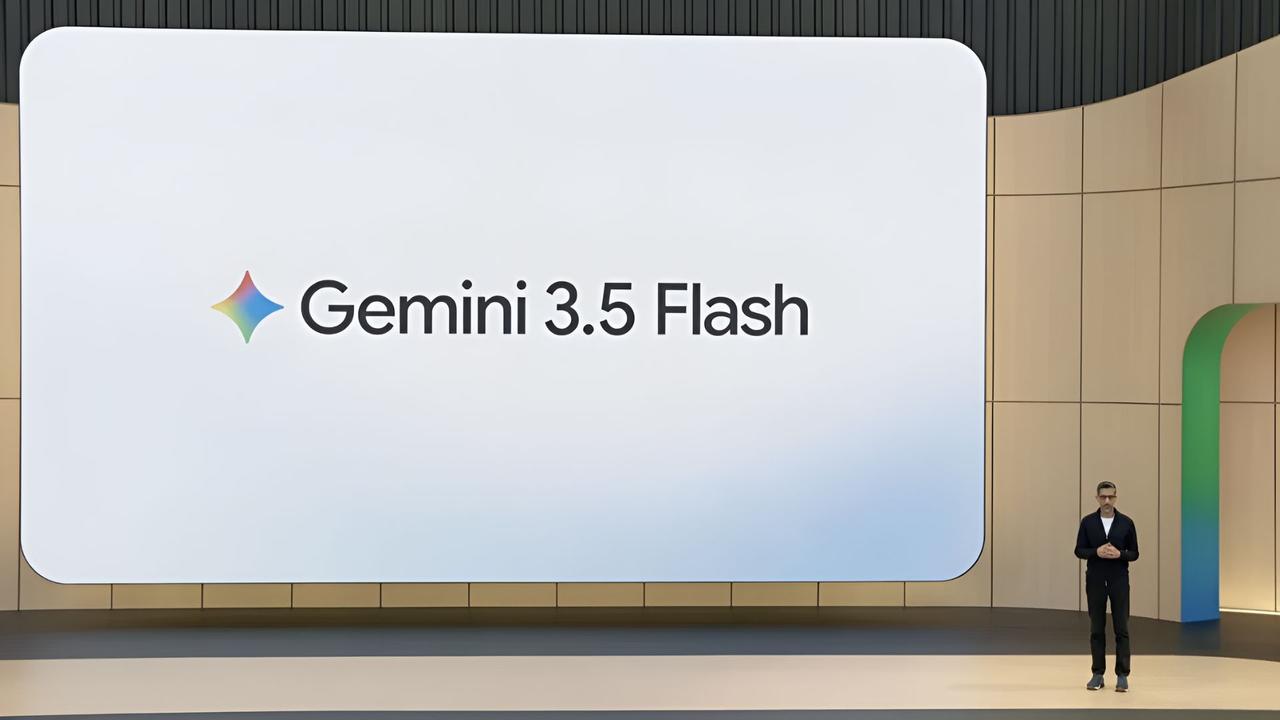
Source: Interesting Engineering
Frontier-Level Performance Meets Cost-Efficiency
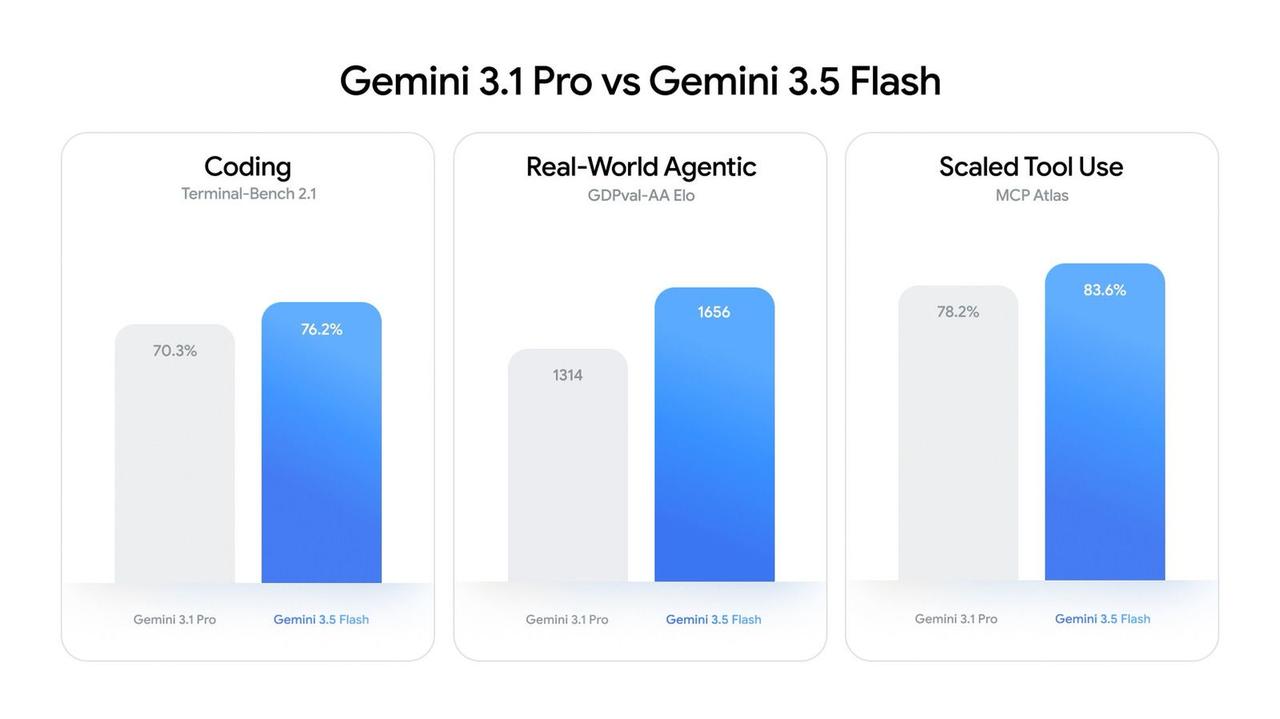
Koray Kavukcuoglu, DeepMind's chief technologist, told reporters that Gemini 3.5 Flash "outperforms our latest frontier model, 3.1 Pro, on nearly all the benchmarks," including coding, agentic tasks, and multimodal reasoning
3
. The AI model is four times faster than other frontier models, with an optimized version reaching 12 times faster speeds while maintaining the same quality. Google CEO Sundar Pichai described it as "an incredible delight to use" and a "game changer" internally at Google, accomplishing tasks at about half the cost of competitor models4
. On coding benchmarks like Terminal Bench and SWE-Bench Pro, Gemini 3.5 Flash substantially outperforms older Flash models and shows measurable improvement versus Gemini 3.1 Pro, with scores comparable to OpenAI's much larger and more expensive GPT 5.51
.
Source: Engadget
Gemini Spark: A 24/7 Personal AI Agent
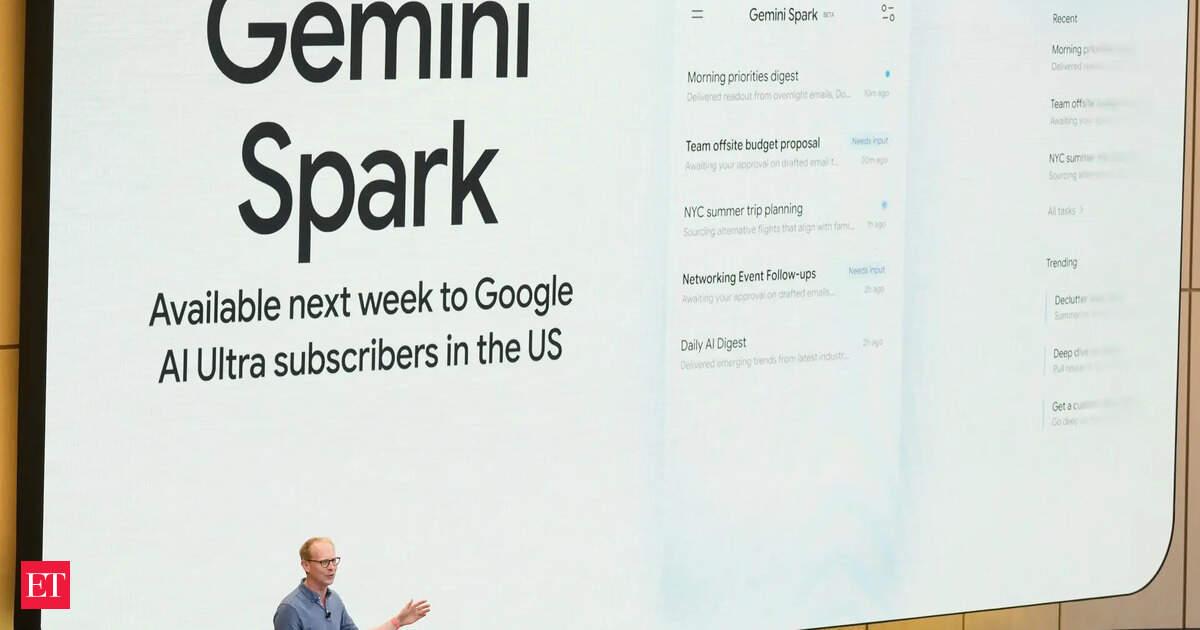
Google introduced Gemini Spark, its first dedicated agent offering that runs continuously in Google's cloud without using device computing resources
2
5
. Powered by Gemini 3.5 Flash, Spark can send emails, scan monthly credit card statements for hidden subscription fees, create summaries of meeting notes, and execute custom workflows across a user's entire Google footprint5
. Josh Woodward, vice president for Google Labs, described the user experience: "When you use it, it almost feels like you're tossing things over your shoulder, Spark's catching them and getting the job done"4
. The agent connects to Workspace apps like Gmail, Docs, and Slides, along with third-party applications including Canva, Instacart, and OpenTable5
. Spark is rolling out to trusted testers this week, followed by a beta launch for US-based Google AI Ultra subscribers next week5
.
Source: ET
Antigravity 2.0 Enables Multi-Agent Development
Google upgraded Antigravity, its integrated development environment, to version 2.0 with support for multiple parallel workflows—essentially sub-agents spawned by Gemini 3.5 Flash
1
. The platform now serves as an agent-first development tool and "a platform to develop and manage teams of autonomous AI agents," according to Kavukcuoglu4
. During the I/O demonstration, Google engineer Varun Mohan showed agents spawning off to work on separate components before coming together to build a full operating system inside Antigravity3
. Kavukcuoglu explained that Flash 3.5 was co-developed with Antigravity so that agents could have a "native environment where they can live, work, and execute"3
. Tulsee Doshi, Google's senior director of product management for Gemini, noted massive internal improvements: "We have a set of internal metrics we've been evaluating that measures how Googlers code, so looking at our own code bases and how well the models perform on that. And you can see a massive, massive jump between where 3.1 Pro was and where 3.5 Flash is"1
.Gemini Omni Brings Multimodal Video Generation
Google announced Gemini Omni, a new AI model that combines Gemini with Google's generative media models to create video outputs grounded in knowledge
2
. Users can upload audio, images, and video to generate consistent, high-quality video from simple prompts like "claymation explainer of protein folding"2
. The first model in the family, Gemini Omni Flash, can create realistic-looking scenes with accurate physics and "reason" about what comes next5
. An Avatars feature allows users to create videos with a digital version of themselves using their own voice5
. Gemini Omni is rolling out to Google Flow and YouTube Shorts for Google AI subscribers, intensifying competition with ChatGPT and Claude in multimodal content generation2
.Related Stories

Redesigned Gemini App with Daily Brief Feature
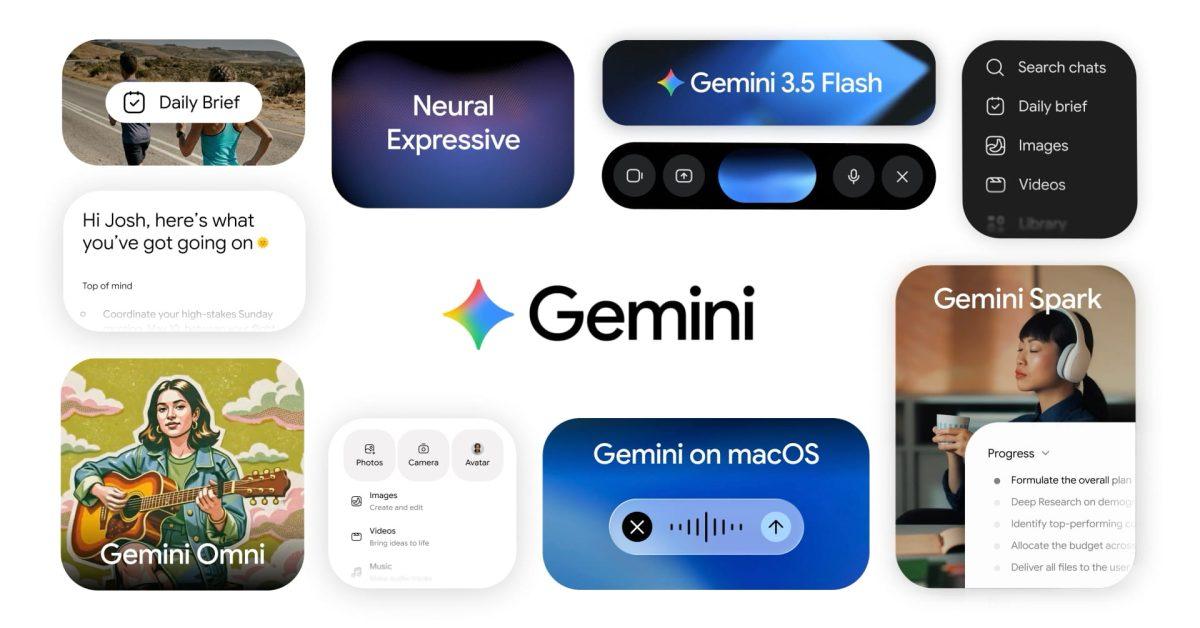
Google rebuilt the Gemini app from the ground up with a new design language called "Neural Expressive," featuring fluid animations, vibrant colors, new typography, and haptic feedback
2
5
. Responses no longer appear as walls of text—key information now appears in bold at the top, with additional text, images, and timelines appearing as users scroll down2
. The visual redesign aims to transform Gemini into an AI hub rather than a stand-alone chatbot, directly competing with ChatGPT and Claude2
. The new Daily Brief feature provides a personalized digest pulling information from users' inboxes, calendars, and tasks, organizing them into a clear overview that prioritizes tasks and suggests next steps2
5
. Daily Brief rolled out Tuesday to Google AI subscribers in the United States2
.
Source: 9to5Google
Implications for Enterprise and Consumer Markets
Gemini 3.5 Flash is now the default model in the Gemini app and in AI Mode in Search globally, available through Antigravity, the Gemini API, and Gemini Enterprise
3
. The Gemini app already reaches more than 900 million monthly users across over 230 countries and in more than 70 languages2
. Google says 3.5 Flash's agentic capabilities are already creating impact among partners, with banks and fintechs automating multi-week workflows and data science teams finding insights in complex data environments3
. The AI model can run autonomously for multiple hours, though it pauses to ask for user input when it hits decision points or permission issues requiring human judgment3
. When Google releases Gemini 3.5 Pro next month, the two models are designed to work in tandem, with Pro serving as orchestrator and planner while leveraging Flash as various sub-agents for workflow automation and background tasks3
. This orchestration approach could define how enterprises deploy AI at scale, making the distinction between reasoning-heavy tasks and execution-focused work more explicit. For consumers, the shift toward always-on agents raises questions about privacy, data access, and the user experience of delegating complex personal tasks to AI systems that operate independently across multiple platforms.References
Summarized by

Navi
[1]
[3]
[5]
Related Stories
Google Teases Exciting Updates for Gemini Advanced: Video Generation, AI Agents, and More
13 Feb 2025•Technology

Google Launches Production-Ready Gemini 2.5 AI Models, Challenging OpenAI's Enterprise Dominance
18 Jun 2025•Technology
Google expands Gemini 3 and Nano Banana Pro to 120 countries with seamless AI Mode integration
01 Dec 2025•Technology
Recent Highlights
1
Meta Unveils Muse Wonder Frontier AI Models, Claims Performance Matching OpenAI and Anthropic
Technology

2
Microsoft and Nvidia Launch Surface Laptop Ultra: A $2,599 AI-Ready PC With RTX Spark Chip
Technology

3
Scientists Build AI Model That Reconstructs Images From Brain Scans in Record Time
Science and Research

Recent Highlights
Today's Top Stories






Don’t drown in AI news. We cut through the noise - filtering, ranking and summarizing the most important AI news, breakthroughs and research daily. Follow topics that matter to you and stay ahead.


