India Leads Workplace AI Adoption as 38% of Pilots Fail Due to Lack of Business Context

3 Sources
[1]
India Leads Global Workplace AI Adoption as Demand for Contextual AI Rises
Workers in India are 45% more likely than the global average to say AI is part of their core workflow -- while unsuccessful pilots reveal the need for trusted, contextual, and personalized AI agents Salesforce today released the India findings from its Agentic Workplace Study, a double-blind
[2]
Workday Study: Indian Workers Are AI-Ready, but Outdated Enterprise Workflows Lag Behind
Nearly all Indian employees report a positive day-to-day work experience, yet only 32% say AI is embedded into their organisation's core systems Workday, Inc. today released The copy/paste economy: Why task-oriented AI is failing the enterprise in India, a new research report that reveals a
[3]
India Leads in Workplace AI Adoption as Workers Push for More Trusted, Contextual AI Experiences
Workers in India are 45% more likely than the global average to say AI is part of their core workflow -- while unsuccessful pilots reveal the need for trusted, contextual, and personalized AI agents Salesforce today released the India findings from its Agentic Workplace Study, a double-blind
Share
Copy Link
India tops global workplace AI adoption with workers 45% more likely to use AI in core workflows than the global average. But the country also reports the highest rate of unsuccessful AI pilots at 38%, revealing a critical gap between employee readiness and how organizations deploy enterprise AI.
Indian Workers Lead Global Workplace AI Adoption
India has emerged as the global leader in workplace AI adoption, with Indian workers 45% more likely than the global average to integrate AI into their core workflows
1
3
. This marks the highest share across all surveyed markets, according to Salesforce's Agentic Workplace Study conducted in partnership with YouGov between December 2025 and January 2026. The double-blind survey included over 1,500 desk workers across 13 countries, with 120 respondents from India1
.While 89% of Indian workers report that AI has improved their day-to-day work experience, only 32% say AI is embedded into their organization's core systems where work actually happens
2
. This disconnect highlights a critical challenge: enterprise AI tools remain siloed rather than integrated into the workflows that define how employees complete their tasks.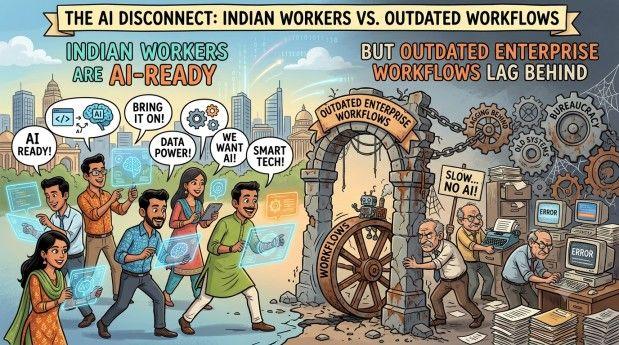
Source: CXOToday
Unsuccessful AI Pilots Expose Limits of Generic Solutions
Despite leading in AI adoption in India, the country also reports the highest incidence of unsuccessful AI pilots globally. 38% of Indian workers say their organization experienced an unsuccessful AI pilot in the last year, compared with 28% globally
1
3
. The data suggests that Indian workers aren't rejecting AI itself—they're rejecting generic AI that fails to deliver meaningful value.The lack of business context emerged as the primary reason unsuccessful AI pilots fall short. Among Indian workers whose AI tools or pilots didn't work out, 34% cited results that lacked business context, significantly higher than the global average of 22%
1
. Other top reasons for failure include limited ability to personalize AI to specific roles or tasks at 31%, generic outputs at 31%, insufficient training at 29%, and too many different tools at 28%3
.Workers Demand Trusted Contextual and Personalized AI
Skepticism remains high among Indian workers despite their active use of AI. 49% of Indian workers consider themselves AI skeptics, compared with 37% globally
1
. This elevated skepticism indicates that greater exposure to AI is creating higher expectations for relevance, trust, and usability. Workers want contextual AI that understands their business, supports their specific role, and integrates seamlessly into existing workflows.Nearly all employees—95%—say AI increases their confidence in decision-making when they trust the underlying systems and data
2
. This finding underscores the importance of embedding AI into core workflows rather than deploying standalone tools that add complexity.
Source: CXOToday
Related Stories

Disconnected Systems Drain Productivity
Research from Workday reveals that more than one-third of Indian employees lose over seven hours each week moving information between disconnected systems
2
. Additionally, 56% devote at least half of their effort to coordinating across systems and teams instead of creating value for their organizations. While AI helps employees complete individual tasks more efficiently, these disconnected systems and workflows continue to limit the value organizations can realize from enterprise AI.Despite these operational challenges, nearly all Indian employees report a positive day-to-day work experience. More than nine in ten say they make meaningful progress, feel a strong sense of ownership over their work, and understand how their contributions support broader organizational goals
2
.The Path Forward for Enterprise-Ready Agents
Deep Chacko, VP of Solution Engineering at Salesforce, emphasized that India's AI story is now about execution. "The workforce is experiencing AI in the flow of work, and that experience is creating a more mature expectation from technology—AI that understands their business, supports their role, and helps them make decisions with confidence," he said
1
.Sunil Jose, President of Workday India, noted that the next phase of enterprise AI depends on how effectively organizations integrate AI into the way work gets done. "As long as employees continue to navigate disconnected systems and workflows, organizations will only realize a fraction of AI's potential," he stated
2
.Organizations that invest in secure, trusted, and enterprise-ready AI agents, connect them to relevant business data through proper data integration, personalize them for role-specific AI applications, and provide adequate employee training will be better positioned to turn experimentation into measurable workforce impact
1
. The opportunity lies in helping AI graduate from a promising tool to a trusted partner that defines how India competes, innovates, and grows in the global economy.References
Summarized by

Navi
[2]
Related Stories
India Leads Global AI Adoption: 79% of Companies to Increase AI Spending in 2025
17 Dec 2024•Business and Economy

Indian Knowledge Workers Lead in Advanced AI Usage, Boosting Productivity
20 Nov 2024•Technology

AI adoption accelerates in India but workforce readiness drops 12%, reveals Kyndryl study
07 Jul 2026•Business and Economy

Recent Highlights



Recent Highlights
Today's Top Stories







Don’t drown in AI news. We cut through the noise - filtering, ranking and summarizing the most important AI news, breakthroughs and research daily. Follow topics that matter to you and stay ahead.


