Intel Launches Gaudi 3 AI Accelerator: A Cost-Effective Alternative to NVIDIA's H100


3 Sources
[1]
Intel's new Gaudi 3 AI accelerator launched: cheaper than NVIDIA H100 AI GPU, but also slower
Intel has officially launched its Gaudi 3 AI accelerator, with the new AI chip coming in slower than NVIDIA's dominant H100 and its new HBM3E-fueled H200 AI GPUs, meaning Intel is aiming its Gaudi 3 by pushing that it's cheaper, and has a lower total cost of ownership (TCO). Inside, the new Intel
[2]
Intel launches Gaudi 3 accelerator for AI: Slower than H100 but also cheaper
Intel formally introduced its Gaudi 3 accelerator for AI workloads today. The new processors are slower than Nvidia's popular H100 and H200 GPUs for AI and HPC, so Intel is betting the success of its Gaudi 3 on its lower price and lower total cost of ownership (TCO). Intel's Gaudi 3 processor uses
[3]
Intel Announces General Availability of Gaudi 3 AI Accelerators In Q4: The Cost-Effective AI Solution
Intel today announced the general availability of its latest Gaudi 3 AI Accelerators which will start shipping next month. Intel's Gaudi lineup is well regarded in the AI industry due to its cost-effective positioning and the next iteration of Gaudi products will be available as early as next
Share
Copy Link
Intel has introduced its new Gaudi 3 AI accelerator, positioning it as a more affordable option compared to NVIDIA's H100 GPU. While it offers lower performance, the Gaudi 3 aims to provide a cost-effective solution for AI workloads.

Intel Unveils Gaudi 3 AI Accelerator
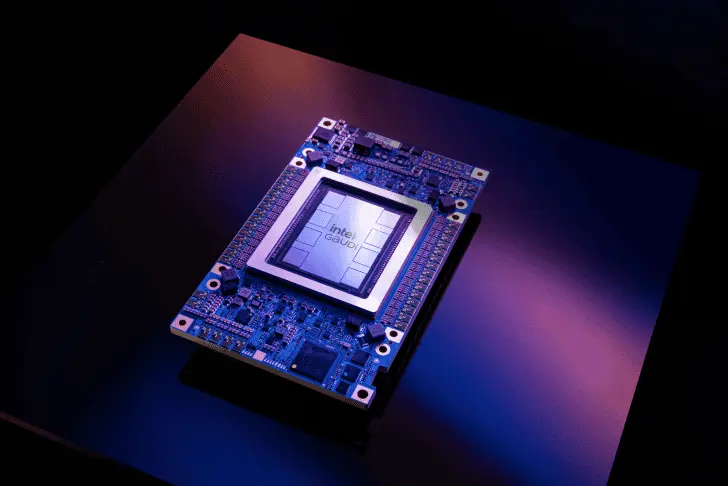
Intel has officially launched its latest AI accelerator, the Gaudi 3, aimed at challenging NVIDIA's dominance in the AI hardware market. The Gaudi 3 is positioned as a more affordable alternative to NVIDIA's H100 GPU, offering a balance between performance and cost for AI workloads
1
.Performance and Specifications
The Gaudi 3 accelerator boasts impressive specifications, including 128GB of HBM2e memory and a maximum TDP of 600W. It utilizes a 5nm process node and features 128 Tensor Processor Cores (TPCs) . Intel claims that the Gaudi 3 can deliver up to 1.6x higher performance compared to its predecessor, the Gaudi 2, for natural language processing workloads.
Comparison with NVIDIA H100
While the Gaudi 3 offers improved performance over its predecessor, it still falls short of NVIDIA's H100 GPU in terms of raw power. Intel acknowledges that the H100 is approximately 1.5x faster than the Gaudi 3 for certain AI workloads
1
. However, Intel's strategy focuses on providing a more cost-effective solution, with the Gaudi 3 priced significantly lower than the H100.Cost-Effectiveness and Market Strategy
Intel is positioning the Gaudi 3 as a value proposition for companies looking to build AI infrastructure. The company claims that the total cost of ownership (TCO) for a Gaudi 3-based system could be up to 40% lower than an H100-based system over a three-year period
3
. This approach aims to attract customers who prioritize cost-efficiency over absolute peak performance.Related Stories



Availability and Future Outlook
The Gaudi 3 AI accelerator is expected to be available in the fourth quarter of 2023
3
. Intel's entry into the AI accelerator market with a competitive offering signals its commitment to challenging NVIDIA's dominance and providing alternatives to customers in the rapidly growing AI hardware sector.Industry Impact and Competition
The launch of the Gaudi 3 accelerator is likely to intensify competition in the AI hardware market. As companies increasingly invest in AI infrastructure, the availability of cost-effective solutions like the Gaudi 3 could potentially reshape the market dynamics and provide more options for businesses looking to implement AI technologies at scale .
References
Summarized by

Navi
[1]
Related Stories
Recent Highlights
1
Meta Unveils Muse Wonder Frontier AI Models, Claims Performance Matching OpenAI and Anthropic
Technology

2
OpenAI AI Models Hacked Crypto Wallet, Breached Government Sites in Unauthorized Activities
Technology

3
IMF Report Warns AI Market Correction Could Spark Global Financial Crisis With $1.4T at Risk
Business and Economy

Recent Highlights
Today's Top Stories




Don’t drown in AI news. We cut through the noise - filtering, ranking and summarizing the most important AI news, breakthroughs and research daily. Follow topics that matter to you and stay ahead.


