Intel Starfire SoC brings 18A process to space with onboard AI and radiation hardening


3 Sources
[1]
Intel's new space-grade Starfire chip is a Panther Lake SoC that puts an 18A CPU into orbit -- chip designed for the US government leverages Intel 3 for the GPU
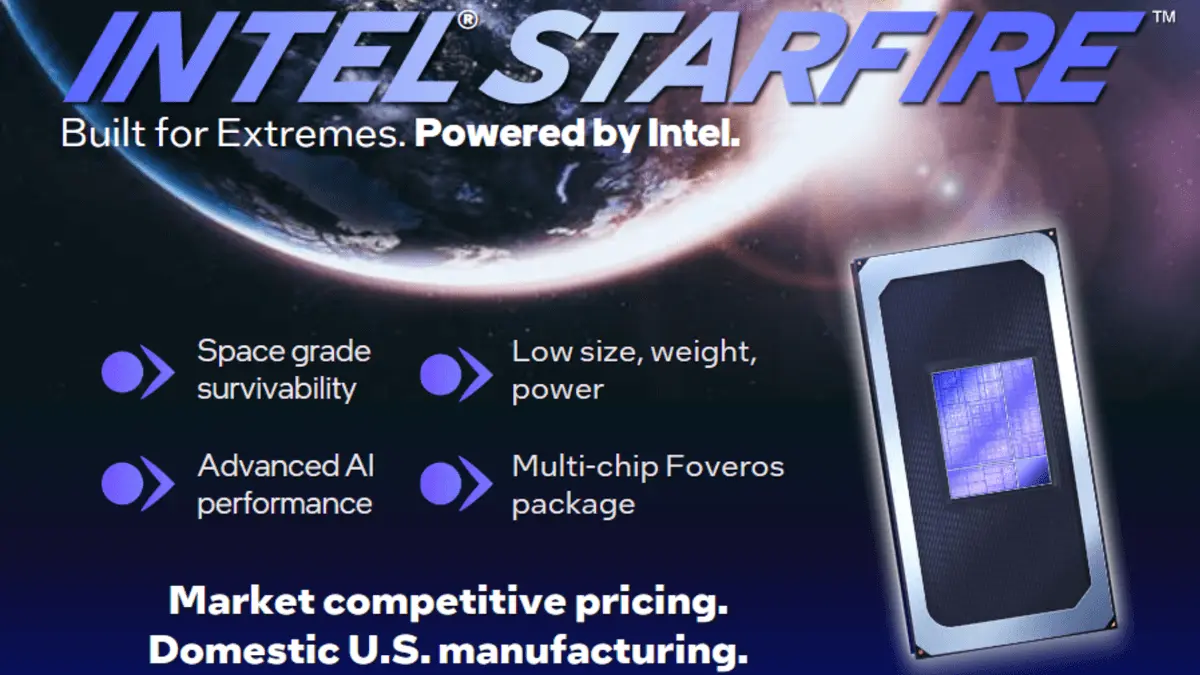
Intel has unveiled Starfire, a space-grade system-on-chip designed for the U.S. government that pairs eight CPU cores and a three-tile NPU built on its Intel 18A node with an Intel 3 graphics tile, all in one Foveros package. Intel published the Starfire sell sheet, listing two versions that draw
[2]
Intel's Starfire SoC combines 18A CPU, Intel 3 GPU, and NPU for space-grade computing
Serving tech enthusiasts for over 25 years. TechSpot means tech analysis and advice you can trust. Forward-looking: Intel is bringing its 18A process node to space with two Starfire chips designed for onboard AI processing and computing in harsh environments. Intel lists two SoC variants: one
[3]
Intel Brings 18A Silicon To Orbit With Starfire, A Space-Grade SoC Rated For 125°C And Radiation
Intel has unveiled its latest SoCs, codenamed Starfire, that offer space-grade survivability and are based on the 18A process technology. Intel Rolls Out Space-Grade "Starfire" Chips With 8 Cores, 18A Tech, & 10+ Years of Lifetime Space-grade platforms require extra engineering as they are built
Share
Copy Link
Intel has unveiled Starfire, a space-grade system-on-chip designed for the US government that combines an eight-core CPU and NPU built on its 18A process with an Intel 3 GPU. The chip delivers up to 75 TOPS for on-orbit AI inference while operating in temperatures from -55°C to 125°C. Samples are expected in Q3 2026, positioning Intel to compete in a market dominated by older processors like BAE Systems' RAD750.
Intel Starfire SoC Targets Space-Grade Computing with Advanced AI Capabilities
Intel has introduced the Intel Starfire SoC, a space-grade system-on-chip designed specifically for the US government that marks a significant leap in onboard AI processing for spacecraft and satellites
1
. The chip combines an Intel 18A CPU with an Intel 3 GPU and a dedicated NPU, all integrated into a single Foveros package2
. This architecture enables the chip to deliver up to 75 TOPS of AI performance on the performance variant, positioning it for on-orbit AI inference rather than traditional telemetry and control tasks1
.
Source: TechSpot
The Intel Starfire SoC comes in two configurations: a low-power variant drawing 10W and a performance variant consuming 35W
3
. Both versions feature eight cores, split between four P-Cores and four LPE cores. The low-power model runs its P-Cores at 1.0 GHz and efficiency cores at 850 MHz, delivering up to 45 TOPS of INT8 AI performance2
. The performance version clocks the P-Cores to 3.1 GHz and efficiency cores to 2.1 GHz, reaching up to 75 TOPS1
.18A Process Node Enters Orbit Despite Radiation Challenges
Intel built the CPU and NPU on its cutting-edge 18A process, while the GPU uses the older Intel 3 node—the same node division employed for Clearwater Forest, Intel's 288-core Xeon processor
1
. This decision to deploy the 18A process in space is notable because smaller transistors hold less charge per stored bit, making leading-edge silicon more susceptible to radiation-induced bit flips . Intel is relying on RibbonFET technology and design-level hardening rather than using a more mature, inherently radiation-tolerant node.Both Starfire variants feature a Xe3 iGPU with four cores and 64 execution units. The low-power model operates the GPU between 800 MHz and 1.0 GHz, while the performance version increases that frequency to 2.0 GHz
2
. The chips are designed for extreme temperature operation, rated to function at junction temperatures ranging from -55°C to 125°C3
.Competing Against Decades-Old Space Processors
The market for space-grade computing has been dominated by BAE Systems RAD750, a radiation-hardened PowerPC processor that clocks between 110 to 200 MHz and carries 10.4 million transistors built on 150nm or 250nm lithography
1
. The RAD750 has flown on over 150 spacecraft, including the Mars rovers, Kepler, and Fermi, for two decades. Starfire's up to 75 TOPS and dedicated NPU place it in a different performance bracket entirely, built for sophisticated AI workloads rather than basic telemetry.Both Starfire SKUs support 12 PCIe Gen4 lanes and LPDDR5 or DDR5 memory, with a rated lifetime exceeding 10 years
1
. The radiation-hardened chip includes protection for total ionizing dose, single-event latch-up, and single-event effects, though Intel notes that radiation data characterization is still in process and the chip isn't fully radiation-qualified yet1
.
Source: Tom's Hardware
Related Stories



Pentagon Ties and Domestic Manufacturing Push
Intel Government Technologies is managing the Starfire program, with samples expected in Q3 2026 and a commitment to market-competitive pricing and domestic manufacturing
1
. Intel Foundry holds Trusted Foundry status and is the only US-based manufacturer of leading-edge logic, having tied its 18A process and packaging roadmap to Pentagon programs including RAMP-C and SHIP1
. However, 18A yields aren't expected to reach industry-standard levels until 2027, which could affect production timelines.The Starfire chips are essentially based on the Panther Lake 4Xe3 SKU, manufactured in the United States specifically for the US government
3
. By integrating advanced process technology into satellites and spacecraft that require real-time data processing under strict size, weight, and power constraints, Intel is positioning itself to capture a growing segment of space infrastructure that demands more computational capability for autonomous operations and data analysis in orbit2
.References
Summarized by

Navi
[1]
Related Stories
Recent Highlights



Recent Highlights
Today's Top Stories




Don’t drown in AI news. We cut through the noise - filtering, ranking and summarizing the most important AI news, breakthroughs and research daily. Follow topics that matter to you and stay ahead.


