Kioxia Reports 45-Fold Profit Surge Driven by AI Demand for NAND Flash Memory


3 Sources
[1]
Chipmaker Kioxia reports AI-driven 45-fold surge in quarterly net profit
Tokyo (AFP) - Ferocious AI-driven demand delivered quarterly net profit more than 45 times higher than last year's figure for Japanese chipmaker Kioxia, the company said Friday. The global race to build artificial intelligence data centres has turbocharged business for chipmakers -- sending prices
[2]
Kioxia's outlook miss clouds optimism about memory chip boom
Kioxia Holdings issued a disappointing earnings outlook after results missed expectations, a sign that an unprecedented AI-driven surge in flash memory prices may be moderating. The Japanese chip leader on Friday forecast operating income of ¥3.16 trillion ($19.7 billion) for its fiscal half-year,
[3]
Kioxia surges 8% despite a consensus miss, AI drives profits
The former Toshiba Memory, one of Japan's major makers of flash memory and SSDs, posted Q1 revenue of 1,767bn yen, up 76% sequentially and up over 400% y-o-y. The showing was still 2.9% below the consensus of 1,820bn yen, while adjusted EPS of 1,621.81 yen also fell short of expectations by about
Share
Copy Link
Japanese chipmaker Kioxia posted a staggering 45-fold increase in quarterly net profit to $5.3 billion, driven by AI-driven demand for NAND flash memory chips. Despite missing analyst estimates, the company announced an $800 billion buyback and 3-for-1 stock split while navigating intense competition from Samsung Electronics and SK hynix.
Kioxia Posts Record Quarterly Net Profit on NAND Flash Memory Demand
Japanese chipmaker Kioxia reported quarterly net profit of 842.2 billion yen ($5.3 billion) for the April-June period, representing a 45-fold surge from 18.3 billion yen in the same quarter last year
1
. The former Toshiba Memory unit posted Q1 revenue of 1,767 billion yen, up 76% sequentially and over 400% year-over-year, though falling 2.9% below consensus estimates of 1,820 billion yen3
. Operating income reached 1,270 billion yen, a roughly 2,700% increase year-over-year, lifting the operating margin to nearly 72%3
. The AI-driven surge in memory chip demand has turbocharged business for the company, which specializes in NAND flash chips increasingly vital for AI-focused data centers.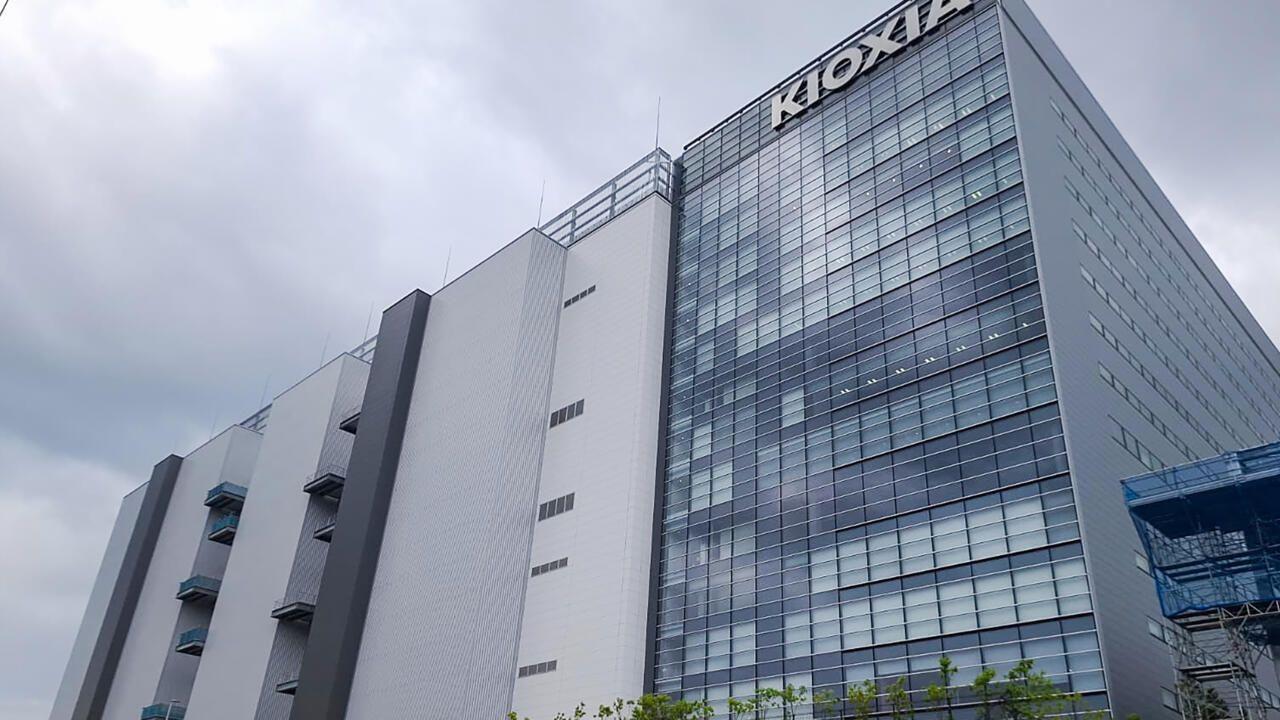
Source: France 24
AI Agents Drive Storage Requirements Higher
The global race to build artificial intelligence data centers has sent prices soaring for memory components, particularly NAND flash memory
1
. AI agents—tools that carry out real-life tasks for users—require ever-more storage space, making Kioxia's NAND flash chips an increasingly hot commodity1
. SSD & Storage revenue nearly doubled sequentially to 1,175 billion yen, driven by higher selling prices fueled by strong demand from AI-focused data centers3
. The memory chip boom has transformed Kioxia's business trajectory, with the company briefly becoming Japan's most valuable company in June1
.
Source: Market Screener
Disappointing Outlook Raises Concerns About Sustainability
Despite the impressive results, Kioxia issued a disappointing earnings outlook that clouded optimism about the memory chip boom. The company forecast operating income of 3.16 trillion yen ($19.7 billion) for its fiscal half-year, translating into a weaker-than-anticipated 1.89 trillion yen projection for the current quarter
2
. For the September quarter, Kioxia is targeting 2,390 billion yen in revenue, another 35% sequential increase3
. However, the underwhelming guidance added to concerns raised by Murata Manufacturing President Norio Nakajima, who warned that the current pace of spending by U.S. hyperscalers won't last due to increasing competition and debt levels2
.Strategic Moves to Stabilize Stock Volatility
Kioxia announced a 3-for-1 stock split and a buyback of up to 800 billion yen to broaden its shareholder base and reduce stock volatility
2
. The company's shares have experienced wild fluctuations, losing more than half their value over the past month despite being up nearly 1,500% over the past year1
. Tomoichiro Kubota, chief market analyst at Matsui Securities, noted that while the size of the share buyback is exceptionally large for a Japanese company, it remains unclear whether it will offset the earnings miss2
.Related Stories

Competition Intensifies with Samsung Electronics and SK hynix
Kioxia faces mounting pressure from Samsung Electronics and SK hynix, leading players in advanced memory chips including HBM, which are also in huge demand thanks to AI-driven demand
1
. Both South Korean competitors posted significant profit jumps this week, with SK hynix surging 30% on Friday following its Wall Street debut after one of the world's largest stock sales1
. Samsung Electronics and SK hynix are expected to introduce next-generation NAND chips next year, challenging Kioxia to catch up in production volume2
. Akira Minamikawa, an analyst at Omdia, emphasized that Kioxia must work harder to attract U.S. hyperscalers, which maintain stronger ties with South Korean suppliers and now seek multiyear supply contracts2
.Cautious Capacity Expansion Strategy Risks Market-Share Losses
Kioxia is proceeding cautiously with capacity expansion, planning to increase production only slightly faster than industry growth to avoid flooding the market
2
. The company reaffirmed its goal of covering about 50% of its expected 2028 volumes through long-term contracts with key customers, while forecasting that NAND demand will still exceed supply in 20273
. However, this conservative approach risks market-share losses to larger, deeper-pocketed rivals2
. TrendForce expects a looser NAND market in the second half of 2027 as new capacity comes online and consumer demand remains fragile3
. Watch for how Kioxia balances securing long-term contracts while maintaining competitive pricing and production capabilities against Samsung and SK hynix in the evolving AI infrastructure landscape.References
Summarized by

Navi
[2]
[3]
Related Stories
Kioxia's $250 billion comeback: AI boom drives next-gen memory mass production in Japan
03 Jul 2026•Technology
Kioxia names new CEO to capture AI storage growth while rivals chase high-bandwidth memory
30 Jan 2026•Business and Economy

Kioxia Forecasts 2.7x Growth in NAND Memory Demand by 2028, Driven by AI Boom
05 Nov 2024•Business and Economy

Recent Highlights



Recent Highlights
Today's Top Stories






Don’t drown in AI news. We cut through the noise - filtering, ranking and summarizing the most important AI news, breakthroughs and research daily. Follow topics that matter to you and stay ahead.


