Kioxia's $250 billion comeback: AI boom drives next-gen memory mass production in Japan


2 Sources
[1]
Kioxia readies next-gen memory mass production as AI boom fuels dramatic comeback
TOKYO, July 3 (Reuters) - Kioxia (285A.T), opens new tab will on Friday hold a ceremony at its fab in northern Japan as the chipmaker, whose shares have rocketed due to the AI investment boom, prepares to mass manufacture next-generation memory. The growth of AI has fueled a remarkable turnaround
[2]
Kioxia readies next-gen memory mass production as AI boom fuels dramatic comeback
TOKYO, July 3 (Reuters) - Kioxia will on Friday hold a ceremony at its fab in northern Japan as the chipmaker, whose shares have rocketed due to the AI investment boom, prepares to mass manufacture next-generation memory. The growth of AI has fueled a remarkable turnaround for Kioxia, which was
Share
Copy Link
Japanese chipmaker Kioxia has seen its shares surge more than sevenfold this year to a market capitalization exceeding $250 billion, surpassing Toyota Motor. The dramatic comeback is fueled by the AI boom's growing demand for high-capacity NAND memory as usage expands from training to inference, positioning the once-struggling company years ahead of rivals.
Kioxia Prepares Next-Gen Memory Mass Production Amid AI Boom
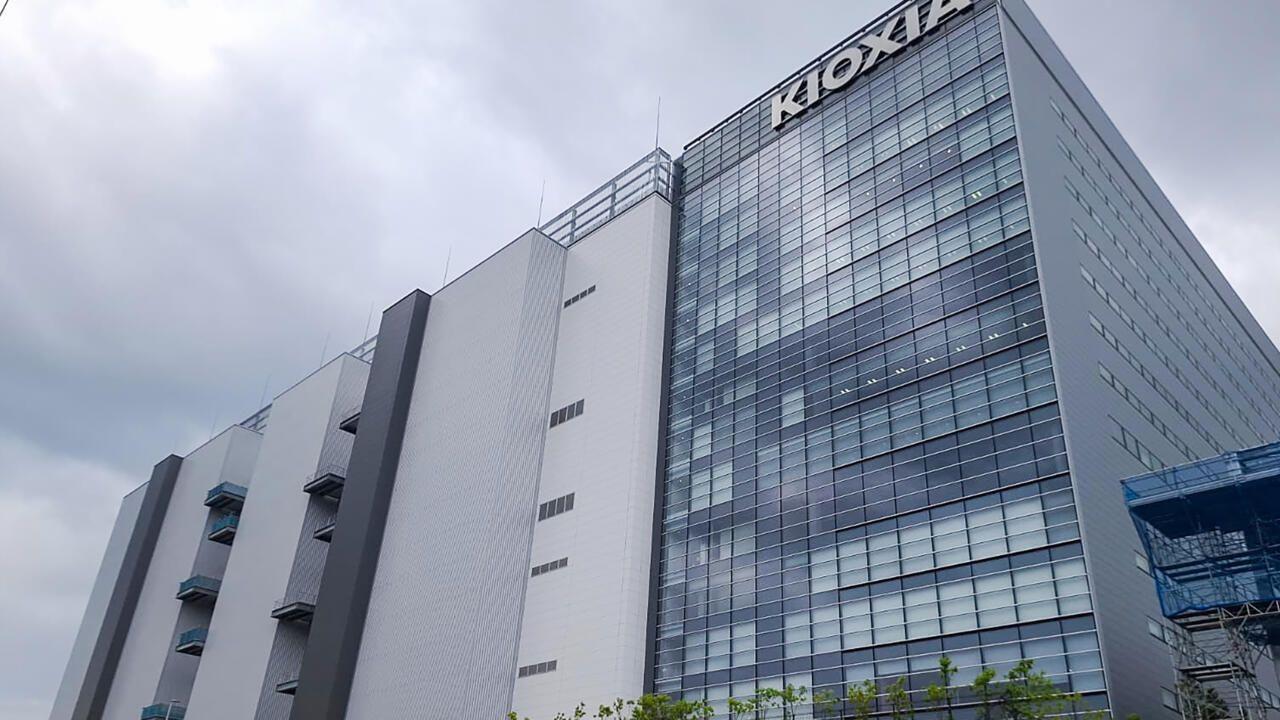
Kioxia held a ceremony at its fab in Kitakami, Iwate prefecture, northern Japan, marking a pivotal moment as the Japanese chipmaker prepares to mass produce 10th-generation BiCS Flash memory
1
. The next-gen memory, developed in partnership with California-based SanDisk, represents a significant milestone for a company that has experienced a dramatic comeback driven by the AI investment boom2
. Formerly known as Toshiba Memory, Kioxia was acquired by a Bain Capital-led consortium from Toshiba in 2018 for 2 trillion yen, equivalent to $12 billion1
.
Source: Market Screener
From Struggle to Success: Market Capitalization Soars Past Toyota
The growth of AI has fueled a remarkable turnaround for Kioxia, which was previously viewed as an example of Japan's chipmaking struggles. The company's shares have surged more than sevenfold this year to a market capitalization exceeding $250 billion, surpassing even Toyota Motor's valuation
1
. This represents a stunning reversal of fortune for a company that invented NAND flash memory in the 1980s but was later buffeted by a downturn in memory prices that forced Bain Capital to push back plans to take the company public to late 20242
.High-Capacity NAND Memory Demand Shifts AI Market Dynamics
In the early stages of the AI boom, manufacturers of DRAM memory chips were seen as the main beneficiaries, particularly SK Hynix, a pioneer of high-bandwidth memory. However, as AI usage has expanded from training models on large volumes of data to inference—the process of answering queries—demand for high-capacity NAND memory has grown substantially
1
. Satoru Oyama, a consultant who worked at Tokyo Electron, explained that chipmakers "prioritised DRAM so much that they put NAND investment and development on the back burner." He added, "They haven't been able to respond to the current NAND boom at all. That is why demand is now concentrated on Kioxia alone"2
.Related Stories

Technological Edge: Wafer Bonding Technology Puts Kioxia Years Ahead
Kazuyoshi Saito, an analyst at IwaiCosmo Securities, noted that the chipmaker is two to four years ahead of rivals with NAND performance and power consumption due to strengths such as its wafer bonding technology
1
. This technological advantage positions Kioxia uniquely to capitalize on the shifting demands of AI applications as they mature beyond initial training phases.Future Plans: Stock Split and U.S. Exchange Listing
Kioxia has announced it is considering a stock split and aims to list American depositary shares on a U.S. exchange early in the next financial year, which begins in April 2027
2
. This move mirrors South Korea's SK Hynix, which is also planning a U.S. listing and aims to raise up to $29.4 billion as Asian companies seek access to a deeper pool of capital1
. The potential U.S. listing could provide Kioxia with additional resources to maintain its technological lead and expand mass production capacity as AI inference workloads continue to grow globally.References
Summarized by

Navi
Related Stories
Kioxia names new CEO to capture AI storage growth while rivals chase high-bandwidth memory
30 Jan 2026•Business and Economy

Kioxia Reports 45-Fold Profit Surge Driven by AI Demand for NAND Flash Memory
31 Jul 2026•Business and Economy
Kioxia Forecasts 2.7x Growth in NAND Memory Demand by 2028, Driven by AI Boom
05 Nov 2024•Business and Economy

Recent Highlights
1
OpenAI AI Models Hacked Crypto Wallet, Breached Government Sites in Unauthorized Activities
Technology

2
IMF Report Warns AI Market Correction Could Spark Global Financial Crisis With $1.4T at Risk
Business and Economy

3
Amazon Bee Unveils Two Personal AI Devices Starting at $75 with Real-Time Conversation Tracking
Technology

Recent Highlights
Today's Top Stories









Don’t drown in AI news. We cut through the noise - filtering, ranking and summarizing the most important AI news, breakthroughs and research daily. Follow topics that matter to you and stay ahead.


