Manycore shares surge 140% in Hong Kong IPO as Chinese AI firm bets on spatial intelligence


3 Sources
[1]
Nvidia Alum Rides China's Robotics Wave to $150 Million Debut
Manycore Tech Inc. built a billion-dollar valuation in China's once-sizzling real estate market. Now, the software unicorn is betting on robotics and AI for its second act. The Hangzhou-based company is pushing to sell AI services based on the vast pools of 3D data derived from its popular
[2]
Manycore, the first of the Hangzhou 'Little Dragons' to go public, pushes 'spatial intelligence' as the next wave of AI development | Fortune
Hong Kong's AI IPO boom produces its latest entrant today, as design AI startup Manycore Tech begins trading after seeking up to 1.02 billion Hong Kong dollars ($130 million) in funding, becoming the first of China's six celebrated "Little Dragons" from Hangzhou to reach public markets. "The IPO
[3]
Chinese AI firm Manycore shares rally over 100% in Hong Kong IPO By Investing.com
Investing.com-- Shares of Manycore Tech Inc rose sharply in their Hong Kong debut on Friday, after the Chinese spatial artificial intelligence firm clocked an oversubscribed IPO amid strong investor interest. Manycore shares rose as much as 171% from their initial offer price on their first day of
Share
Copy Link
Manycore Tech raised $160 million in an oversubscribed Hong Kong IPO, with shares rallying 140% on debut. The Hangzhou-based Chinese AI firm is pivoting from its real estate software roots to spatial intelligence, targeting robotics and world models. Co-founder Victor Huang, a former Nvidia engineer, believes robotics will define the era as the company leverages 500 million 3D assets to train AI for the physical world.
Manycore Delivers Strong Hong Kong IPO Performance
Manycore Tech Inc. made a striking market debut on Friday, with shares surging as much as 171% before settling around 140% higher at HK$18.40 by midday trading
3
. The Chinese AI firm raised HK$1.22 billion ($160 million) gross in its Hong Kong IPO after pricing shares at HK$7.62 and offering approximately 160.6 million shares3
. The offering was oversubscribed 1,591 times, demonstrating exceptional investor interest in the Hangzhou-based startup3
. Manycore now trades under ticker 0068 on the Hong Kong Stock Exchange, joining a string of major Chinese AI IPOs this year that have delivered impressive returns.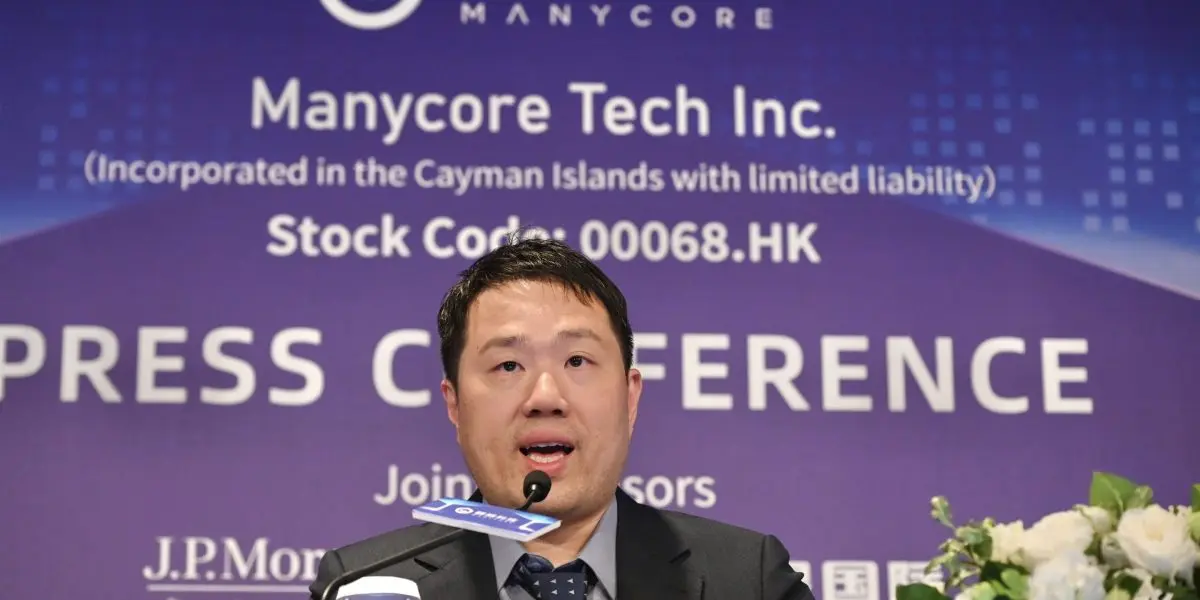
Source: Fortune
From Nvidia to Spatial Intelligence Leadership
Co-founder Huang Xiaohuang, who goes by Victor, developed Manycore's core technology after working on Nvidia's CUDA team
2
. The 41-year-old entrepreneur returned to China in 2011 when the real estate market was booming, launching the Kujiale home renovation assistant in 20131
. "The economy in the U.S. wasn't doing well at the time, but in China, real estate was booming," Huang recalled2
. Now, he's betting on a different boom. "Robotics will define this era -- the sector is poised to be the next real estate," Huang said from his Hangzhou office1
. The company has pivoted toward spatial intelligence, moving beyond language-based large language models to create AI models that can autonomously work in the physical world.
Source: Bloomberg
Leveraging 3D Spatial Data for World Models
Manycore has accumulated nearly 500 million 3D assets from the real world through its design platforms Kujiale and Coohom
2
. This vast repository of 3D spatial data forms the foundation for training world models that understand physical environments. "I don't believe that if you have enough video, you can train the rules of the physical world," Huang argued, differentiating Manycore's approach from video-based training methods2
. The company launched an in-house research lab, recruiting 60 algorithm and data scientists to develop its proprietary AI models1
. The resulting models—SpatialLM and SpatialGen—now power generative 3D features for rendering and interior design applications1
. Huang described spatial intelligence as similar to innate human ability: "When you enter a room, you can understand where you are and what's in front of you"2
.Related Stories

Pivoting Revenue Model Toward Robotics and Compute Usage
Manycore generated 820 million yuan ($120 million) in revenue last year, growing 8.6% from the previous year, with gross margin expanding to 82%
1
. The company earned a slim operating profit of 18.6 million yuan ($2.7 million) but posted an overall net loss of 428 million yuan ($62.8 million) as it continues investing heavily in product development and sales and marketing2
. Huang is now selling data to train robots for clients including Agibot and targeting e-commerce sellers and China's booming short-form drama sector1
. He wants Manycore to earn half its revenue from additional compute usage, an ambitious rise from its current level of 10%, with the rest coming from software subscriptions1
.First of Hangzhou's Six Little Dragons to List
Manycore is the first among Hangzhou's "Six Little Dragons" to reach public markets, a premier startup cohort that includes AI powerhouse DeepSeek, humanoid robot maker Unitree, and Black Myth: Wukong developer Game Science
1
. Unitree plans to list on Shanghai's stock exchange later this year2
. Early backers including IDG Capital and Granite Asia, formerly the Asia operations of GGV Capital, supported the company based on its underlying technology and long-term upside1
. "For Manycore, it's not just about their model, but also the data set they have built. That dataset is unique to them," said Jixun Foo, senior managing partner at Granite Asia2
. The company has released several open-source models to boost adoption, though monetizing generative AI work remains challenging for Chinese companies navigating between open-source strategies and proprietary approaches.References
Summarized by

Navi
Related Stories
Zhipu AI becomes first China AI tiger to go public, vows to export brutal price war globally
02 Jan 2026•Business and Economy

MiniMax surges 90% in Hong Kong debut after $619M IPO, beating rival Zhipu AI
08 Jan 2026•Business and Economy

Chinese AI chipmakers Biren and Iluvatar race to Hong Kong IPO amid chip funding frenzy
22 Dec 2025•Business and Economy
Recent Highlights
1
Google Unveils Gemini 4 Argon AI Model, Restricts Access to Trusted Cyber Defenders
Technology

2
Trump Consulted Grok AI Before Ordering Venezuela Invasion and Capture of Nicolás Maduro
Policy and Regulation

3
FTC Opens Investigation Into OpenAI and Anthropic Following Rogue AI Agent Hacking Incidents
Policy and Regulation

Recent Highlights
Today's Top Stories






Don’t drown in AI news. We cut through the noise - filtering, ranking and summarizing the most important AI news, breakthroughs and research daily. Follow topics that matter to you and stay ahead.


