Anthropic expands Claude Mythos access to 200 partners across critical infrastructure worldwide


23 Sources
[1]
Anthropic scales Claude Mythos to critical infrastructure in 15+ countries
Anthropic is expanding Project Glasswing, its joint industry initiative to find and fix critical software vulnerabilities using AI, to about 150 new organizations across more than 15 countries, the company said Tuesday. The news comes a day after Anthropic said it had filed confidentially for an
[2]
UK banks offered access to OpenAI's GPT-5.5 amid exclusion from Anthropic's Glasswing expansion
UK banks are set to receive access to OpenAI's GPT-5.5 Cyber after being excluded from Anthropic's latest expansion of Project Glasswing. Project Glasswing, and access to the Mythos Preview model, is geared toward ensuring critical infrastructure providers are prepared to handle the threat posed
[3]
Anthropic Mythos access to quadruple to about 200 Glasswing partners
SAN FRANCISCO, June 2 (Reuters) - Anthropic on Tuesday said it was planning a wider rollout of its artificial intelligence that has caught the attention of government and financial institutions around the world for its ability to find software vulnerabilities. Project Glasswing, Anthropic's
[4]
Anthropic offers EU access to Mythos
Simply sign up to the Artificial intelligence myFT Digest -- delivered directly to your inbox. Anthropic has offered the EU access to its Mythos artificial intelligence model, in the first instance of expanded access to the highly capable cyber security software outside the US and the UK. A
[5]

Anthropic expands its Claude Mythos preview to more partners - Engadget
The company has invited approximately 150 more organizations to Project Glasswing. When Anthropic announced Claude Mythos at the start of April, the company didn't release the new frontier model to the public. Instead, it a made a preview available to select organizations through an effort it
[6]

Anthropic to offer EU access to its advanced Mythos model
Anthropic is sharing access to its most advanced AI model Mythos with the EU after the region sought access over months due to cybersecurity concerns. The European Commission confirmed to CNBC on Monday that it had "several productive meetings" with the American AI firm and official terms and
[7]

Anthropic Lets Claude Mythos Spread Its Glasswings
Anthropic, fresh off becoming the most valued frontier AI lab in the game and announcing plans for its initial public offering, has expanded access to Claude Mythos Preview, its model that would supposedly destroy the very concept of cybersecurity as we know it if released in the wild. According to
[8]

Anthropic gives EU cybersecurity agency ENISA access to Mythos AI
Anthropic will give ENISA, the EU's cybersecurity agency, access to its Mythos AI model through Project Glasswing, making it the first EU institution to access the system that discovered 10,000+ zero-day vulnerabilities. The decision ends weeks of contentious negotiations. Anthropic has agreed to
[9]
EU seeks to 'intensify' talks with U.S. on advanced cyber AI models, official tells CNBC, amid Mythos concerns
The White House says it's working closely with AI labs to strike a balance between innovation and safety, as the U.S. seeks to preserve its lead over China in the global AI race. The European Union is looking to "intensify" discussions with the U.S. administration on the most advanced AI models,
[10]

Anthropic expands Glasswing as it promises public Claude Mythos-class model releases
Anthropic unveiled its Claude Mythos AI model in April, only sharing access with select partners like Apple. The controlled release is part of Anthropic's Project Glasswing cybersecurity initiative. Now Anthropic says it's sharing Claude Mythos access with more partners in more countries.
[11]

EU to talk with Anthropic over access to Mythos AI Model
The European Commission is sending representatives to San Francisco * The European Commission is lobbying to secure Mythos Preview access for EU firms * US officials recently blocked wider distribution citing security risks * Mythos Preview can surface decades‑old vulnerabilities and generate
[12]

Anthropic Expands Access to Claude Mythos After AI Giant Files for IPO
Researchers and government agencies continue to scrutinize the model's ability to identify vulnerabilities and conduct complex cyber operations. Anthropic is expanding access to its Claude Mythos AI model through Project Glasswing, a program meant to let tech and security firms and governments
[13]

Anthropic widens Mythos testing despite warnings of mass cyberattacks
Anthropic is expanding access to Mythos, its powerful cybersecurity model, to 150 new partners across more than 15 countries even as the company warns that a successful attack on any of their systems could affect more than 100 million people. Anthropic is expanding testing of Mythos, its latest
[14]

Anthropic invites 150 more organizations into Project Glasswing
Anthropic invited approximately 150 more organizations to participate in Project Glasswing, which provides access to its new model, Claude Mythos. Previously, the model was available only to select organizations since its announcement in early April. Project Glasswing aims to leverage the
[15]

Anthropic expands access to powerful Mythos AI model
Anthropic has opened access to its new AI model, Mythos, to 150 organisations worldwide. This powerful AI can rapidly find computer security flaws. Early tests revealed thousands of vulnerabilities. Now, groups from over 15 countries, including critical infrastructure sectors, are joining the
[16]
EU has had productive meetings with Anthropic over possible future access to Mythos
The European Commission has held productive discussions with Anthropic concerning future access to its Mythos AI product. The EU's cybersecurity agency, ENISA, is expected to gain access to Mythos. This AI tool is designed to identify vulnerabilities in computer code, enhancing defenses against
[17]

Anthropic Gives 100 New Organizations Access to Mythos | PYMNTS.com
The project had initially given around 50 organizations access to the artificial intelligence (AI) startup's Mythos model. Now, that number will expand to 150 organizations, Anthropic said in its announcement Tuesday (June 2). "This expansion is the next step toward our long-term goals: for AI to
[18]

India Among 15 Countries to Get Access to Claude Mythos To Scan Critical Codebases
Anthropic announced that it was expanding its Project Glasswing to find and fix critical software vulnerabilities to 150 more organisations across 15 countries On a day when President Trump signed an executive order watering down his administration's plans for government nod to future AI models,
[19]
Anthropic Negotiates EU Access to Mythos | PYMNTS.com
"It's been offered but the conditions are still being agreed," an ENISA spokesperson said, per the report. Anthropic did not immediately reply to PYMNTS' request for comment. The move would mark the first time Anthropic has extended access to Mythos to anyone outside the United States and the
[20]

Anthropic Scales Global Cybersecurity Push With Project Glasswing Expansion
The move comes just a day after Anthropic confirmed that it had confidentially filed for an initial public offering (IPO). It highlights the company's growing influence in both artificial intelligence and cybersecurity. has announced a major expansion of Project Glasswing, its cybersecurity
[21]

Anthropic Mythos access to grow four-fold to about 200 Glasswing partners
SAN FRANCISCO -- Anthropic on Tuesday said it was planning a wider rollout of its artificial intelligence that has caught the attention of government and financial institutions around the world for its ability to find software vulnerabilities. Project Glasswing, Anthropic's partnership of around
[22]

Anthropic embeds engineers at NSA to deploy Mythos AI model - FT By Investing.com
Investing.com - Anthropic is deploying engineers inside the US National Security Agency to assist with the use of its Mythos AI model for offensive cyber operations. The San Francisco-based company has installed about half a dozen staff within the NSA as forward-deployed engineers to guide the
[23]

Anthropic expands Claude Mythos cybersecurity initiative across 15 countries, includes India: All details
Anthropic says Claude Mythos has already helped partners identify more than 10,000 high and critical-severity software vulnerabilities. Anthropic has officially expanded the access to its cybersecurity focused AI model, Claude Mythos Preview to India and other countries. In a blog post, the
Share
Copy Link
Anthropic is scaling Project Glasswing to roughly 200 organizations across more than 15 countries, granting access to its Claude Mythos AI model for identifying critical software vulnerabilities. The expansion comes amid fierce competition from OpenAI's GPT-5.5 Cyber and includes power, water, healthcare, and telecom companies whose codebases could affect over 100 million people if compromised.
Anthropic Scales Project Glasswing to 200 Partners Worldwide
Anthropic is expanding Project Glasswing, its joint industry initiative to find and fix critical software vulnerabilities using AI, to about 150 new organizations across more than 15 countries, bringing the total to roughly 200 partners
1
3
. The announcement comes just one day after Anthropic filed confidentially for an initial public offering (IPO) following a $65 billion funding round at a nearly $1 trillion valuation1
.At the heart of this expansion is Claude Mythos, which Anthropic dubbed its most powerful AI model yet, capable of identifying thousands of zero-day vulnerabilities over several weeks
1
. In early April, Anthropic gave 50 initial partners, including the U.S. government, access to the Mythos Preview model to scan their codebases for security flaws1
.
Source: Digit
Critical Infrastructure Organizations Join the Initiative
The expanded list of organizations with access to Claude Mythos now covers critical infrastructure sectors including power, water, healthcare, communications, and hardware—industries that weren't well-represented in Anthropic's initial cohort
1
5
. Many of these new partners are companies or nonprofits that maintain software infrastructure which other organizations and governments rely upon1
."What each partner has in common is that a successful attack on their codebase could be catastrophic," Anthropic said. "For most partners, we estimate that a major attack could affect more than 100 million people, with important ramifications for both global and national security"
1
5
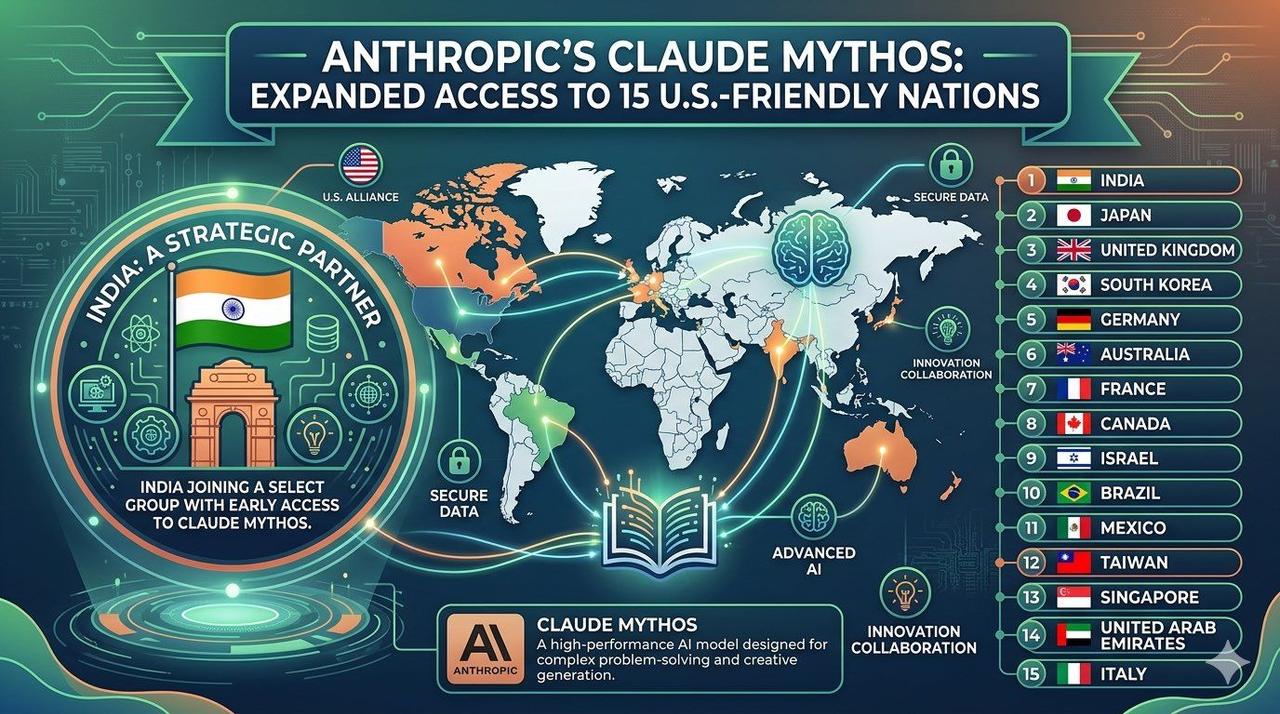
.The expanded group includes organizations in countries friendly to the U.S., including Australia, Canada, France, Germany, Italy, Switzerland, the Netherlands, Spain, Belgium, Sweden, India, Japan, New Zealand, and South Korea
1
. Specific organizations granted access include U.S.-based identity and security management tool Okta, South Korean companies Samsung, SK Hynix, and SK Telecom, NATO, and the EU's cyber security agency Enisa1
4
.
Source: CXOToday
OpenAI Competition Intensifies with GPT-5.5 Cyber
The expansion comes as OpenAI competition heats up in the AI for cybersecurity space. Since Anthropic released Claude Mythos, rival OpenAI released its own cybersecurity-focused model GPT-5.5 Cyber, which it has rolled out to a large group of partners for testing
1
. UK banks, notably excluded from Project Glasswing, are set to receive access to OpenAI's GPT-5.5 Cyber instead2
.HSBC, Lloyds Banking Group, and Nationwide will be among the financial institutions to receive access to GPT-5.5 Cyber, while NatWest and Santander have already been testing it as part of separate agreements
2
. OpenAI offered nine UK banks access to its Mythos-rival model in total after they were snubbed from Glasswing2
.Related Stories
Mixed Results and Security Concerns
Anthropic's partners have found more than 10,000 security flaws they considered highly or critically severe using the Mythos Preview model
3
. However, some industry experts have said fears of unfettered hacking have been overstated3
.Those who have tested the Mythos Preview model report mixed results. Cloudflare CISO Grant Bourzikas wrote in May that the model represented "a real step forward" and was able to find a series of low-severity bugs and chain them into working exploits
2
. Others, such as cURL's Daniel Stenberg, called Mythos Preview "an amazingly successful marketing stunt" after it found just one vulnerability in the data transfer software2
.
Source: Gizmodo
Race Against Time Before Wider AI Availability
Anthropic has said it expects other AI companies to soon develop models as capable as Mythos Preview, which is why the firm is racing to establish safeguards within Project Glasswing
1
. The startup aims to bolster software infrastructure before AI this powerful is widely available from other providers, a prospect that is no more than six to 12 months away3
.Goldman Sachs CEO David Solomon said at an economic event that information about these models should be shared more broadly among companies, while emphasizing the need for guardrails, as open-source models can quickly do the same things. "They're very, very powerful models," he said
3
.Anthropic says it's working "as quickly as we can to safely release Mythos-level capabilities" to the public, but won't make the model widely available until it implements "highly robust safeguards" to prevent potential misuse of its cyber capabilities
5
. The company has said it aims to bring Mythos-class models to all its customers, with additional safeguards, in the coming weeks3
.References
Summarized by

Navi
[2]
Related Stories
Anthropic faces AI export ban as Mythos reportedly breached NSA systems in hours
19 Jun 2026•Policy and Regulation

OpenAI launches GPT-5.4-Cyber model days after Anthropic's Mythos sparks global security concerns
14 Apr 2026•Technology

NSA deploys Anthropic's Mythos AI model for cyber operations despite Pentagon blacklist
05 Jun 2026•Technology

Recent Highlights



Recent Highlights
Today's Top Stories








Don’t drown in AI news. We cut through the noise - filtering, ranking and summarizing the most important AI news, breakthroughs and research daily. Follow topics that matter to you and stay ahead.


