Microsoft Copilot Health launches to store medical records and answer personalized health questions


3 Sources
[1]
I tested Microsoft Copilot Health with my real medical records - here's my verdict
Follow ZDNET: Add us as a preferred source on Google. Do you ever turn to an AI for medical or health advice? We can debate the wisdom of doing so. But one pitfall is that the AI knows little or nothing about you medically. That means it can provide only generic information at best and bad
[2]
Microsoft wants you to share your health symptoms with its new Copilot tool
* Copilot Health lets you upload medical and wearable data for AI-assisted interpretation. * Built with clinicians and 250+ physicians worldwide for safer, evidence-informed guidance. * It nudges you toward care, but always see and follow a human doctor's diagnosis and treatment. Whenever
[3]
Microsoft wants Copilot to answer all your health-related questions and store your medical records
Copilot Health is Microsoft's most personal AI feature yet. It is built with 250 physicians, and explicitly designed not to replace your doctor. Copilot Health is now in preview, and Microsoft's ambition for it is clear, an AI assistant that knows your health history, understands your fitness
Share
Copy Link
Microsoft has launched Copilot Health in preview, an AI health assistant that stores medical records and integrates wearable device data to provide personalized health information. Built with input from over 250 physicians across 24 countries, the service aims to help users interpret test results and find healthcare providers, though it explicitly states it's not a substitute for professional medical advice.
Microsoft Copilot Health Brings Personalized Health Information to AI
Microsoft has unveiled Copilot Health, an AI health assistant that marks the company's most ambitious move yet into personal healthcare technology. Available in preview to US users aged 18 and over with a Microsoft 365 Personal, Family, or Premium subscription, the service allows users to upload medical records from over 50,000 US provider organizations and connect wearable device data for AI-powered assistance
1
3
. The AI-powered assistant aims to address a fundamental limitation of generic health chatbots: the lack of personal medical context that often leads to generic or potentially harmful advice.
Source: XDA-Developers
Users can access Copilot Health through a dedicated space at copilot.microsoft.com/health or via the Copilot mobile app for iOS and Android. The service creates a comprehensive health profile by integrating background information, health goals, and data from sources like Apple Health, with additional wearable integrations planned for the future
3
. Microsoft's consumer products already handle over 50 million health questions daily, making Copilot Health a formalization of behavior already happening at scale3
.Clinical Oversight and Data Privacy and Security Measures
Microsoft developed Copilot Health with significant clinical oversight, working with an internal clinical team and an external panel of over 250 physicians from more than 24 countries who provide clinical guidance, safety feedback, and real-world perspective
2
3
. The service has achieved ISO/IEC 42001 certification, meaning an independent third party verified its development and improvement processes1
.Addressing inevitable data privacy and security concerns, Microsoft states that Copilot Health conversations are not shared with the rest of Copilot and are not used to train AI models. All data is encrypted both at rest and in transit, and users can manage, remove, or disconnect their health data sources at any time
1
3
. The service sources information from thousands of trusted health organizations using principles published by the National Academy of Medicine and through a partnership with Harvard Health1
.How the AI Health Assistant Helps Interpret Test Results and Find Healthcare Providers
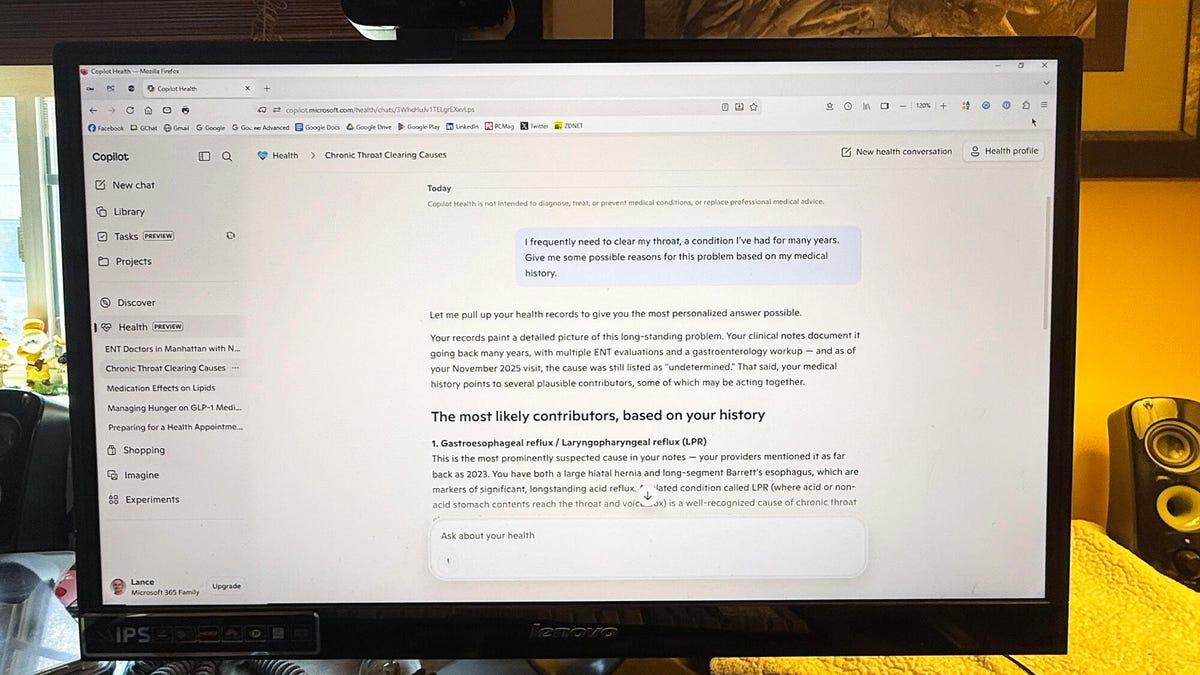
Copilot Health delivers several practical functions beyond answering general health questions. The service can help users interpret test results, such as blood work reports, translating complex medical terminology into understandable insights based on the user's complete health profile
3
. It can also assist in finding healthcare providers based on specialty, preferred language, gender, insurance coverage, and location1
3
.
Source: ZDNet
The AI responds to user queries and then asks follow-up questions to guide users on specific medical matters, creating a more interactive experience than traditional search engines
1
. Microsoft has implemented guardrails to protect against health misinformation, guided by its responsible AI, clinical, safety, engineering, and health product teams1
.Related Stories
Not a Replacement for Professional Medical Advice
Despite its sophisticated capabilities, Microsoft explicitly states that Copilot Health is not intended to diagnose, treat, or prevent diseases or other conditions and is not a substitute for professional medical advice
1
3
. The company acknowledges that features, experiences, and usage limits may change during the preview period as improvements are made1
.The design philosophy behind Copilot Health centers on nudging users toward appropriate care rather than replacing physicians. Users are expected to take the AI's findings to a doctor who can validate any diagnosis and create proper treatment plans
2
. This approach reflects growing awareness that while AI can process vast amounts of medical information, the heavy lifting of actual diagnosis and treatment remains best left to human healthcare providers2
.References
Summarized by

Navi
Related Stories
Microsoft launches Copilot Health to analyze medical records and fitness data with AI
12 Mar 2026•Technology

Microsoft Copilot Unveils Major Upgrades: Voice Interactions, News Summaries, and More
02 Oct 2024

Microsoft Copilot Unveils Major AI Expansion with Secure Sandboxing and No-Code Development Tools
29 Oct 2025•Technology
Recent Highlights



Recent Highlights
Today's Top Stories







Don’t drown in AI news. We cut through the noise - filtering, ranking and summarizing the most important AI news, breakthroughs and research daily. Follow topics that matter to you and stay ahead.


