Europe Deploys AI-Powered Anti-Drone Systems as Russian Incursions Expose NATO Vulnerabilities


6 Sources
[1]
As Russian drone incursions rattle Europe, Poland and Romania deploy a new defensive system
Poland and Romania are deploying a new weapons system to defend against Russian drones, following a spate of incursions into NATO airspace in recent months that exposed the alliance's vulnerabilities and put Europe on edge. The American Merops system, which is small enough to fit in the back of a
[2]
How a European cottage industry is fighting Russian drone incursions
RIGA, Latvia -- In a nondescript factory on the edge of Latvia's capital, a small team is trying to solve a continental-sized problem: How can Europe protect itself from swarms of Russian attack drones? Used on an almost nightly basis in the war in Ukraine, a spate of mysterious drone incursions
[3]
As Russian drone incursions rattle Europe, Poland and Romania deploy a new defensive system
Poland and Romania are deploying a new weapons system to defend against Russian drones, following a spate of incursions into NATO airspace in recent months that exposed the alliance's vulnerabilities and put Europe on edge. The American Merops system, which is small enough to fit in the back of a
[4]
As Russian drone incursions rattle Europe, Poland and Romania deploy a new defensive system
Poland and Romania are deploying a new weapons system to defend against Russian drones, following a spate of incursions into NATO airspace in recent months that exposed the alliance's vulnerabilities and put Europe on edge. The American Merops system, which is small enough to fit in the back of a
[5]

As Russian Drone Incursions Rattle Europe, Poland and Romania Deploy a New Defensive System
Poland and Romania are deploying a new weapons system to defend against Russian drones, following a spate of incursions into NATO airspace in recent months that exposed the alliance's vulnerabilities and put Europe on edge. The American Merops system, which is small enough to fit in the back of a
[6]

This anti-drone technology is used on the Ukrainian battlefield and in NATO airspace after flyovers
AALBORG, Denmark -- In a warehouse more than 1,500 kilometers (900 miles) from Ukraine's capital, workers in northern Denmark painstakingly piece together anti-drone devices. Some of the devices will be exported to Kyiv in the hopes of jamming Russian technology on the battlefield, while others
Share
Copy Link
NATO allies Poland, Romania, and Denmark are deploying the AI-powered Merops anti-drone system following Russian drone incursions into European airspace. The compact, truck-mounted system uses artificial intelligence to detect and neutralize hostile drones cost-effectively.

NATO's Response to Growing Drone Threats
Poland and Romania are deploying the American-made Merops anti-drone system following a series of Russian drone incursions that have exposed critical vulnerabilities in NATO's air defense capabilities
1
. The compact system, small enough to fit in a midsized pickup truck, represents a significant shift in how the alliance approaches drone warfare along its eastern flank.The deployment comes after approximately 20 Russian drones violated Polish airspace in early September, forcing NATO to scramble multimillion-dollar fighter jets to intercept drones costing only tens of thousands of dollars
3
. Similar incidents have occurred across Europe, with drone activity temporarily shutting down airports in Copenhagen, Munich, Berlin, and Brussels, while mysterious sightings were reported near military installations in Belgium and Denmark.AI-Powered Defense Technology
The Merops system utilizes artificial intelligence to identify and intercept hostile drones, maintaining operational capability even when satellite and electronic communications are compromised
1
. This technological approach addresses a fundamental challenge in modern air defense: traditional radar systems calibrated for high-speed missiles struggle to detect slow-moving, low-altitude drones that can easily be mistaken for birds or aircraft."What this system does is give us very accurate detection," explained Col. Mark McLellan, assistant chief of staff operations at NATO Allied Land Command. "It's able to target the drones and take them down and at a low cost as well ... It's a lot cheaper than flying an F-35 into the air to take them down with a missile"
4
.The system operates by "basically flying drones against drones," either engaging targets directly or providing targeting information to ground and air forces
5
. This approach gives military commanders crucial time to assess threats and make informed decisions about engagement.European Innovation in Anti-Drone Technology
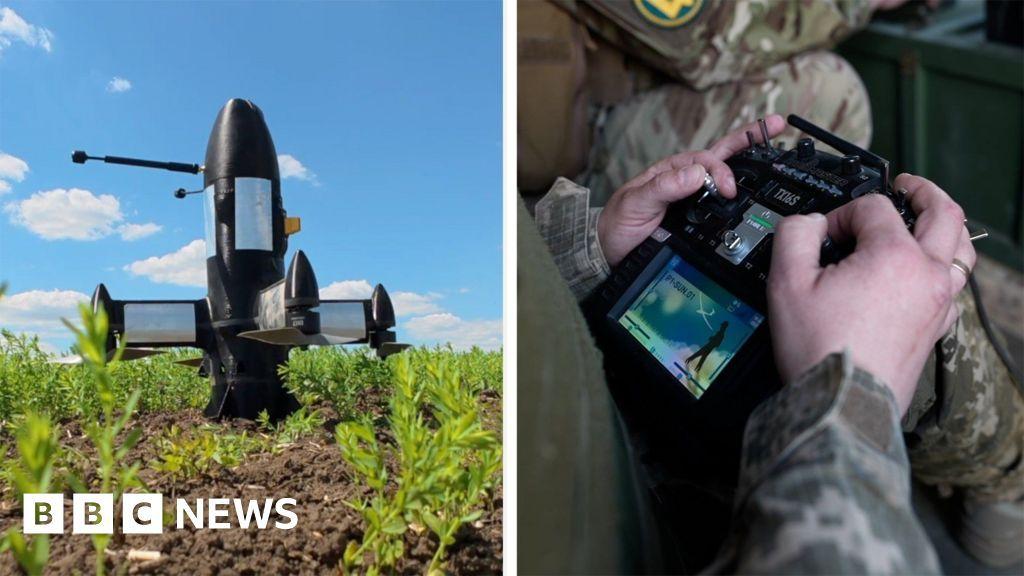
Beyond the American Merops system, European companies are developing their own solutions to the growing drone threat. In Latvia, the tech company Origin has created the "Blaze," a 3-foot-tall interceptor drone powered by artificial intelligence
2
. The system can autonomously recognize hostile targets and navigate close to them before alerting human operators who make the final decision to engage."We don't fly these systems. These systems fly themselves," Origin CEO Agris Kipurs explained, emphasizing how the technology addresses "the problem of relatively cheap, low-flying threats that are deployed in volumes"
2
. The Ukrainian government estimates Russia now produces over 300 drones daily at costs of just a few thousand dollars each, highlighting the scale of the challenge facing European defenders.Related Stories

Strategic Defense Planning
The Merops deployment represents the initial phase of a comprehensive defense strategy that NATO officials estimate will take two to five years to fully implement
1
. U.S. military leaders are advocating for an "Eastern Flank Deterrence Line" stretching from Norway to Turkey, designed to create such formidable defenses that Russian forces would be deterred from attempting border crossings.Gen. Chris Donahue, commanding general for the U.S. Army in Europe and Africa, has outlined plans for a network of sensors and command-and-control systems capable of integrating various hardware platforms
4
. This modular approach would allow systems to be updated or replaced as technology evolves, ensuring long-term effectiveness against emerging threats.References
Summarized by

Navi
[3]
[4]
Related Stories
Ukraine's drone revolution: How AI and swarm tech are redefining robotic warfare against Russia
15 May 2026•Technology
Ukraine: The Ultimate Testing Ground for European Drone Manufacturers
19 Jun 2025•Technology

NATO Unprepared for AI-Driven Drone Warfare, Warns Ukrainian Commander
05 Mar 2025•Technology

Recent Highlights
1
Microsoft and Nvidia Launch Surface Laptop Ultra: A $2,599 AI-Ready PC With RTX Spark Chip
Technology

2
Google Unveils Gemini 4 Argon AI Model, Restricts Access to Trusted Cyber Defenders
Technology

3
OpenAI Releases 722 AI-Generated Math Papers on GitHub, Igniting Fury Among Mathematicians
Science and Research

Recent Highlights
Today's Top Stories










Don’t drown in AI news. We cut through the noise - filtering, ranking and summarizing the most important AI news, breakthroughs and research daily. Follow topics that matter to you and stay ahead.


