5 Sources
[1]
Nebius Agrees to Buy Startup That Makes AI Run Faster, Cheaper
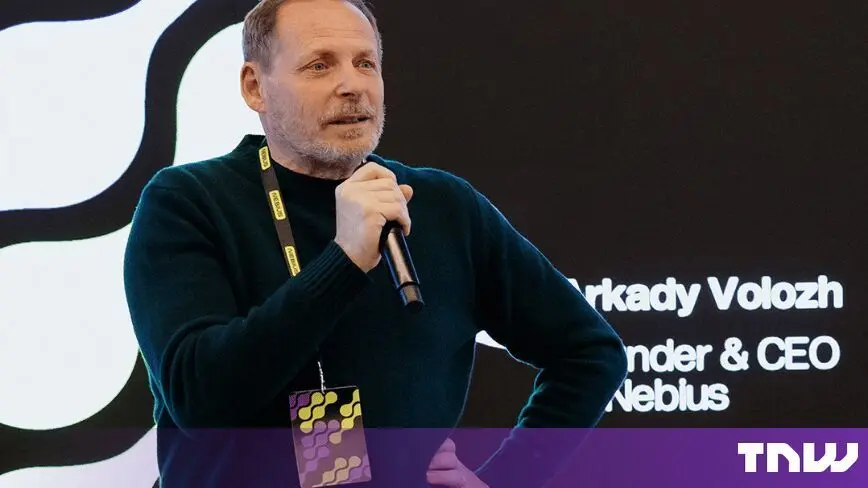
Cloud computing provider Nebius Group NV agreed to buy Eigen AI, a startup that boosts the performance of chips used to run artificial intelligence tasks, for about $615 million in stock and cash. Eigen, a 20-person California startup cofounded by two alumni of a prominent MIT AI lab, works on optimizing the performance of some of the leading open-source models from OpenAI, Alibaba Group Holding Ltd., Meta Platforms Inc. and Nvidia Corp. Eigen's technology maximizes the number of tokens -- the basic units of data in large language models -- generated by each Nvidia chip that Nebius uses for inference, or running AI models, said Roman Chernin, Nebius co-founder and chief business officer. That helps Nebius provide better and cheaper services to customers. "This is like the Olympic sport of the current market: Who can extract more tokens for the same price?" he said in an interview. The Eigen team members are "like Olympic runners in this discipline, which for us is a significant improvement in our inference business." Nebius, which split from Russian internet provider Yandex in 2024, is among a group of firms called "neoclouds," which rent AI computing capacity to companies like Microsoft Corp. In November, Amsterdam-based Nebius unveiled a product called Token Factory for running inference tasks, competing with startups like Fireworks and Baseten, as well as the cloud giants. Right now, with data center capacity in short supply, Nebius is reserving some of its computing power for Token Factory rather than selling it ahead of time to large clients in multiyear deals, Chernin said. It can charge higher prices for these kinds of short-notice contracts, he said, plus it's critical for Nebius to add more and different services. The company's goal is to become one of the key players in the inference market in the next 18 months, he said. The acquisition is Nebius' second in the past three months, after a February deal to buy Tavily, and the company is looking at other deal opportunities, Chernin said, declining to specify targets. In general, Nebius wants to purchase companies with teams or capabilities that speed its planned strategy or add products and features that are closer to direct usage by customers. "We don't want to be the infrastructure and someone above us works with the real customers," he said.
[2]
Nebius acquires 20-person Eigen AI for $643M as inference optimisation becomes AI infrastructure's most valuable layer
Nebius Group, the Dutch cloud computing company that split from Russian internet provider Yandex in 2024, has agreed to acquire Eigen AI for approximately $643 million in stock and cash. The deal, announced on 1 May, is for a 20-person startup founded by alumni of MIT's HAN Lab. In a market where the largest AI companies are valued in the hundreds of billions and the most prominent acquisitions involve thousands of engineers, $643 million for 20 people requires explanation. The explanation is inference. Eigen AI's technology maximises the number of tokens, the basic units of data in large language models, that each Nvidia chip can generate when running AI models. "This is like the Olympic sport of the current market: who can extract more tokens for the same price?" said Roman Chernin, Nebius co-founder and chief business officer. The Eigen team members, he said, are "like Olympic runners in this discipline." The discipline, it turns out, is worth $32 million per person. The AI industry's most expensive problem is not training models. It is running them. Training a frontier model is a one-time capital expenditure, measured in hundreds of millions of dollars, that produces a set of weights. Inference, the process of running those weights to generate responses for users, is a recurring operational cost that scales with every query, every API call, and every token produced. For companies that sell AI as a service, inference is the dominant cost line. Every percentage point of efficiency gained in inference, every additional token squeezed from the same Nvidia GPU, translates directly into lower costs or higher margins. Eigen AI specialises in exactly this: optimising the performance of open-source models from OpenAI, Alibaba, Meta, and Nvidia so that each chip produces more output for the same input of electricity and silicon. The technique that made Eigen AI's founders notable in the field is activation-aware weight quantisation, a method for compressing AI models from higher-precision to lower-precision numerical formats without significant loss in output quality. Co-founder Wei-Chen Wang received the MLSys 2024 Best Paper Award for this work. In practice, quantisation allows a model that would normally require four GPUs to run on two, or allows a model running on one GPU to generate tokens twice as fast. For a cloud provider like Nebius, which raised $700 million from Nvidia and Accel to build out its GPU fleet, the ability to extract more value from each chip changes the unit economics of the entire business. Nebius occupies a specific position in the AI infrastructure market. It is one of a group of companies called "neoclouds," cloud providers that rent AI computing capacity to enterprises rather than building consumer products. The established hyperscalers, AWS, Microsoft Azure, and Google Cloud, dominate the cloud market overall, but the neoclouds have carved out a niche by offering AI-optimised infrastructure with lower overhead and faster deployment. Nebius has been tripling its Nvidia GPU capacity at its data centre in Finland, deploying Nvidia's H200 chips, and launched a data centre in Paris as part of a $1 billion European investment plan. In November, it unveiled Token Factory, a managed inference product that competes with startups like Fireworks and Baseten as well as the hyperscalers' own inference offerings. The acquisition of Eigen AI is intended to make Token Factory the most efficient inference platform on the market. With Eigen's optimisation layer integrated into Token Factory, Nebius can offer customers lower per-token prices or higher throughput from the same hardware, a competitive advantage in a market where pricing is transparent and switching costs are low. The neocloud market is expanding rapidly, with companies like CoreWeave signing infrastructure deals worth tens of billions. FluidStack, another neocloud, is in talks to raise $1 billion at an $18 billion valuation. The competitive dynamics are clear: whoever can offer the most tokens per dollar per GPU wins. The Eigen deal is Nebius's second acquisition in three months, following its February purchase of Tavily, an AI agent search company, for $275 million. Chernin said the company is looking at other deal opportunities. The pattern suggests a strategy of acquiring small, technically excellent teams whose capabilities would take years to build internally. Eigen AI brings 20 people and a production-grade optimisation stack. Tavily brought search infrastructure for AI agents. Both acquisitions add capabilities that move Nebius up the stack, from renting raw GPU capacity toward providing higher-value services that interact directly with customers. "We don't want to be the infrastructure and someone above us works with the real customers," Chernin said. This is the neocloud dilemma in a sentence. Renting GPU capacity is profitable but commoditised. The margins improve as you move closer to the application layer: from raw compute, to managed inference, to optimised model serving, to fine-tuning pipelines, to enterprise-grade endpoints. Eigen AI's technology operates at the intersection of compute and model serving, which is precisely where the value in AI infrastructure is migrating. The $643 million price tag, roughly $32 million per employee, reflects a market in which the scarcest resource is not chips or capital but the people who know how to make chips produce more tokens for less money. With data centre capacity in short supply, Nebius is reserving some of its computing power for Token Factory rather than selling it in multiyear bulk deals, charging premium prices for short-notice inference contracts. The economics only work if each GPU generates as many tokens as possible. That is what Nebius just bought.
[3]
Nebius acquires AI model optimization startup Eigen AI for $643M - SiliconANGLE
Nebius acquires AI model optimization startup Eigen AI for $643M Nebius Group NV, a Dutch operator of artificial intelligence data centers, today announced plans to buy software maker Eigen AI Inc. for $643 million. The company will finance the acquisition with cash and stock. It expects to close the deal in a few weeks. Nebius provides access to graphics card unit clusters that developers can use to train AI models and run inference workloads. It also offers a managed inference service, Token Factory, that removes the need to manage the underlying GPUs. Nebius will use Eigen AI's technology to enhance the service. Token Factory enables customers to perform inference using more than a dozen open-source AI models. Eigen AI's software, in turn, optimizes open-source models to improve their speed and hardware efficiency. Neural networks comprise code snippets called kernels. Eigen AI's platform can replace some of the default kernels in an open-source model with custom modules that provide better performance. According to the company, those custom modules are implemented in CUDA and Triton. CUDA is the interface through which applications interact with Nvidia Corp. chips, while Triton is a Python-like programming language optimized for AI projects. Eigen AI says that its software also optimizes other components of open-source AI models. It compresses their weights, the settings that determine how input data is processed, to lower memory requirements. Additionally, the platform enhances the KV cache in which language models store the information they use to answer prompts. Nebius' push to integrate Eigen AI into Token Factory will place particular emphasis on the former platform's post-training features. Post-training is the process of fine-tuning a model that has already been trained to boost output quality. In many cases, developers go about the task by providing the model with examples of how to perform actions that it doesn't support well out of the box. Post-training a model usually requires software teams to adjust many of its parameters, which requires a significant amount of infrastructure. Eigen AI's platform uses a more efficient approach called LoRA. The technology works by extending neural networks with a small number of external parameters. During post-training, LoRA only recalibrates the new parameters, which is faster than reconfiguring a large subset of the model's existing settings. Eigen AI offers its core model optimization features alongside several complementary products. One offering, Eigen Data, speeds up the process of assembling training datasets. A cloud service called Eigen Inference helps developers lower their AI models' latency.
[4]
Nebius Acquires Eigen AI for $643 Million By Investing.com
Investing.com -- Nebius has agreed to purchase Eigen AI for $643 million in a move to expand its artificial intelligence capabilities and strengthen its presence in the United States. The acquisition will enhance Nebius's inference technology operations, the company said. Eigen AI specializes in AI inference solutions, which enable machine learning models to make predictions and decisions based on trained data. The $643 million transaction represents a significant investment by Nebius as it seeks to grow its footprint in the competitive AI market. The deal is expected to provide Nebius with additional technological resources and expertise in the inference segment of artificial intelligence. The acquisition also marks Nebius's strategic push into the US market, where demand for AI infrastructure and services continues to grow. Eigen AI's existing operations and client base in the United States will support Nebius's expansion efforts in the region. Financial terms beyond the purchase price were not disclosed. The companies did not provide a timeline for when the transaction is expected to close or details about regulatory approvals that may be required. This article was generated with the support of AI and reviewed by an editor. For more information see our T&C.
[5]
Nebius agrees to acquire Eigen AI, strengthening Nebius Token Factory as a frontier inference platform
Nebius Group NV is a Netherlands-based infrastructure company operating in the technology industry. The Company is engaged in developing a portfolio of artificial intelligence-related technology assets. It is involved in creating an artificial intelligence-centric player to integrate the essential elements of artificial intelligence development with infrastructure, data and advisory globally. It offers products and services such as a cloud platform for artificial intelligence-related workloads, development team services for autonomous vehicles, development of generative artificial intelligence. Nebius builds full-stack infrastructure to service the growth of the global AI industry, including GPU clusters, cloud platforms and tools and services for developers. Company is developing three other businesses that operate under their own brands: Toloka AI, TripleTen and Avride.
Share
Copy Link
Cloud provider Nebius agreed to buy Eigen AI, a California startup that optimizes AI chip performance, for $643 million in stock and cash. The 20-person team from MIT specializes in maximizing tokens generated per Nvidia GPU, a critical capability as inference costs dominate AI operations. The acquisition strengthens Nebius Token Factory against competitors.
Nebius Group NV, the Dutch cloud computing company that split from Yandex in 2024, has agreed to acquire Eigen AI for approximately $643 million in stock and cash
2
3
. The deal, announced on May 1, targets a 20-person California startup cofounded by alumni of MIT's prominent HAN Lab1
2
. The transaction represents Nebius's second acquisition in three months, following its February purchase of Tavily for $275 million2
. Nebius expects to close the deal in a few weeks3
.
Source: SiliconANGLE
The $643 million price tag for a 20-person team reveals a fundamental shift in AI infrastructure economics. "This is like the Olympic sport of the current market: who can extract more tokens for the same price?" said Roman Chernin, Nebius co-founder and chief business officer
1
.
Source: Bloomberg
Eigen AI specializes in AI model optimization that maximizes the number of tokens—the basic units of data in large language models—generated by each Nvidia chip used for AI inference
1
. While training a frontier model is a one-time capital expenditure measured in hundreds of millions of dollars, inference represents a recurring operational cost that scales with every query and API call2
. For companies selling AI as a service, every percentage point of efficiency gained in inference translates directly into lower costs or higher margins.Eigen AI's core technology centers on activation-aware weight quantisation, a method for compressing AI models from higher-precision to lower-precision numerical formats without significant loss in output quality
2
. Co-founder Wei-Chen Wang received the MLSys 2024 Best Paper Award for this work2
. The platform works on optimizing performance of some of the leading open-source models from OpenAI, Alibaba, Meta, and Nvidia1
. In practice, quantisation allows a model that would normally require four GPUs to run on two, or enables a model running on one GPU to generate tokens twice as fast2
. The software also optimizes other components by compressing weights to lower memory requirements and enhancing the KV cache where language models store information used to answer prompts3
.Nebius unveiled Token Factory in November as a managed inference product competing with startups like Fireworks and Baseten, as well as cloud giants
1
. The acquisition of Eigen AI is intended to make Nebius Token Factory the most efficient frontier inference platform on the market2
. With Eigen's optimization layer integrated, Nebius can offer customers lower per-token prices or higher throughput from the same hardware—a competitive advantage in a market where pricing is transparent and switching costs are low2
. Token Factory enables customers to perform inference using more than a dozen open-source AI models3
. The platform will place particular emphasis on Eigen AI's post-training features, which use LoRA technology to extend neural networks with a small number of external parameters, making the process faster than reconfiguring a large subset of existing settings3
.Related Stories

Nebius occupies a specific position as one of a group of companies called "neoclouds"—cloud providers that rent AI computing capacity to enterprises rather than building consumer products
2
. While established hyperscalers like AWS, Microsoft Azure, and Google Cloud dominate the overall cloud market, neoclouds have carved out a niche by offering AI-optimized infrastructure with lower overhead and faster deployment2
. Nebius has been tripling its Nvidia GPU capacity at its data center in Finland, deploying Nvidia's H200 chips, and launched a data center in Paris as part of a $1 billion European investment plan2
. The company raised $700 million from Nvidia and Accel to build out its GPU fleet2
. Right now, with data center capacity in short supply, Nebius is reserving some computing power for Token Factory rather than selling it ahead of time to large clients in multiyear deals, allowing it to charge higher prices for short-notice contracts1
."We don't want to be the infrastructure and someone above us works with the real customers," Chernin explained
1
. This statement captures the neocloud dilemma: renting GPU capacity is profitable but commoditized, while margins improve closer to the application layer2
. The pattern of acquisitions suggests a strategy of acquiring small, technically excellent teams whose capabilities would take years to build internally2
. The company's goal is to become one of the key players in the inference market in the next 18 months1
. Chernin said the company is looking at other deal opportunities, seeking to purchase companies with teams or capabilities that speed its planned strategy or add products and features closer to direct customer usage1
. The acquisition also marks Nebius's strategic push into the US market, where demand for AI infrastructure continues to grow4
. As the neocloud market expands rapidly—with competitors like CoreWeave signing infrastructure deals worth tens of billions and FluidStack in talks to raise $1 billion at an $18 billion valuation—the competitive dynamics are clear: whoever can offer the most tokens per dollar per GPU wins2
.Summarized by
Navi
[2]
[4]
02 Dec 2024•Business and Economy

09 Sept 2025•Business and Economy

25 Sept 2024

1
Entertainment and Society

2
Health

3
Technology