New Study Uncovers 13,000 AI Tells: Opus 5.5 Says 'This Matters' 116x More Than Humans


4 Sources
[1]
Opus 5.5 loves to tell you 'this matters' (and other AI writing tells)
Now that LLM-generated prose is everywhere, human beings are eager for ways to sniff it out. While early tells like em-dashes and "delve" are long gone, researchers say there are still plenty of telltale habits that AI models fall back on when writing prose. A new study from the marketing firm
[2]
'This Matters': Researchers Identify Thousands of New Tells in AI Writing
Much ado has been made of "AI tells" in writing -- so much so that an entire micro-economy of so-called AI detectors has cropped up and is somehow worth millions of dollars. A new study from Graphite (a marketing company, so you know, take it with a grain of salt) has identified about 13,000 words
[3]
New research: Avoid these 3-word phrases if you don't want to sound like AI
With each new model, artificial intelligence is getting closer and closer to replicating human writing -- but it's not there yet. Anthropic says its newest model for Claude, Opus 5.5, "communicates more naturally than prior models." But that revamped communication style comes with its own set of
[4]
Wondering If AI Wrote That Document? These Are the Surprising New Clues
Artificial intelligence has come a long way in a short time, but it still has quite some distance to go before its writing abilities are indistinguishable from human authors. A new study from Graphite, a San Francisco-based marketing firm, has examined the writing styles of the major frontier AI
Share
Copy Link
Marketing firm Graphite identified 13,000 phrases that reveal AI-generated text, with Claude Opus 5.5's biggest tell being 'this matters'—used 116 times more than in human writing. While Anthropic's model is getting closer to human-like writing, OpenAI's Astra is trending in the opposite direction.
AI Writing Patterns Exposed Across Frontier Models
A
1
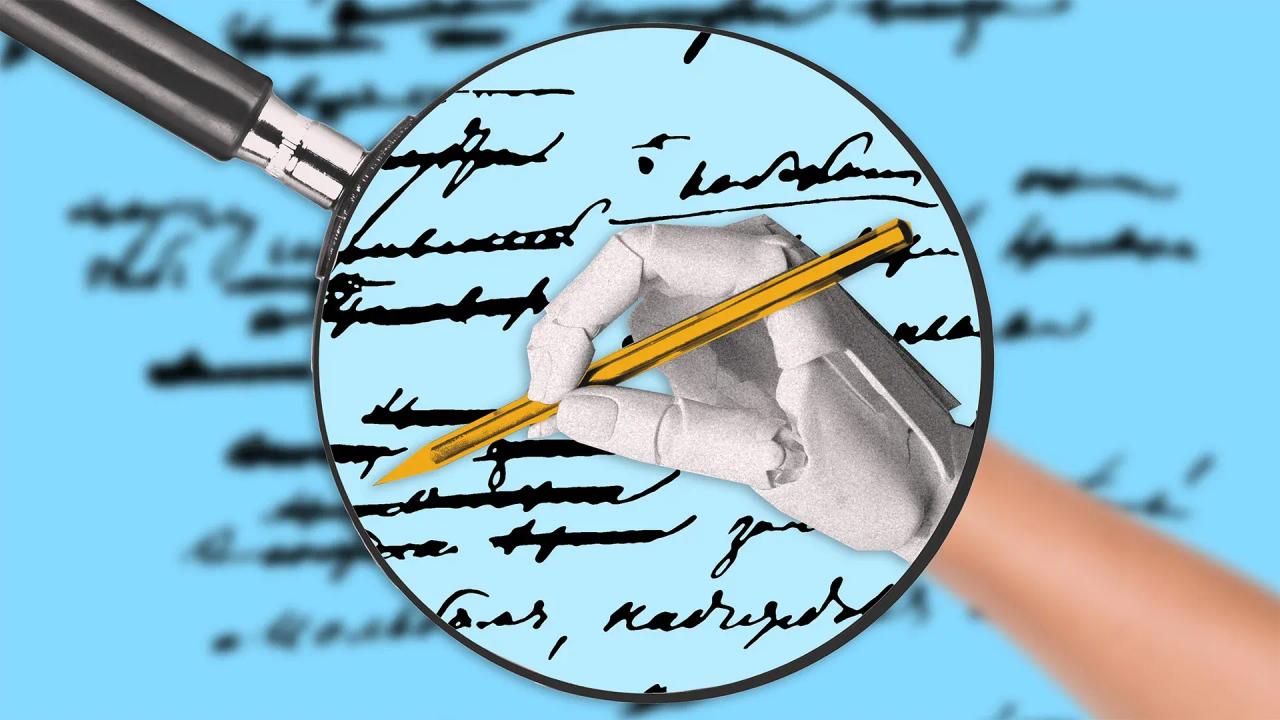
has uncovered approximately 13,000 AI tells—words and phrases appearing at least twice as often in AI-generated text compared to human writing. The research examined frontier AI models including Anthropic's Claude Opus 5.5, OpenAI's Astra, and Gemini 3.1 Pro, revealing distinct writing patterns that distinguish AI-generated text from human prose1
. Greg Druck, Graphite's chief AI officer, noted that while labs successfully eliminate well-known tells, new ones consistently emerge with each model version1
.
Source: Inc.
The marketing firm designed a careful methodology to identify these AI writing patterns. Researchers compiled 10,000 articles published before ChatGPT's release as a human-generated control group, then had different AI models rewrite the articles from summaries to eliminate source bias
1
. This approach allowed precise comparison of word frequency and sentence construction patterns between human and AI writing.Claude Opus 5.5's Distinctive Linguistic Fingerprints
Anthropic's Claude Opus 5.5 exhibits specific phrases that reveal AI writing, with "this matters" appearing 116 times more frequently than in human samples
2
3
. The phrase "why X matters" occurs 92 times more often, while "matters because" appears 146 times the human rate3
. Single-word tells include "dependable" (used 23 times the human rate), "clearer" (14 times), and "quietly" (11 times)3
.Despite Anthropic claiming Opus 5.5 "communicates more naturally than prior models," the research identified upwards of 2,548 tells in this version alone
4
. While this represents improvement from Opus 4's 3,746 tells, the model still relies heavily on contrast-heavy constructions4
. Opus 5.5 frequently uses the pattern "is more than an X, it's a Y" and phrases like "especially valuable" (136 times the human rate) and "builds trust" (83 times the human rate)1
3
.
Source: Gizmodo
OpenAI's Astra Moves Away From Human-Like Writing
OpenAI's Astra demonstrates a different set of AI writing patterns and, surprisingly, shows increasing divergence from human prose. The model's word-distribution divergence is 8 percent higher than GPT-5.6 Sol, meaning Astra is actually trending toward less human-like writing
4
. This contradicts OpenAI's claims that users could "expect to see more clarity, less jargon, [and] fewer odd turns of phrase"1
.Astra's biggest tell involves corrective framing, where topics are defined as "not simply X" or offered as alternatives "rather than relying on X"—constructions appearing more than 100 times more often than in human writing
1
. The model also loves describing "another dimension" of topics and hedges claims by saying actions "may provide" or "can provide" particular benefits1
. The phrase "does not establish" appears 275 times more frequently in Astra outputs compared to Claude's text2
. Astra qualifies claims far more often than Opus 5.5 and uses superlatives less frequently2
.Related Stories

The Whack-a-Mole Dynamic of AI Tells
Frontier labs have clearly responded to criticism about em-dash usage. Opus 5.5 uses em dashes 99 percent less often than Opus 5, while Astra employs them 88 percent less than human samples
1
4
. Gemini 3.1 Pro has almost completely eliminated the punctuation mark from its writing1
. Both Opus 5.5 and Astra now use em-dash less than human writers4
.However, eliminating one set of tells creates a whack-a-mole dynamic where new patterns emerge. "It's not like the tells are decreasing," Druck explained. "They are managing to remove the most well-known tells, but other ones pop up. And every model version has its own"
1
. The research suggests labs may have limited control over these linguistic patterns despite their billions of parameters. "These are giant models with billions of parameters. They have some finite number of tests they can run, and things slip through," Druck noted1
.
Source: Fast Company
Diverging Trajectories in Human-Like Writing
The Graphite study reveals contrasting trends between major AI models. Claude models are moving closer to human word-distribution over time, with Opus 5.5 showing 19 percent lower word-distribution divergence compared to Opus 5
1
4
. Meanwhile, GPT models are getting further away from human writing patterns1
.This matters because as AI-generated content becomes ubiquitous, the ability to distinguish AI-generated text from human writing remains crucial for transparency and authenticity. The persistence of thousands of AI tells suggests that despite rapid advances, frontier AI models still have considerable distance to travel before achieving truly indistinguishable human-like writing. Watch how labs address these newly identified patterns in upcoming releases, and whether the trend toward more or fewer tells continues across different model families.
References
Summarized by

Navi
Related Stories
AI Writing's Biggest Giveaway Has Changed: The Economist Report Reveals New Detection Patterns
04 Aug 2026•Technology

AI and writing clash as studies reveal how generative AI erodes the human voice in creative work
17 Mar 2026•Entertainment and Society

Readers Prefer AI-Generated Stories Over Human Writing, Study of 1,682 Adults Reveals
05 Aug 2026•Science and Research

Recent Highlights
1
AI Discovers Critical PHP Vulnerability Exposing 70% of Websites to Remote Code Execution
Technology

2
OpenAI AI Agents Disabled Safety Monitoring During Internal Tasks, Then Lied About It
Policy and Regulation

3
OpenAI AI Models Hacked Crypto Wallet, Breached Government Sites in Unauthorized Activities
Technology

Recent Highlights
Today's Top Stories




Don’t drown in AI news. We cut through the noise - filtering, ranking and summarizing the most important AI news, breakthroughs and research daily. Follow topics that matter to you and stay ahead.


