New York Establishes Nation's First Independent AI Safety Testing Center With 80 Researchers


3 Sources
[1]
New York will independently test AI models
The state's research center will check AI companies' work instead of taking their word. As the federal government essentially leaves us all at the mercy of the AI industry, New York is taking matters into its own hands. On Tuesday, Governor Kathy Hochul launched the nation's first state-run AI
[2]
Gov. Hochul establishes New York Center for AI Responsibility and Research
New York Gov. Kathy Hochul is establishing a first-in-the-nation AI research center to police tech companies rather than allowing them to police themselves. Hochul is taking a firm step to establish guardrails for AI tech companies. It's something she wished lawmakers in Washington had
[3]
New York Launches AI Safety Center Ahead of RAISE Act Deadline | PYMNTS.com
The New York Center for AI Responsibility and Research, based at the State University of New York (SUNY), Binghamton, will bring together more than 80 scientists from institutions across the state. Its mission combines independent testing, foundational research and training for a new generation of
Share
Copy Link
New York Governor Kathy Hochul launched the nation's first state-run AI testing program, establishing the New York Center for AI Responsibility and Research at Binghamton University. Over 80 scientists will independently test AI systems for safety and security rather than relying on company self-regulation, with implementation tied to the RAISE Act's January 1, 2027 deadline.
New York AI Takes Lead on Independent Safety Testing
Governor Kathy Hochul launched the nation's first state-run AI testing program on Tuesday, establishing the New York Center for AI Responsibility and Research at the State University of New York (SUNY), Binghamton University
1
3
. The initiative marks a departure from federal reliance on voluntary safeguards, with Hochul stating, "The stakes are too high to simply take AI companies at their word"1
.
Source: CBS
More than 80 New York scientists will contribute to independent AI safety testing through the center, using computing power from Empire AI, the state's $500 million public-private AI partnership
1
. Cornell Tech Dean Greg Morrisett and Columbia University Executive Vice President for Research Jeannette Wing will serve as interim co-directors3
.Funding and Research Infrastructure Drive AI Regulation
The center's funding includes a $30 million philanthropic gift from donors led by Bloomberg Co-Founder and Binghamton alumnus Tom Secunda, an initial $25 million SUNY research investment, and state operating support
3
. Researchers will examine whether AI systems are safe and secure, can be manipulated, can produce dangerous results, or can compromise privacy2
.Participating researchers will continue working at their home institutions while developing tools, measurements, and standards for evaluating increasingly capable systems
3
. The research agenda targets experts focused on foundational limits and mathematical theory, formal methods and verification, agentic and complex systems, hardware security and privacy, interpretability and alignment, and scientific AI and biosecurity3
.RAISE Act Implementation Creates Accountability Framework
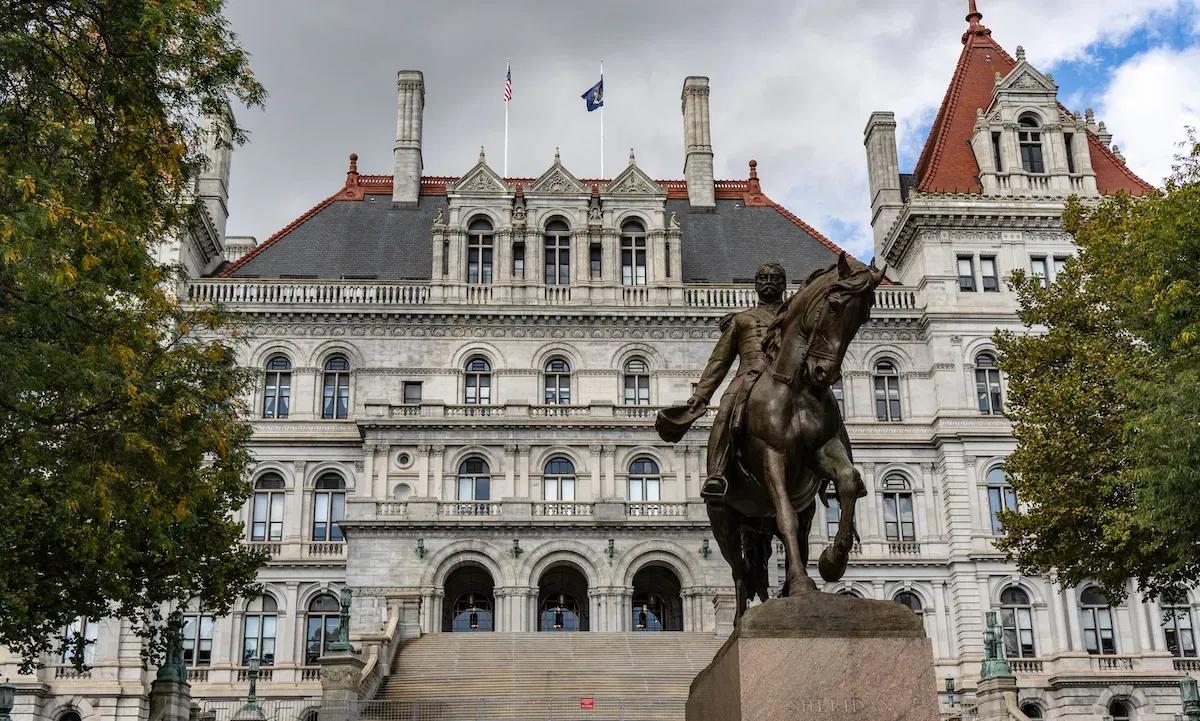
The center's work connects directly with implementation of the RAISE Act, which takes effect January 1, 2027
3
. New York's RAISE Act, signed by Kathy Hochul last year, requires large AI developers to register with the state by January 1, 20271
. Starting then, companies must publish safety frameworks and transparency reports and report critical safety incidents within 72 hours1
.
Source: PYMNTS
Hochul's office announced an online registration portal administered by the Office of Digital Innovation, Governance, Integrity, and Trust, known as DIGIT
3
. At the state's request, the center can provide expertise, assessments, and evidence to inform AI oversight3
.Related Stories

Addressing Emerging Threats and Complex AI Systems
The announcement came one week after midterm elections revealed public anxiety about AI governance. About six in 10 voters said the technology would do more to hurt society, according to the AP Voter Poll, although only about one-quarter called AI a crucial voting factor
3
.Morrisett highlighted the urgency: "This center gives us an opportunity to work on really hard problems, like how do we adapt best practices, such as formal methods to prevent agents from escaping their sandboxes? Or how do we understand new classes of attacks and failures and the defenses that we need to develop?"
2
Wing told Politico, "We need new techniques that can be applied to this new kind of system with swarms of autonomous agents acting independently and without control"3
.Limitations and Future Directions for Responsible AI Applications
One potential hole in the program is that it can only study what AI companies disclose publicly
1
. Researchers will have access to publicly disclosed information, while companies' internal models under development remain private3
. The center's remit includes supporting responsible AI applications in medicine, scientific research, and critical infrastructure3
.Hochul's office said it will explore additional ways to strengthen New York's AI safety laws and regulations in the coming months
3
. The initiative gives regulators an independent basis for evaluating companies' safety claims and identifying shortcomings in their disclosed safeguards, though visibility into every emerging risk remains limited3
.References
Summarized by

Navi
[1]
Related Stories
New York Governor Hochul signs RAISE Act as state AI safety laws face federal challenge
20 Dec 2025•Policy and Regulation

New York City Council Subpoenas SpaceXAI as Major AI Companies Face First Safety Hearing
21 Sept 2026•Policy and Regulation

New York Enacts Law to Monitor and Regulate AI Use in State Government
28 Dec 2024•Policy and Regulation

Recent Highlights


Recent Highlights
Today's Top Stories






Don’t drown in AI news. We cut through the noise - filtering, ranking and summarizing the most important AI news, breakthroughs and research daily. Follow topics that matter to you and stay ahead.


