Nvidia revenue tops $96 billion as AI chip demand accelerates and memory commitments reach $160 billion


88 Sources
[1]
Nvidia revenue tops $96 billion as memory commitments soar to $160 billion -- CEO Jensen Huang says AI 'has reached its inflection point'
It has become a tradition that every single quarter Nvidia reports record results that outpace all of its quarterly results before that. This Wednesday was no exception as the company posted revenue of $96.2 billion, which was up 106% year-over-year, due to rising demand for its AI hardware. But
[2]
Nvidia rises after signaling longer AI spending runway
Aug 27 (Reuters) - Nvidia (NVDA.O), opens new tab shares rose about 6% before the bell on Thursday as investors embraced the chipmaker's strong long-term outlook, betting that a global race to build AI infrastructure will fuel years of rapid growth despite concerns about supply bottlenecks and
[3]
Nvidia jumps 6% in premarket trading after blockbuster earnings boost AI confidence
Follow your favorite stocksCREATE FREE ACCOUNT Nvidia shares rose on Thursday after the chip giant's revenue guidance reassured investors that AI demand will remain strong. Shares of Nvidia were up 5.95% in premarket trading. Nvidia CFO Colette Kress said on Wednesday that the company expects
[4]
Strong AI chip demand fuels Nvidia's Q2 results well beyond Wall Street's expectations
Nvidia's latest quarterly results once again blew past Wall Street's expectations as revenue for the computer chip company's high-end artificial intelligence chips soared, the latest sign that AI infrastructure spending remains strong. The company reported on Wednesday net income of $59.69
[5]

Nvidia posts record quarter and predicts AI-driven growth will last through 2028
Serving tech enthusiasts for over 25 years. TechSpot means tech analysis and advice you can trust. The takeaway: Nvidia this week reported blockbuster results for the quarter ending in July 2026 and issued ambitious revenue guidance that topped Wall Street consensus estimates. The company's stock
[6]

Nvidia sales soar on rapid buildout of AI data centres
Chipmaker Nvidia has reported another huge jump in sales as the global push to build artificial intelligence (AI) systems continues at a rapid pace. The company said on Wednesday it brought in $96bn (£71bn) in revenue during the second quarter, more than double from a year ago. And it expects
[7]

Nvidia's Profit Doubles to $59.69 Billion Thanks to A.I. Spending
Sign up for the On Tech newsletter. Get our best tech reporting from the week. Get it sent to your inbox. Silicon Valley's artificial intelligence spending spree may have unsettled Wall Street, but the chipmaker Nvidia is still cashing in on sales to the biggest technology companies. Nvidia's
[8]

Nvidia Tries to Defend Against Circular Dealmaking Accusations
Nvidia makes a lot of money from deals fueled by AI hype. It also spends a lot of money on deals that in turn fuel that same AI hype. But Nvidia executives want you to ignore how circular that might sound, because the companies they are investing in are going to "become the largest technology
[9]

Nvidia reported revenue of $96.2bn for the second quarter
Nvidia reported revenue of $96.2bn for the quarter, up 106% from the same period last year, and then did something it has never done before by guiding a full year ahead. The shares slipped about 1.3% on the release and only turned sharply higher once chief financial officer Colette Kress reached
[10]
Nvidia bounce shows Wall Street's AI obsession is far from over
NEW YORK, Aug 26 (Reuters) - Nvidia's (NVDA.O), opens new tab results on Wednesday afternoon gave its investors another roller coaster ride, highlighting just how high the expectations for AI and its favorite chip designer have gotten on Wall Street. Nvidia handily beat the consensus estimates for
[11]
Jensen Huang defends Nvidia's growing financial support for AI ecosystem, says 'the risk is low'
* Nvidia CEO Jensen Huang defended the chipmaker's growing role in financing AI companies, calling its investments in frontier labs a "once in a generation" opportunity. * He said the risk to Nvidia is low because its computing infrastructure can be redeployed to other customers and workloads if a
[12]
Nvidia is about to report its fastest growth in seven quarters
Revenue is forecast at $92bn, but the scrutiny has moved to how much of the demand Nvidia is financing itself. Nvidia is expected to report quarterly revenue of $92.18bn, close to double the same period last year and its fastest growth in seven quarters, with analysts forecasting a further rise to
[13]

What we learned from Nvidia's big day
Why it matters: The chipmaker's earnings are viewed as a barometer of the overall health of the AI trade. * Every three months when it reports its financials, Wall Street combs through the numbers for signs the whole shebang is slowing down. By the numbers: The numbers are bonkers. Nvidia's
[14]

NVIDIA Announces Financial Results for Second Quarter Fiscal 2027
* Revenue of $96.2 billion, up 106% from a year ago * Data Center revenue of $89.0 billion, up 117% from a year ago NVIDIA (NASDAQ: NVDA) today reported revenue for the second quarter ended July 26, 2026, of $96.2 billion, up 18% from the previous quarter and up 106% from a year ago. For the
[15]

Nvidia's quarterly revenue doubles to nearly $100bn as CEO declares 'golden age'
The $5tn firm beat Wall Street expectations for yet another blockbuster quarter but stock stays flat Nvidia announced on Wednesday that its quarterly revenue had doubled in a year to nearly $100bn. Jensen Huang, the founder and CEO, jubilantly declared that demand is accelerating as the AI
[16]
Nvidia forecasts quarterly revenue above estimates
Aug 26 (Reuters) - Nvidia (NVDA.O), opens new tab forecast quarterly revenue above Wall Street estimates on Wednesday, but its outlook did little to ease investor concerns about the company's long-term dominance in the AI chip market. Shares of the world's most valuable company fell 1.2% in
[17]

Nvidia gave its first-ever year-ahead forecast -- a 70% growth bombshell meant to silence AI bubble critics and 'circular financing' doomsayers | Fortune
The 70% preliminary expectation wildly exceeded projections for fiscal 2028 revenue of roughly $570 billion, or 44% growth from fiscal 2027 (the current year). Nvidia's projected growth, applied to fiscal 2027 revenue and expected revenue, would imply fiscal 2028 revenue in the range of $690
[18]

Nvidia Q2 FY2027 earnings: revenue doubles, stock falls
The AI chip giant posted record quarterly revenue of $96.2 billion and guided for $108 billion next quarter, but shares dipped in after-hours trading Nvidia $NVDA posted record quarterly revenue of $96.2 billion in its second fiscal quarter -- more than twice what it earned in the same period last
[19]
Nvidia wows Wall Street with a strong quarter and an eye-popping sales forecast
Nvidia CEO Jensen Huang did it again. The AI chip powerhouse delivered better-than-expected quarterly revenue and earnings that more than doubled the year-ago period. Business is so strong that management felt comfortable enough to provide a financial outlook further into the future than ever
[20]

Nvidia Shares Surge in After-Hours Trading After Record $96.2 Billion Revenue
* Nvidia's quarterly revenue rose 106% year over year to $96.2 billion. * Data Center revenue increased 117% to $89 billion. * The company disclosed $366 billion in future commitments. Nvidia shares rebounded in after-hours trading Wednesday after initially falling following the chipmaker's
[21]

Nvidia smashes Q2 forecasts at $96.2bn as AI hits 'inflection point'
The chipmaker's data centre revenue surged 117% to $89 billion as it guided next quarter revenue to $108 billion, both above Wall Street expectations, without counting sales to China. Nvidia posted quarterly revenue of $96.2 billion (€82.4bn) on Wednesday, comfortably beating the $92.2 billion
[22]

Nvidia doubles revenue, forecasts even more AI spending
San Francisco (United States) (AFP) - AI juggernaut Nvidia on Wednesday reported quarterly revenue of $96.2 billion, more than double from a year earlier, as the world's most valuable company beat Wall Street expectations and forecast even stronger sales ahead. Shares leapt nearly five percent in
[23]
Nvidia under pressure after stock's 7-day losing streak
Why it matters: Nvidia is trying to use its massive pile of capital to keep the good times rolling -- through a wide assortment of investments and capital deals -- while continuing to feed the growing chip needs of the AI hyperscalers. Zoom in: The company will report second-quarter earnings after
[24]

Nvidia stock price jumps on stunning growth forecast as Hugging Face acquisition rumors swell
All eyes are on the AI chip company this morning after it handily beat Wall Street's earnings expectations. Here's what's happening. Shares in Nvidia Corporation (Nasdaq: NVDA) are up in premarket trading on Thursday, one day after the world's largest technology company announced not only
[25]

Nvidia doubles its revenue as demand for AI chips accelerate, but bubble fears still persist
Nvidia doubles its revenue as demand for AI chips accelerate, but bubble fears still persist Shares of Nvidia Corp. moved higher in late trading today after the chipmaker reported better-than-expected second quarter earnings and revenue. It also delivered bullish guidance for the current quarter
[26]
Nvidia posts $96.2 billion in revenue, cruising past estimates of $92 billion | Fortune
Nvidia doubled its revenue and profit year-over-year in its second quarter, and forecast sales in the current quarter that topped analyst estimates, as red-hot demand for its AI chips continues to bolster the company's fortunes. Revenue in the three months ended July 26 totaled $96.2 billion, up
[27]
Nvidia faces growth test as Rubin debut meets AI financing scrutiny
Aug 25 (Reuters) - Nvidia's (NVDA.O), opens new tab results on Wednesday will test whether the company's latest Rubin chips can drive another period of explosive growth, with some investors questioning the sustainability of the AI spending boom. The chipmaker has been the biggest beneficiary of
[28]

NVIDIA Posts Record Quarterly Results as Blackwell Demand Keeps Rising
NVIDIA has reported another record quarter, with AI infrastructure remaining the overwhelming growth engine. The results matter to PC buyers because the same company controls GeForce supply decisions, competes for advanced wafers and packaging, and influences demand for HBM, server DRAM, networking
[29]

Nvidia: AI boom continues apace as world's most valuable company beats expectations
The world's most valuable company has again defied eye-watering forecasts, delivering a bumper set of financial results. Nvidia, the chipmaker valued at more than $5.1bn (£3.8bn) and powering much of the artificial intelligence (AI) boom, said gross profit hit $133.3bn (£98bn) in the first half of
[30]
Nvidia's 70% growth forecast puts it on track to become tech's No. 2 company by revenue
* Nvidia shocked the AI world on Wednesday when, in the middle of its second-quarter earnings report for fiscal 2027, said that it forecast 70% growth in the company's fiscal 2028. * That was significantly higher than Wall Street analysts were expecting for the period ending Feb. 1 in 2028. *
[31]

NVIDIA's quarterly revenue reaches almost $100 billion, and $90 billion of that is from AI
NVIDIA has posted its latest quarterly financial results for Q2 2027, for the period ending July 26, 2026. Total revenue hit an impressive $96.2 billion for the three-month period, which was up 18% from the previous quarter and 106% from the same period last year. To make that $96.3 billion figure
[32]

Strong AI chip demand fuels Nvidia's Q2 results well beyond Wall Street's expectations
Nvidia's latest quarterly results once again blew past Wall Street's expectations as revenue for the computer chip company's high-end artificial intelligence chips soared, the latest sign that AI infrastructure spending remains strong. The company reported on Wednesday net income of $59.69
[33]

AI giant Nvidia's stock jumps after strong second quarter earnings
Nvidia's stock leaped on Thursday, after the company reported strong earnings in the second quarter of this year. The company's stock is up by roughly 8.5 percent as of just after 12 p.m. EDT Thursday, surpassing $227 per share. At the start of this year, Nvidia was trading at below $190 per
[34]

Strong AI Chip Demand Fuels Nvidia's Q2 Results Well Beyond Wall Street's Expectations
Nvidia's latest quarterly results once again blew past Wall Street's expectations as revenue for the computer chip company's high-end artificial intelligence chips soared, the latest sign that AI infrastructure spending remains strong. The company reported on Wednesday net income of $59.69
[35]
Nvidia's Q2 revenue tops $96.2 billion on strong AI chip demand
Nvidia's latest quarterly results once again blew past Wall Street's expectations as revenue for the computer chip company's high-end artificial intelligence chips soared, the latest sign that AI infrastructure spending remains strong. The company reported on Wednesday net income of $59.69 billion,
[36]

Here's What Wall Street Analysts Are Saying After Nvidia's Earnings
Kara Greenberg is a senior news editor for Investopedia, where she does work writing, editing, and assigning daily markets and investing news. Prior to joining Investopedia, Kara was a researcher and editor at The Wire. Earlier in her career, she worked in financial compliance and due diligence at
[37]

Jensen Huang's Answer to the 'A.I. Bubble' Talk is a $96 Billion Quarter
Nvidia posted $96.2 billion in quarterly sales and told Wall Street to expect roughly 70 percent growth next year. Apparently, the only limit is how fast suppliers can meet demand. While most of Silicon Valley's giants claim that their big ideas came while dwelling in basements or tinkering in
[38]
Nvidia's 70% sales growth projection for 2028 wows analysts on earnings call
Nvidia reported another blowout quarter on Wednesday, delivering a beat on topline metrics that was strong enough to send the stock up 4% in extended trading. Analysts on the earnings call couldn't get over the 70% growth projection for 2028 revenue delivered by the California-based chipmaker,
[39]

Nvidia shares extend gains, jump 7% as blockbuster earnings revive AI trade ,
Nvidia shares jumped about 7% after strong quarterly results and a bullish revenue forecast eased concerns over slowing AI spending. The chipmaker reported $96.2 billion in second-quarter revenue and expects about $108 billion in the current quarter. Its 70% fiscal 2028 growth outlook further
[40]

Here's How Much You'd Have if You Invested $1,000 in NVIDIA Stock in 2010
Every time you use an AI chatbot, generate an image, or watch a company tout its artificial intelligence ambitions, there is a good chance NVIDIA's chips are doing the work underneath. That role has made NVIDIA the most valuable company on earth, worth about $5.25 trillion after another
[41]

NVIDIA Ties $103 Billion in Commitments to OpenAI Site That Could Return $200 Billion in Revenue
As part of its earnings release for the second quarter of fiscal 2027, NVIDIA shared that it has entered land, power and shell guarantees for its AI cloud partners that are worth $108.5 billion. NVIDIA's guarantees and agreements with its customers have caused considerable debate, with the firm's
[42]
Here's How Much Nvidia Stock Is Expected to Move After Earnings
Get personalized, AI-powered answers built on 27+ years of trusted expertise. Nvidia is scheduled to post earnings after the closing bell on Wednesday, with traders anticipating a big move from the AI chip leader's stock. Based on current options pricing, traders expect Nvidia (NVDA) shares could
[43]
Nvidia earnings live updates: Q2 results, memory prices and AI outlook
BMO's Kristin Milchanowski on Nvidia earnings and the AI trade Nvidia will report fiscal second-quarter results after the bell. Here are the key numbers, according to analyst estimates as compiled by LSEG. * Earnings per share: $2.10 estimated * Revenue: $92.17 billion estimated Nvidia sits at
[44]
Nvidia at heart of data centre revolution, says BNP Paribas; sees 36% upside
BNP Paribas has issued an outperform rating on Nvidia with a target price of $285, implying a 36% upside. The brokerage highlighted Nvidia's role in the data centre revolution, accelerated computing, strong Q2 financial results, and robust demand for its Blackwell and Vera Rubin platforms despite
[45]

Nvidia Says AI Agents Are Draining Its Chip Supply | PYMNTS.com
Huang waved off the industry's fixation on artificial general intelligence entirely, calling AGI benchmarks "kind of senseless at this point." Nvidia's own numbers backed the claim. The company reported record second-quarter revenue of $96.2 billion, more than double the prior-year period, as
[46]
NVIDIA Growth Outlook Signals Multi-Year AI Demand Beyond Supply Limits: Analysts - NVIDIA (NASDAQ:NVDA)
NVIDIA Corp (NASDAQ:NVDA) stock slid lower by about 0.50% during Friday's premarket session as risk appetite cools for mega-cap tech ahead of the open. Nasdaq futures are down 0.23% while S&P 500 futures have shed 0.01%. Nvidia's fiscal 2028 outlook strengthened Wall Street's bullish case, with
[47]

Nvidia's $96 billion quarter revealed a surprising constraint
Most companies would kill for the biggest problem Nvidia (NVDA) has. The AI-chip giant just generated $96.2 billion in quarterly revenue, more than double its sales from a year earlier. Its Data Center division reached $89 billion, and Nvidia forecasts another $108 billion of companywide revenue
[48]
The AI Trade Is Under Pressure to Start the Week. Nvidia's Results Will Test the Sector
Get personalized, AI-powered answers built on 27+ years of trusted expertise. The AI trade has hit a few stumbling blocks lately, with the sector facing a key test from Nvidia's earnings later this week. The AI chipmaker, widely seen as a bellwether for the AI trade, is set to give investors an
[49]
Nvidia CEO Says AI Is Already Productive, Not Just Promising | PYMNTS.com
What matters now, he told analysts, is that "AI is now doing productive and useful work" and "generating profitable tokens," not whether it has cleared some abstract intelligence threshold. He waved off the industry's fixation on artificial general intelligence entirely, calling AGI benchmarks
[50]
Nvidia Q2 FY2027 earnings: AI boom rolls on, but new questions emerge - Nvidia delivers another blockbuster quarter
Nvidia Q2 FY2027 earnings: AI boom rolls on, but new questions emerge 1/10 Nvidia delivers another blockbuster quarter Nvidia posted record second-quarter fiscal 2027 revenue of $96.2 billion, beating Wall Street expectations and more than doubling revenue from a year earlier. The results
[51]
Cramer says Nvidia has become 'all-important' to the AI trade. Here's what to watch beyond the numbers
* CNBC's Jim Cramer said Nvidia has become so central to the AI ecosystem that its earnings are effectively a referendum on the entire AI trade. * He said that despite concerns around competition, data-center opposition, memory shortages and AI financing, Cramer remains bullish on Nvidia. CNBC's
[52]
How new tariff risks could reshape Nvidia's AI costs
Nvidia (NVDA) posted one of the best quarters in the chip giant's history. Revenue reached $96.2 billionin the fiscal second quarter, up 106% from a year earlier and 18% from the previous quarter. Data center revenue alone climbed to $89 billion, a 117% year-over-year increase. Nvidia maintained
[53]
Jensen Huang is '100% Confident' AI Labs Will Stay With Nvidia - NVIDIA (NASDAQ:NVDA)
As leading AI developers race to build their own custom chips, Nvidia Corp (NASDAQ:NVDA) CEO Jensen Huang says he remains unfazed. Responding to questions about OpenAI, Anthropic and other frontier AI labs designing in-house silicon, Huang said he is "100% confident" they will remain Nvidia
[54]

Nvidia forecasts quarterly revenue above estimates, shares rise
Nvidia's quarterly revenue more than doubled and the chipmaker forecast third-quarter revenue above Wall Street estimates on Wednesday, signaling persistent demand for its AI chips. The company also said it expects revenue to grow by about 70% in fiscal 2028, and announced an expansion of its
[55]

Nvidia and the AI Ecosystem: The 70% Signal That Sets Everything Else in Motion
* Nvidia's results -- a solid quarter, and a fiscal 2028 outlook nobody had modeled * Vera Rubin ramps -- the fastest ramp in Nvidia's history, and $40B of content per gigawatt * OpenAI's Jalapeño -- what custom silicon actually threatens, and what it doesn't * The balance sheet -- $500B+ of
[56]
Nvidia shares rally 5% after stellar Q2; revenue guidance for 2028 tops analyst estimates
Nvidia shares jumped 5% in extended trading on Wednesday after the chipmaker reported stellar Q2 results and forecast 70% revenue growth for FY28. The guidance topped analyst expectations, while strong AI demand continued to drive optimism despite memory shortages and margin pressures. Nvidia
[57]
Nvidia just demolished one of Wall Street's biggest AI fears
For much of 2026, it's been a strange time to be Nvidia. Its business kept growing, but investors became harder to convince. That was, until this week. Shares of Nvidia (NVDA) jumped 6.8% on Aug. 27 after the artificial-intelligence chipmaker did something it rarely does. Management looked well
[58]
Nvidia Still Dominates AI Chips as Rivals Build Their Own - Meta Platforms (NASDAQ:META), Amazon.com (NAS
Nvidia Still Dominates AI Chips. Meta, Google and Amazon Still Want Their Own. The biggest takeaway from this week's Hot Chips conference wasn't that Nvidia Corp's (NASDAQ:NVDA) grip on AI chips is slipping. It was that its biggest customers are investing more aggressively than ever in building
[59]

AI chip demand fuels Nvidia's Q2 results well beyond Wall Street's expectations | BreakingNews
Nvidia's latest quarterly results once again blew past Wall Street's expectations as revenue for the computer chip company's high-end artificial intelligence chips soared, the latest sign that AI infrastructure spending remains strong. The company reported net income of 59.69 billion US dollars
[60]
Nvidia's AI Demand Is Exploding -- but So Are Its Receivables
Nvidia (NASDAQ:NVDA) reported record fiscal second-quarter results Wednesday with revenue more than doubling year over year to $96 billion. After initially falling on the news, the stock rose over 8% overnight. During the earnings call with analysts, CFO Colette Kress guided Nvidia's fiscal 2028
[61]
Nvidia investors beware: Firm flags 2 risks after better-than-expected Q2 earnings
Nvidia's AI boom remains strong, but rising memory costs and growing debt are emerging as key risks. The chipmaker expects gross margins to bottom at 71-72% in Q4 FY27, while rising debt could pressure its financial condition and cash flows. Nvidia's AI boom, stellar Q2, and an even better
[62]

Nvidia Tops Expectations Despite the Rise of In-House AI Chips
Demand remains supported by spending from Big Tech, which is expected to pour more than $730bn into AI infrastructure this year, up from $400bn last year. A growing share of that investment is funding internally developed processors aimed at reducing reliance on Nvidia's GPUs. Intel, AMD, and
[63]
Bank of America doubles down on Nvidia stock
Nvidia reported earnings on Aug. 26. Wall Street expected it to beat. Bank of America was not particularly interested in that part of the story. The firm's note, published ahead of the report, was really about one thing: whether the market had correctly priced the scale of what Nvidia has been
[64]
Bill Gates AI Warning Meets Nvidia's AI Financing Push - NVIDIA (NASDAQ:NVDA)
Bill Gates Wants to Hit the Brakes. Nvidia Is Financing AI's Next Sprint. Bill Gates and Nvidia Corp's (NASDAQ:NVDA) Jensen Huang weren't responding to each other on Wednesday. But together, they captured the central tension shaping artificial intelligence. Hours after Gates said he would support
[65]
Why is NVIDIA stock surging today? By Investing.com
Investing.com -- NVIDIA stock surged 7.4% in pre-open trading after the chip giant delivered a record-breaking fiscal second-quarter earnings report that exceeded analyst expectations across every major metric and issued forward guidance that dramatically outpaced Wall Street forecasts. Revenue
[66]
Nvidia's results suggest the AI boom has further to run
STORY: AI has been going gangbusters for years. And the big question is: can it continue? :: Peter Henderson, Companies Breaking News Editor ::TSMC Nvidia is the main designer of AI chips, so it doesn't make them itself -- there's a company in Taiwan called TSMC that does most of that. But you
[67]
Nvidia: Nvidia forecasts 70% sales growth next year, signals AI spending boom has years left to run
"AI has reached its inflection point. It's doing useful work. Its tokens are productive and profitable. Now, compute is revenue," Nvidia Chief Executive Jensen Huang said. Nvidia on Wednesday forecast a 70% jump in revenue next fiscal year, underscoring unabated demand for AI computing, while
[68]
Jensen Huang Has a Message for NVDA Bears Betting on Open Models: 'Both Closed and Open Models Are Going
Nvidia Corp (NASDAQ:NVDA) CEO Jensen Huang said the company is benefiting from the rapid rise of both open and closed AI models, arguing that the success of either approach ultimately drives demand for Nvidia's computing infrastructure. Nvidia Sees Opportunity In Both Open And Closed AI During
[69]
Nvidia's Quarter Dwarfed TSMC's Year and AI Demand Could Still Surprise
Nvidia (NASDAQ:NVDA) just generated more revenue in a single quarter than the company that manufactures its chips generated in the whole of last year. Sit with that for a second, because I don't think the market has. The numbers themselves are already extraordinary. Nvidia reported quarterly
[70]
Nvidia Beats Expectations Despite the Rise of In-House AI Chips
Demand remains supported by spending from Big Tech, which is expected to devote more than $730bn to AI infrastructure this year, up from $400bn last year. A growing share of that investment is increasingly funding internally developed processors to reduce reliance on Nvidia GPUs. Intel, AMD, and
[71]
Nvidia's 70% sales growth forecast sends a message to AI doubters. What did CEO Jensen Huang say?
Nvidia has forecast a 70% jump in revenue for fiscal 2028, signalling that strong AI computing demand remains intact despite memory supply constraints. The upbeat outlook, which is well above Wall Street's 44% growth estimate, highlights broadening demand from hyperscalers, AI labs, startups and
[72]
KeyBanc reiterates Overweight rating on Nvidia stock at $330 By Investing.com
Investing.com - KeyBanc reiterated an Overweight rating on Nvidia Corp. (NASDAQ:NVDA) with a $330.00 price target following the company's second-quarter results. Nvidia reported second-quarter data center revenue of $89 billion, up 117% year-over-year, with both Hyperscale and ACIE segments
[73]
Nvidia CEO Jensen Huang Not Taking OpenAI's 'Jalapeño' Chip Personally: 'Lots of Projects Get Started. Lo
On Wednesday, Nvidia Corp (NASDAQ:NVDA) CEO Jensen Huang brushed off OpenAI's new Jalapeño chip, saying he remains confident in Nvidia's technology and ability to supply the AI industry even as customers develop their own processors. Jensen Huang Shrugs Off OpenAI's Jalapeño Chip Challenge During
[74]
Nvidia forecasts quarterly revenue above estimates
Aug 26 (Reuters) - Nvidia forecast quarterly revenue above Wall Street estimates on Wednesday, a sign that big technology companies are still spending heavily on its chips to power their AI ambitions, even as many of them race to build their own. The company expects third-quarter revenue of $108.0
[75]
Nvidia Earnings Preview: Blackwell Growth Meets a Sky-High Valuation Bar
NVIDIA is set to report its fiscal second-quarter 2027 results after the market closes today, August 26. The stock is trading near $212, about 10.89% below its 52-week high of $236.54, reached in May. Analysts forecast revenue of $91.9 billion and earnings per share of $2.08, implying
[76]
Nvidia earnings: Chipmaker forecasts quarterly revenue at $108 billion, well above analysts' estimates
Nvidia earnings: Nvidia anticipates strong revenue, exceeding analyst expectations for the upcoming quarter. Nvidia faces growing competition in the inference chip market from rivals. The company's AI chip market opportunity is projected to exceed one trillion dollars. Nvidia forecast quarterly
[77]
Nvidia Q2 Highlights: Double Beat, Huang Says 'AI Infrastructure Buildout is at Full Steam' - NVIDIA (NAS
NVIDIA Corporation (NASDAQ:NVDA) reported second-quarter financial results Wednesday after market close. Here are the key highlights. Nvidia Q2 Earnings Nvidia reported second-quarter revenue of $96.22 billion, up 106% year-over-year. The revenue total beat a Street consensus estimate of $92.18
[78]
Forget Nvidia's Q2 results. Wall Street is watching this $200 billion exposure By Investing.com
Investing.com -- A potential $200 billion in off-balance-sheet credit exposure is the number Wall Street is watching when Nvidia reports its second-quarter results after Wednesday's close, eclipsing what is shaping up to be a near-doubling of revenue. For BofA analyst Vivek Arya, it's the balance
[79]
US Stock Market: Nvidia earnings to test AI boom as markets brace for sharp move
Nvidia options are pricing in a 5.4% post-earnings move, implying a potential $280 billion swing in market value after its Q2 results. The expected move is below the 6.5% forecast before May earnings and Nvidia's 7.4% average post-results swing over the past 12 quarters. The subdued pricing
[80]
Jim Cramer Sees 'No Real Competitors' to Nvidia, Even as Sam Altman Says OpenAI 'Made a Chip and It Is Fa
OpenAI says its new Jalapeño AI chip could significantly reduce the cost of running artificial intelligence by delivering substantially higher efficiency and faster inference, but Jim Cramer remains skeptical that the chip threatens Nvidia Corp's (NASDAQ:NVDA) dominance. OpenAI's Jalapeño Chip
[81]
Nvidia Earnings Put Jensen Huang -- and the AI Trade -- Back in the Spotlight
* NVIDIA's profit report on Wednesday headlines a busy week for traders, with results and Jensen Huang's commentary likely to shape the broader AI trade * The world's biggest company is oddly absent from the September conference calendar * Shares enter earnings week under pressure, making its
[82]
Nvidia Q2 Earnings: Can the AI chip giant beat sky-high expectations? - Nvidia Earnings: The AI Market's Biggest Test
Nvidia Q2 Earnings: Can the AI chip giant beat sky-high expectations? 1/12 Nvidia Earnings: The AI Market's Biggest Test Nvidia is set to report its fiscal second-quarter 2027 results on Wednesday, August 26, after the U.S. market close. Wall Street expects another quarter of exceptional growth,
[83]
Nvidia Enters Earnings After Worst Losing Streak - NVIDIA (NASDAQ:NVDA)
Nvidia Enters Earnings on Its Worst Losing Streak Since 2022 as Jim Cramer Prepares 'a Truckload' of Questions NVIDIA Corp. (NASDAQ:NVDA) heads into one of its most closely watched earnings reports under an unusual cloud. The AI chip giant has fallen for seven straight trading sessions -- its
[84]
Nvidia Earnings Could Create New Entry Points in These 8 Chip Stocks
* Nvidia's earnings are expected tomorrow, Wednesday, August 26 * A surprise could impact the entire semiconductor sector * Which chip stocks should you watch ahead of this key event? NVIDIA (NASDAQ:NVDA) will report its fiscal second-quarter 2027 results after the market closes on Wednesday,
[85]
Nvidia Earnings: 3 AI Bottlenecks To Watch - NVIDIA (NASDAQ:NVDA)
EXCLUSIVE: Watch These 3 AI Bottlenecks Ahead of Nvidia Earnings, Yorkville CEO Says Nvidia Corp. (NASDAQ:NVDA) reports earnings Wednesday in what may be the clearest test yet of whether Big Tech's enormous AI infrastructure buildout is still accelerating. The largest technology companies are set
[86]
Nvidia's Supplier Selloff Exposes Rising Risk Across the AI Hardware Chain
Nvidia (NVDA) is trading at $212.48, down $2.24 or 1.04%, after touching a 2.45% intraday loss near $209.46. Friday's close was $214.72, itself a 0.98% decline on 88.9 million shares. Market capitalization sits at $5.146 trillion against 24.2 billion shares outstanding, with a 52-week range of
[87]
Top Analyst Says Nvidia Earnings Could Reveal If AI Infrastructure Boom Has Finally Peaked: 'The Biggest
Nvidia Corp.'s (NASDAQ:NVDA) fiscal second-quarter results could offer the clearest indication yet of whether the massive AI infrastructure spending cycle is still accelerating or nearing a peak. Nvidia Earnings Put AI Infrastructure Boom to the Test Nvidia is set to report results Wednesday
[88]
Nvidia Earnings Preview: Stock Has Dropped After 5 of Last 6 Reports, and 'A Simple Beat May Not Be Enoug
Quarterly financial results from Nvidia Corporation (NASDAQ:NVDA) on Wednesday after market close are among the most anticipated events of the week. Analysts and investors are expecting the company to once again report strong results that beat estimates and to provide guidance ahead of estimates.
Share
Copy Link
Nvidia delivered record-breaking Q2 results with $96.2 billion in revenue, up 106% year-over-year, driven by surging AI chip demand. CEO Jensen Huang declared AI has reached its inflection point as the company committed $160 billion to memory procurement and projected 70% revenue growth for fiscal 2028, despite ongoing supply constraints from TSMC and memory chip shortages.
Nvidia Posts Record $96.2 Billion Revenue Amid Explosive AI Chip Demand
Nvidia reported unprecedented financial results for the second quarter of fiscal 2027, ending July 26, 2026, with revenue reaching $96.2 billion—an 18% quarter-over-quarter increase and a staggering 106% year-over-year surge
1
4
. The chipmaker's net income totaled $59.69 billion, more than doubling from $26.42 billion in the same quarter last year4
. Adjusted earnings came in at $2.22 per share, exceeding Wall Street expectations of $2.09 per share4
. These results demonstrate how strong AI chip demand continues to drive Nvidia's financial performance, with the company's gross margin reaching an impressive 75.0%1
.
Source: Market Screener
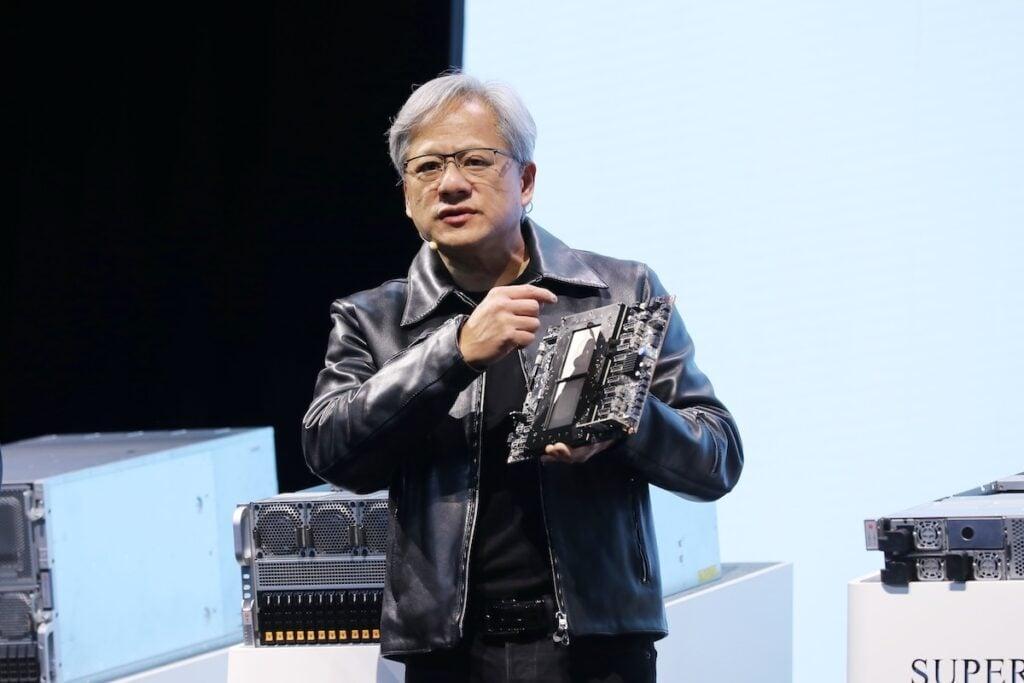
Jensen Huang Declares AI Has Reached Its Inflection Point
"AI has reached its inflection point," declared Jensen Huang, Nvidia's founder and CEO, during the earnings announcement
1
. Huang emphasized that artificial intelligence is now "doing useful work" with tokens that are "productive and profitable," marking a fundamental shift where "compute is revenue"1
. The CEO highlighted the emergence of multiple frontier AI labs scaling in parallel, a thriving open-model ecosystem, and physical AI coming online1
. The AI infrastructure buildout is "at full steam," with Nvidia's new Vera Rubin chip now in full production to power this transformative moment1
5
.
Source: Benzinga
Data Center Sales Drive AI-Driven Growth Across Customer Segments
Nvidia's Compute & Networking hardware sales reached $88.3 billion, up 18% sequentially and 114% year-over-year
1
. Data center customers purchased $89 billion worth of AI chips, representing a 117% increase compared to the same quarter last year1
2
. Hyperscalers acquired $48.7 billion worth of hardware, up 102% year-over-year and 13% quarter-over-quarter1
. Notably, revenue from AI Clouds, Industrial and Enterprise customers climbed to $40.3 billion, surging 138% year-over-year and 25% quarter-over-quarter1
. This faster growth rate in the ACIE segment signals that AI demand is broadening beyond hyperscalers to include expanding capacity at firms such as CoreWeave and Nebius, along with a deeper partnership with Amazon Web Services2
.Massive $160 Billion Memory Commitments Signal Long-Term Supply Strategy
Nvidia dramatically increased its long-term purchase commitments from $119 billion in Q1 fiscal 2027 to $279 billion in the second quarter, with the bulk "primarily related to the procurement of memory"
1
. These commitments include a memory supply pact with SK hynix and represent a strategic move to ensure shipment growth rather than precautionary inventory-building1
. The company is effectively reserving memory chips and other capacity because it expects AI demand to exceed what the supply chain can deliver through at least the end of fiscal 20281
. These massive commitments underscore the ongoing supply constraints facing both TSMC, Nvidia's main manufacturer, and memory chip producers3
5
.
Source: Market Screener
Related Stories

Revenue Guidance Projects 70% Growth Despite Supply Bottlenecks
For the third quarter of fiscal 2027, Nvidia expects revenue of approximately $108 billion, plus or minus 2%, surpassing Wall Street expectations of $104.86 billion
1
4
. CFO Colette Kress revealed that the company expects revenue growth of 70% for fiscal 2028, which runs from February 2027 to January 20283
5
. Jensen Huang emphasized that demand "is much greater than 70%," but supply constraints limit what the company can deliver3
. "Even though our demand is much greater than 70%, our supply allows us to confidently deliver 70%. The unconstrained would be a lot, a lot higher," Huang explained1
. Kress noted that "customers' forecasts point to our growth doubling next year," confirming that the AI spending boom remains intact5
. The company's management explicitly stated that supply will remain a bottleneck at least through fiscal 20281
.Market Response and Analyst Outlook on AI Infrastructure Investment
Nvidia shares rose approximately 6% in premarket trading on Thursday as investors embraced the chipmaker's strong long-term outlook
2
3
. Following the results, at least 10 brokerages raised their price targets on the shares2
. Morgan Stanley analysts stated that "70% growth supply constrained is a remarkable figure," and noted that Nvidia's push into cloud revenue-sharing could become a fresh catalyst for the stock. The forecast offers fresh ammunition to bulls after Nvidia's shares fell nearly 12% from their May peak as investors increasingly demanded evidence that the AI spending boom would last2
. The stock trades at 17.9 times forward earnings estimates, well below Advanced Micro Devices' 37.2 times and Intel's 46.2 times2
. Analysts also pointed to potential threats from custom semiconductors built by hyperscalers and AI labs like OpenAI, though these concerns were overshadowed by the strong revenue guidance3
. The company's outlook excludes data center compute revenue from China due to uncertainties with export restrictions and import licenses1
.References
Summarized by

Navi
[1]
Related Stories
Nvidia's Record-Breaking Earnings Fuel AI Boom Amid Market Scrutiny
22 Aug 2025•Business and Economy

Nvidia Surges Past $5 Trillion Market Cap as CEO Huang Reveals $500 Billion Order Backlog
04 Nov 2025•Business and Economy

Nvidia Stock Hits Cheapest Valuation Since 2019 After $1 Trillion Wipeout, But AI Chips Rally Looms
10 Jul 2026•Business and Economy

Recent Highlights



Recent Highlights
Today's Top Stories







Don’t drown in AI news. We cut through the noise - filtering, ranking and summarizing the most important AI news, breakthroughs and research daily. Follow topics that matter to you and stay ahead.


