Nvidia RTX PRO 5500 Blackwell delivers 84GB VRAM with 21760 CUDA cores for AI and workstation tasks


3 Sources
[1]
Gaming takes a backseat as Nvidia overhauls the RTX 5090 for maximum AI margins -- RTX Pro 5500 delivers 2.6X VRAM at matching specs
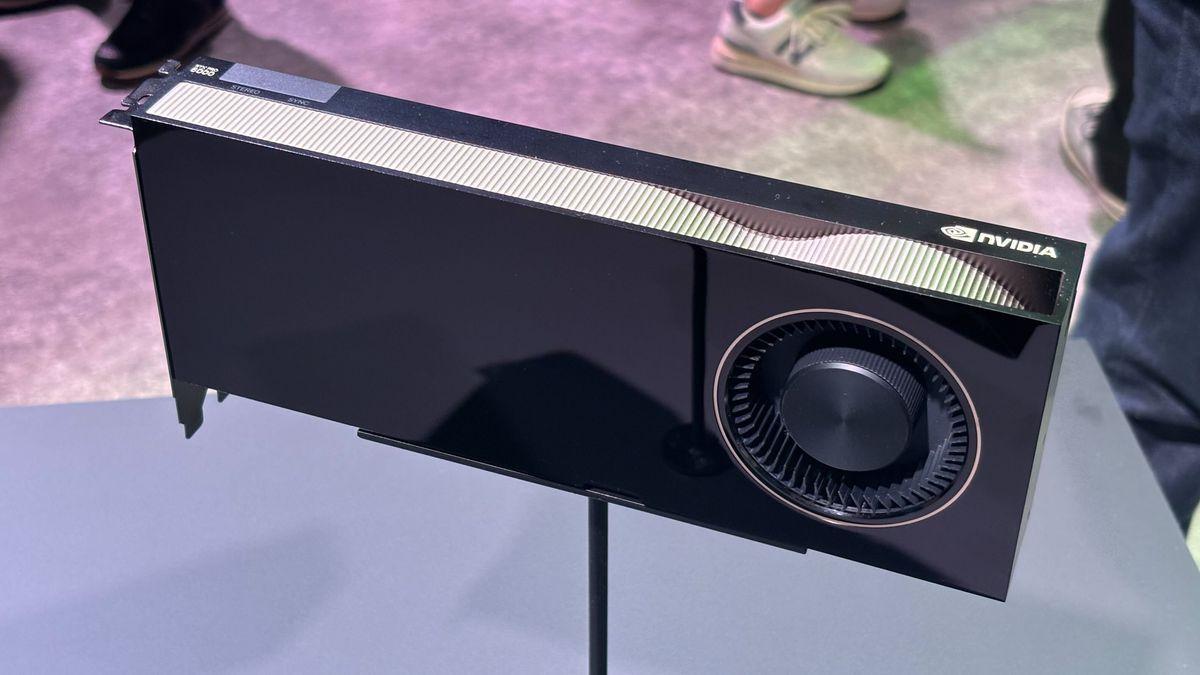
The GeForce RTX 5090 is undeniably one of the best graphics cards money can buy. Banking on the fact that many already use it for AI, Nvidia has bolstered it with even more memory and launched it as the new RTX 5500 Pro Blackwell Workstation Edition. It offers comparable specifications to the
[2]
Nvidia RTX PRO 5500 Blackwell: 84GB GDDR7 / 21760 CUDA Cores
Nvidia has added the RTX PRO 5500 Blackwell to its professional graphics lineup, a workstation card built on the same silicon configuration as the GeForce RTX 5090, RTX 5090 D, and RTX 5090 D v2. The card carries 21,760 CUDA cores, matching the top-end consumer die count, but pairs the GPU with
[3]
NVIDIA Intros RTX PRO 5500 Blackwell Graphics Card, Features Same Core Count As The 5090 But With 2.6x The VRAM
NVIDIA's latest addition to the Blackwell PRO family is the RTX PRO 5500 Workstation Edition graphics card with 84 GB of memory. NVIDIA RTX PRO 5500 Blackwell Workstation Edition Graphics Card Packs 21,760 Cores & 84 GB Memory The NVIDIA RTX PRO "Blackwell" family is one of the most extensive PRO
Share
Copy Link
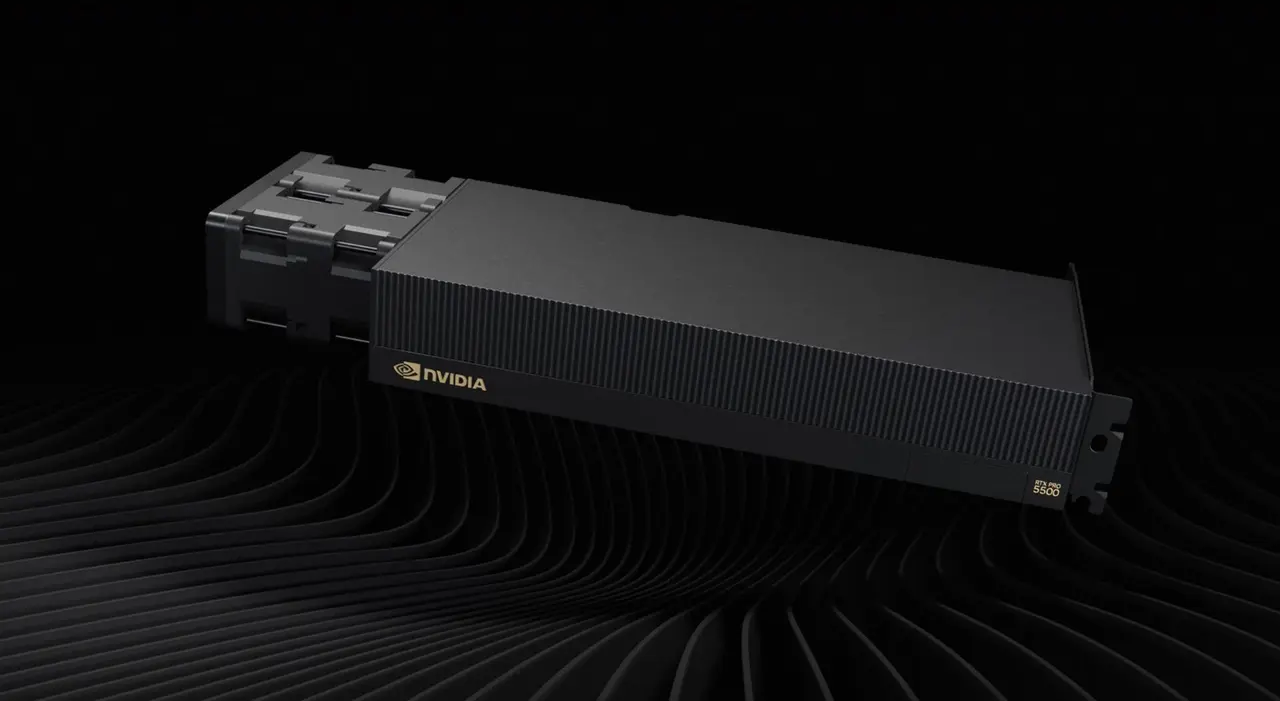
Nvidia unveiled the RTX PRO 5500 Blackwell workstation graphics card featuring 84GB of GDDR7 memory and 21760 CUDA cores—matching the GeForce RTX 5090's core count but delivering 2.6X more VRAM. Built on Blackwell architecture with the GB202 GPU, the card targets large-model inference, rendering, and AI workloads while filling the gap between RTX Pro 5000 and RTX Pro 6000.
Nvidia RTX PRO 5500 Bridges Workstation Lineup with Massive Memory
Nvidia has introduced the RTX PRO 5500 Blackwell workstation graphics card, a professional GPU that shares the same GB202 GPU silicon and 21760 CUDA cores as the GeForce RTX 5090 but distinguishes itself with 84GB of GDDR7 memory—2.6X more VRAM than its gaming counterpart.
1
The card fills a strategic gap in Nvidia's professional and enterprise workstation lineup, positioned between the RTX Pro 5000 with 72GB and the flagship RTX Pro 6000 with 96GB.1
Source: Wccftech
Built on Blackwell architecture, the RTX PRO 5500 features 170 enabled Streaming Multiprocessors out of a possible 192, matching the configuration found in the GeForce RTX 5090.
1
This decision reflects Nvidia's strategy of mirroring its GeForce Blackwell dies into the RTX PRO workstation stack with substantially expanded memory pools, serving professional visualization, AI and high-performance computing, and scientific computing markets without requiring separate architecture.2
Memory Configuration Prioritizes Capacity Over Bandwidth
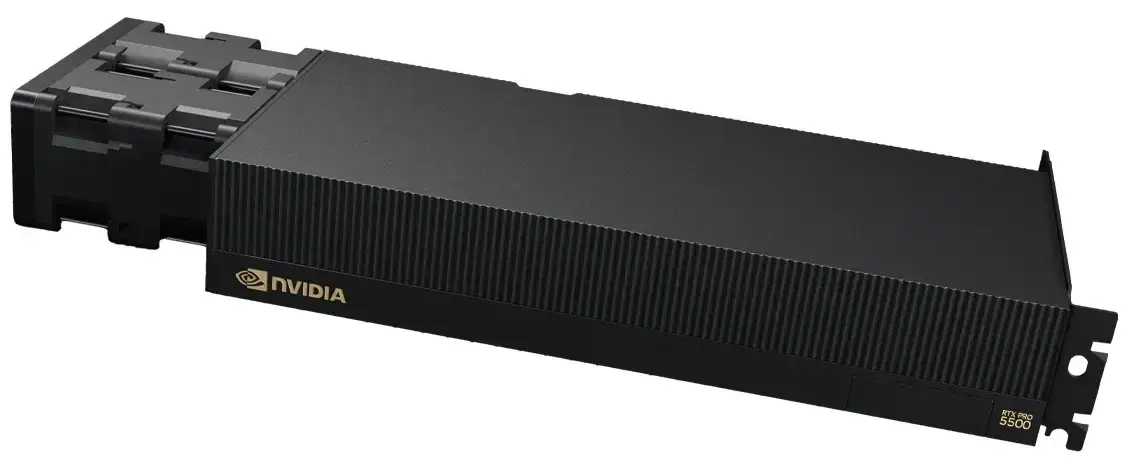
Nvidia achieved the 84GB memory capacity by outfitting the RTX PRO 5500 with 28 GDDR7 memory chips in a clamshell configuration, with each side of the PCB housing 14 24Gb (3GB) GDDR7 memory modules.
1
These modules run at 25 Gb/s across a 448-bit memory interface, delivering up to 1,398 GB/s of bandwidth.1
Source: Guru3D
The memory operates at around 27 Gbps speeds, positioning the card slightly above the RTX PRO 5000 in bandwidth but 22% slower than both the RTX Pro 6000 and GeForce RTX 5090, which fully leverage 28 Gb/s GDDR7 memory chips.
1
3
Nvidia downclocks the memory modules from their standard 28 Gb/s specification, likely to meet thermal and power targets or avoid cannibalizing higher-tier SKUs.1
Targeting Large-Model Inference and Dataset-Heavy Workloads
The 84GB capacity places the RTX PRO 5500 well above typical consumer cards and into territory commonly associated with data-center GPUs, though it retains a workstation form factor and driver stack through Nvidia RTX Enterprise drivers.
2
The card accelerates agentic AI, physical simulation, and rendering workloads for teams requiring workstation power at scale.3
The RTX PRO 5500 supports Multi-instance GPU functionality, which partitions one card into two instances with 42 GB of memory each, enabling efficient resource allocation for multiple simultaneous workloads.
3
This arrives as demand for high-VRAM single-GPU solutions for large-model inference continues growing among developers and small studios seeking to avoid multi-GPU orchestration overhead.2
Related Stories
Thermal Solutions and Technical Specifications
The RTX PRO 5500 will be offered in both air-cooled and liquid-cooled variants, designed for rack-mounted workstation deployment to let teams centralize, share, and scale workstation GPU power across enterprises.
2
3
The card features a 600W TDP and includes up to four DisplayPort 2.1b outputs, a PCIe Gen5 x16 connector interface, and a single CEM5 16-pin connector for power.3
Nvidia mentions a trio of 9th Generation NVENC and 6th Generation NVDEC engines on the chip, alongside 680 TMUs, 680 Tensor cores, 176 ROPs, and 170 RT cores with a 96 MB L2 cache—though exact specifications may vary from the GeForce RTX 5090.
3
Profit Margins Drive Strategic Positioning
Nvidia's main motivation centers on filling the large performance and pricing gap between the RTX Pro 6000 and RTX Pro 5000 while maximizing profit margins.
1
The chipmaker generates substantially more profit by placing recycled GB202 silicon into an RTX PRO 5500 than into a GeForce RTX 5090, hoping to win customers over with expanded memory at similar core specifications.1
Pricing remains undisclosed, but given that the RTX Pro 6000 retails for $15,599 and the RTX Pro 5000 72GB starts at $9,209, industry observers expect the RTX PRO 5500 to fall somewhere within this range.
1
The timing arrives against continued reporting on tight GDDR7 and general DRAM supply through 2026, meaning this workstation SKU carrying 84GB of premium memory faces elevated component costs across the industry.2
References
Summarized by

Navi
[1]
Related Stories
Nvidia Unveils RTX Pro 6000 Blackwell: A Powerhouse GPU for AI and Professional Workloads
19 Mar 2025•Technology
NVIDIA's RTX PRO 6000 Blackwell: A $10,000+ Powerhouse GPU for Professional Workloads
05 May 2025•Technology
NVIDIA's Blackwell GPU Powerhouse: RTX PRO 6000 X with 96GB GDDR7 for AI and Intensive Workloads
08 Mar 2025•Technology
Recent Highlights



Recent Highlights
Today's Top Stories







Don’t drown in AI news. We cut through the noise - filtering, ranking and summarizing the most important AI news, breakthroughs and research daily. Follow topics that matter to you and stay ahead.


