Nvidia's $4,399 desktop wants to run your AI at home, not in the cloud


4 Sources
[1]
Nvidia and Microsoft Bring RTX Spark to Compact Desktops
Powered by the N1X superchip and up to 128GB of unified memory, the new compact machines are built to run AI models locally. The Nvidia-Microsoft team-up that produced the RTX Spark line of laptops just a few short weeks ago has expanded to include a new class of small-form-factor Windows PCs
[2]
Nvidia's RTX Spark Desktops Imagine They Can Actually Compete With the Mac Studio
Nvidia seems to think you'd rather spend $20 on an electric bill than $1,200 on AI tokens. That doesn't mean these PCs are cheap. As if Nvidia wasn't already blowing up your news feed, the company wants you to consider that it's still making PC chips and not just making you nervous about the
[3]
NVIDIA RTX Spark Compact Desktops Out Now
Systems from ASUS, Dell and MSI are now available -- with more from Acer, GIGABYTE, HP and Microsoft on the way -- bringing RTX acceleration and up to 128GB of unified memory to local AI, development and creative workflows. New NVIDIA RTX Spark compact desktops from ASUS, Dell and MSI are
[4]
NVIDIA launches RTX Spark desktops and a four-system DGX Spark kit
NVIDIA is expanding its local AI hardware range with compact RTX Spark desktops from ASUS, Dell and MSI. The company says these Windows PCs are now available and can handle AI agents, image and video generation, and model fine-tuning locally. At Supercomputing 26 in Chicago, NVIDIA also introduced
Share
Copy Link
Nvidia and Microsoft have launched RTX Spark compact desktops, a new class of small Windows machines built to run AI models locally, with machines from Asus, Dell and Micro-Star International on sale now
1
3
2
4
. The pitch is simple: stop paying per token in the cloud and let a box in your house do the work.
Source: NVIDIA
Nvidia's argument is that cloud economics have shifted: running AI on hardware you own is now cheaper, more private and more secure than paying per token through an API
1
3
. By Nvidia's math, a desktop generates about 61 million output tokens a month for roughly $20 of electricity1
2
. The same output costs $1,200 in API fees via Anthropic's Claude Sonnet 5.5 Medium1
2
. Gizmodo calls that math ironic, given Nvidia's hardware starts at $4,3992
. "Nvidia seems to think you'd rather spend $20 on an electric bill than $1,200 on AI tokens. That doesn't mean these PCs are cheap," the outlet writes2
.The hardware
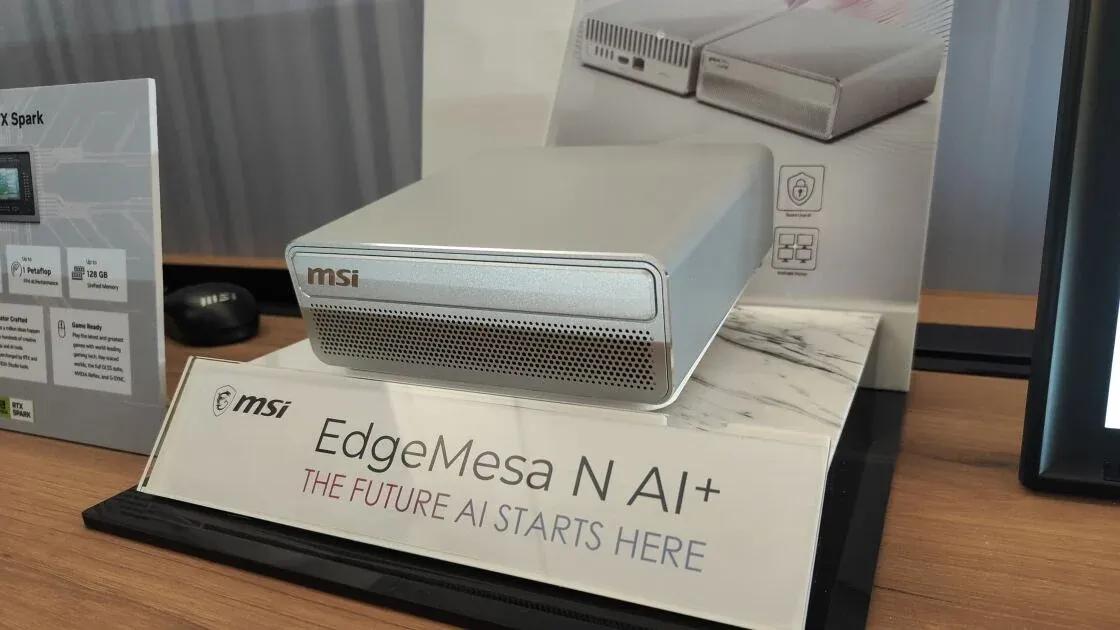
Every desktop uses the same top configuration: Nvidia's N1X Superchip, pairing a 6,144-core Blackwell RTX GPU with a 20-core Grace CPU designed with MediaTek
1
3
4
. It delivers a petaflop of compute using 4-bit floating point, with up to 128GB of unified memory1
3
4
. With the full 128GB, Nvidia says a desktop can run a 120-billion-parameter model with a 1 million-token context window locally1
3
4
. The RTX Spark laptops that went on sale in October came in cheaper variants; the desktops offer a choice between 64GB and 128GB of memory1
2
.
Source: PC Magazine
The line is distinct from the earlier DGX Spark desktops, which were built for local AI and not much else; these also run games and ordinary Windows software
2
.The household hub
Nvidia positions the desktop as an always-on appliance for home automation, security and calendars
1
2
. Its software routes AI tasks from other household devices, including laptops and MacBooks, to idle machines on the network1
2
. A desktop, unlike a power-limited laptop, can sit at home running agents around the clock3
2
.Microsoft's contribution is at the operating-system level: agentic Windows features including OpenShell, sandboxing and fine-grained permission controls, plus NeMo Switchyard in Hermes for routing tasks between local and cloud models
1
3
. Nvidia claims day-zero support from llama.cpp, Ollama, LM Studio and other tools, alongside integrations with Microsoft 365, Google Workspace, Slack and Adobe apps1
3
.Related Stories

The competition
Gizmodo frames the machines against Apple's Mac Studio, which starts at $2,500 with an M5 Max chip and runs to about $3,099, and against Advanced Micro Devices' Ryzen AI Max+ 495 workstations
2
. Per Gizmodo, even a maxed-out RTX Spark cannot match Apple's latest M-series chips on raw CPU and GPU performance, based on the outlet's earlier comparisons2
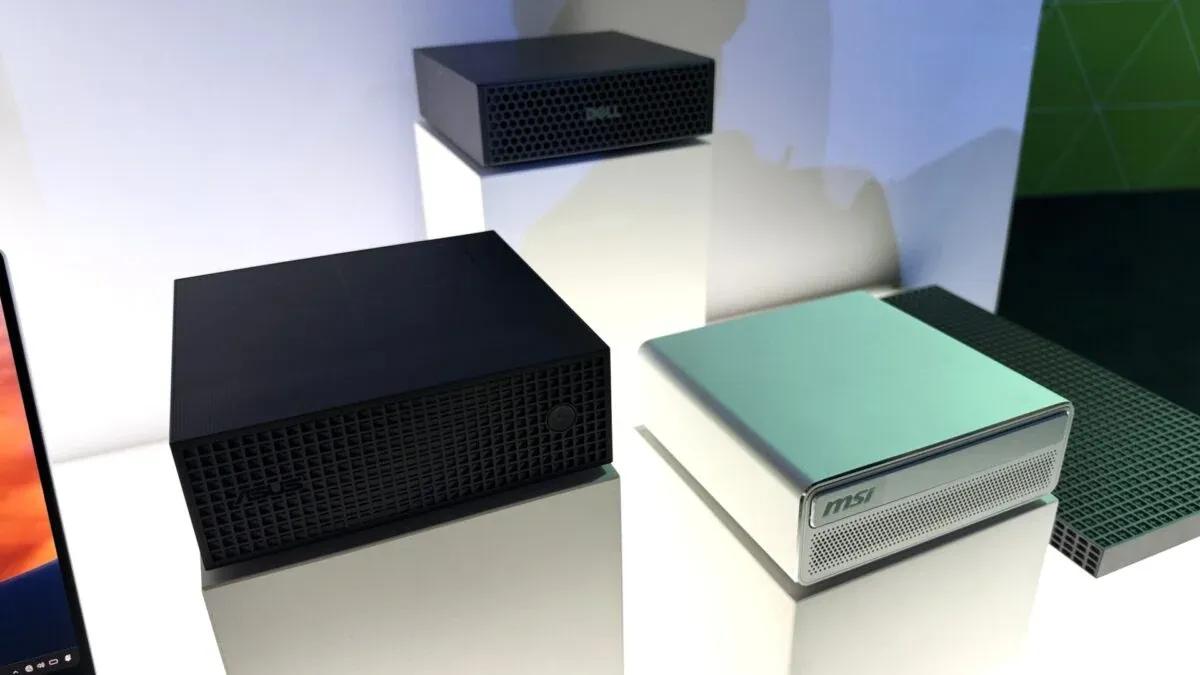
.Availability is staggered: Asus, Dell and Micro-Star International shipped systems on day one
1
3
2
. Acer, Gigabyte, Hewlett-Packard and a Microsoft Surface Dev Box follow over the coming weeks1
3
. Per Gizmodo, Acer's small-form-factor model may not arrive until early 20272
.
Source: Gizmodo
Nvidia also used Supercomputing 26 in Chicago to introduce the DGX Spark HPC Developer Kit, a four-system cluster linked in a ring over ConnectX-7 with 512GB of combined memory
4
. Nvidia says it supports models up to 700 billion parameters and is aimed at researchers developing multi-node software before scaling to larger supercomputers4
. Its own materials disagree on storage: 20TB in the press information against 16TB in the Supercomputing blog, and Guru3D advises buyers to confirm the final configuration4
.Per Gizmodo, Apple wins on price and raw performance, while Nvidia's advantage is variety: seven computer makers building the machines against Apple's single lineup
2
.References
Summarized by

Navi
[1]
Related Stories
Nvidia Launches DGX Spark: A Tiny AI Powerhouse for Desktops
13 Oct 2025•Technology

Nvidia RTX Spark AI PCs Set for October Launch as Lenovo Unveils First Hardware at IFA 2026
03 Sept 2026•Technology
Nvidia Unveils DGX Spark and DGX Station: Personal AI Supercomputers for the Desktop
19 Mar 2025•Technology
Recent Highlights


Recent Highlights
Today's Top Stories








Don’t drown in AI news. We cut through the noise - filtering, ranking and summarizing the most important AI news, breakthroughs and research daily. Follow topics that matter to you and stay ahead.


