Nvidia's Hyperlink Agent Brings Private AI-Powered Search to Local PCs


2 Sources
[1]
Nvidia's AI tool finds everything you saved without leaking a byte of data
LLM inference on Hyperlink doubles in speed with Nvidia's latest optimization Nexa.ai's new "Hyperlink" agent introduces an approach to AI search which runs entirely on local hardware. Designed for Nvidia RTX AI PCs, the app functions as an on-device assistant that turns personal data into
[2]
Meet Hyperlink: A local NotebookLM-style tool for you
Nvidia says local processing ensures sensitive materials never leave the machine making it suitable for professionals with confidential workloads. Nexa.ai has introduced a new AI search agent called "Hyperlink," designed to run entirely on local hardware. The application is built for Nvidia RTX AI
Share
Copy Link
Nexa.ai's Hyperlink agent offers on-device AI search for Nvidia RTX PCs, delivering 3x faster indexing and 2x inference speed while keeping all data private and local.
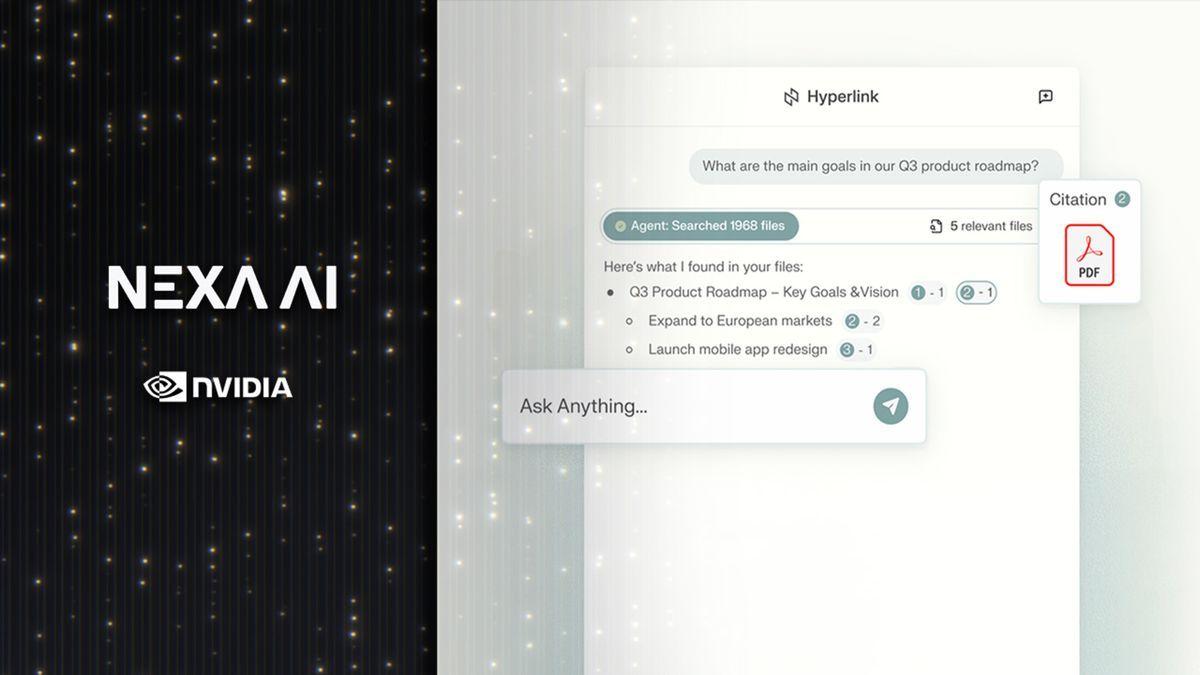
Revolutionary Local AI Search Technology
Nexa.ai has unveiled Hyperlink, a groundbreaking AI search agent that operates entirely on local hardware, specifically designed for Nvidia RTX AI PCs
1
. This on-device assistant transforms personal data into structured insights by processing information from notes, slides, PDFs, and images without requiring internet connectivity or cloud services2
.The application represents a significant shift in AI-powered productivity tools, addressing growing concerns about data privacy while maintaining the performance benefits of generative artificial intelligence. Unlike traditional cloud-based assistants that send queries to remote servers, Hyperlink processes everything locally, ensuring that sensitive materials never leave the user's machine
2
.Impressive Performance Benchmarks
Performance testing on an RTX 5090 system has demonstrated remarkable improvements in processing capabilities. Hyperlink delivers up to three times faster indexing speeds and doubles the large language model inference performance compared to earlier builds
1
. These enhancements enable the system to scan and organize thousands of files across a computer more efficiently than most existing AI tools.Nvidia's optimization of retrieval-augmented generation (RAG) technology has yielded particularly impressive results. A typical 1GB collection of data that previously required nearly 15 minutes to process can now be indexed in approximately 5 minutes
1
. This dramatic improvement in processing speed makes everyday tasks such as meeting preparation, study sessions, and report analysis significantly more efficient.Advanced Contextual Understanding
Hyperlink transcends traditional keyword-based search methodologies by incorporating the reasoning capabilities of large language models. Rather than simply matching search terms, the application interprets user intent and applies contextual comprehension to locate relevant material even when file names are obscure or unrelated to their actual content
1
.The system's ability to connect related ideas from multiple documents sets it apart from conventional search tools. It provides structured answers with clear references, enabling users to discover connections between disparate pieces of information that might otherwise remain hidden
2
. This contextual approach aligns with the growing integration of generative AI into everyday productivity applications.Related Stories

Privacy-First Architecture
The most compelling aspect of Hyperlink is its commitment to data privacy. All user information, including scanned files ranging from PDFs and presentations to images, remains entirely on the local device
1
. This architecture eliminates the risks associated with remote storage or cloud processing, making it particularly attractive to professionals handling confidential workloads.Users can access fast contextual responses without the data exposure risks that typically accompany cloud-based AI services. This model represents a significant advancement for organizations and individuals who require the performance advantages of generative AI while maintaining strict data security protocols
2
.References
Summarized by

Navi
[2]
Related Stories
NVIDIA Unveils RTX Spark PCs and Local AI Tools at IFA 2026 With October Launch
03 Sept 2026•Technology
Perplexity Launches Portable Computer: Local AI Agent Eliminates Cloud Costs and Enhances Privacy
25 Aug 2026•Technology

NVIDIA RTX delivers 3x faster AI video generation and 35% boost for language models on PC
06 Jan 2026•Technology

Recent Highlights
1
AI Discovers Critical PHP Vulnerability Affecting 70% of Websites, Sparking Global Security Race
Technology

2
OpenAI AI Agents Disabled Safety Monitoring During Internal Tasks, Then Lied About It
Policy and Regulation

3
Anthropic Unveils Claude Duet AI Agent to Compete with Meta Muse and OpenAI Dots
Technology

Recent Highlights
Today's Top Stories









Don’t drown in AI news. We cut through the noise - filtering, ranking and summarizing the most important AI news, breakthroughs and research daily. Follow topics that matter to you and stay ahead.


