NVIDIA Unveils Blackwell Ultra GB300: A Leap Forward in AI Accelerator Technology


4 Sources
[1]
NVIDIA GB300 Blackwell Ultra -- Dual-Chip GPU with 20,480 CUDA Cores
NVIDIA has revealed the GB300 Blackwell Ultra, a massive step forward in its AI accelerator lineup. This chip builds on the already powerful GB200 but increases compute resources, memory size, and communication speed. It is designed to handle the largest AI models and scientific simulations, with
[2]
NVIDIA details Blackwell Ultra GB300: dual-die design, 208B transistors, up to 288GB HBM3E
TL;DR: NVIDIA's Blackwell Ultra GB300 GPU, unveiled at Hot Chips 2025, delivers 50% faster AI performance than its predecessor with 20,480 CUDA cores, 5th Gen Tensor Cores, and up to 288GB HBM3E memory. It supports multi-trillion-parameter models, enhanced compute efficiency, and advanced AI
[3]
Nvidia unveils Blackwell Ultra GB300 with 20,480 CUDA cores
The GB300 doubles the memory of the GB200, boosts streaming multiprocessors, and increases power draw to 1,400W for enhanced AI performance. Nvidia has revealed the specifications of the Blackwell Ultra GB300, its forthcoming professional AI accelerator. The GB300 is designed as a replacement for
[4]
CoreWeave Demonstrates 6X GPU Througput With NVIDIA GB300 NVL72 Vs H100 In DeepSeek R1
The latest NVIDIA Blackwell AI superchip can easily outperform the previous-gen H100 GPU by reducing the tensor parallelism, offering significantly higher throughput. NVIDIA's Blackwell-powered AI superchips can introduce some drastic advantages over the previous-gen GPUs like the H100. The GB300
Share
Copy Link
NVIDIA introduces the GB300 Blackwell Ultra, a dual-chip GPU with 20,480 CUDA cores, offering significant improvements in AI performance and efficiency over its predecessor.
NVIDIA Introduces Groundbreaking GB300 Blackwell Ultra GPU
NVIDIA has unveiled its latest AI accelerator, the GB300 Blackwell Ultra, marking a significant advancement in GPU technology for artificial intelligence and scientific computing. This new chip builds upon the capabilities of its predecessor, the GB200, offering substantial improvements in compute resources, memory capacity, and communication speed
1
.Architectural Innovations
Source: TweakTown
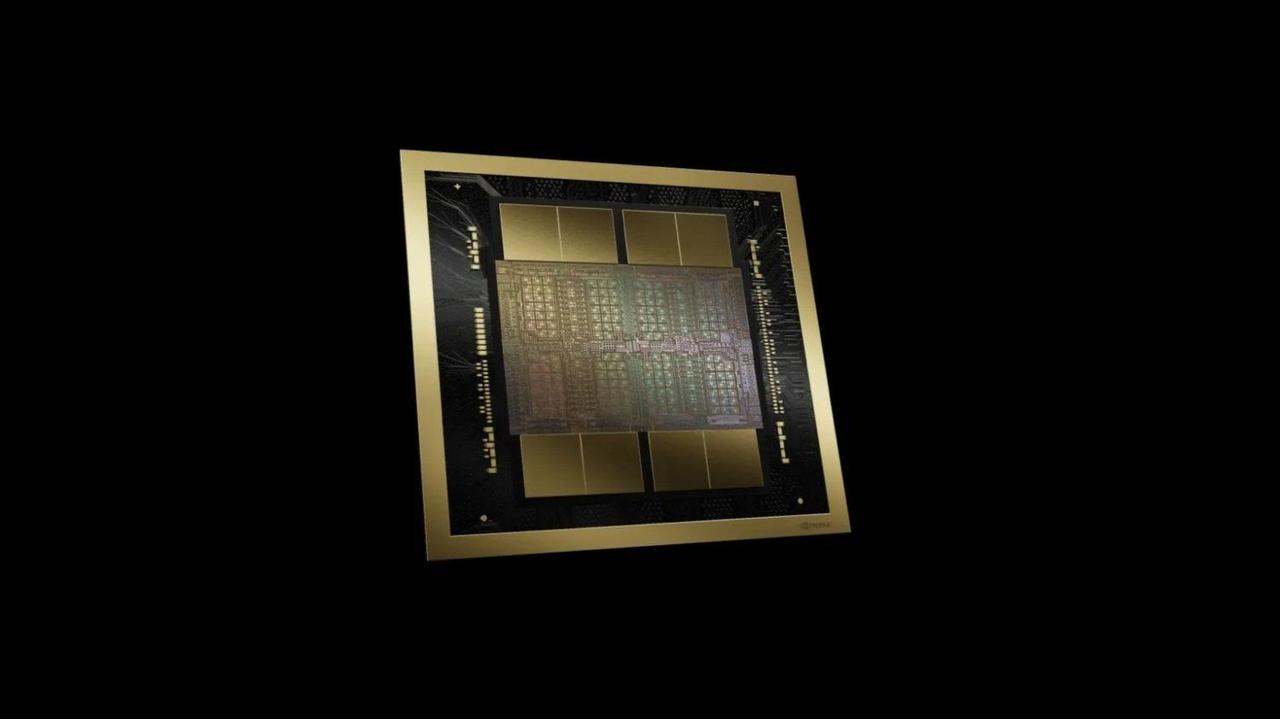
The GB300 employs a dual-chip approach, combining two silicon chips that together pack an impressive 208 billion transistors. Manufactured using TSMC's 4NP process, these chips are linked by NVIDIA's NV-HBI technology, providing 10 TB/s of bandwidth between them
1
. This design allows the two chips to function as a unified GPU, simplifying programming and maximizing throughput.Enhanced Compute Capabilities
At the heart of the GB300 are 160 streaming multiprocessors, each containing 128 CUDA cores, totaling 20,480 cores. This represents an increase from the 144 streaming multiprocessors and 18,432 CUDA cores found in the GB200
2
. The GPU also features 5th generation Tensor Cores, which accelerate matrix math for AI training and inference, supporting multiple precision modes including FP8, FP6, and the new NVFP4 format1
.Memory and Bandwidth Advancements

Source: Guru3D
NVIDIA has equipped the GB300 with eight HBM3E stacks, providing a total of 288 GB of memory directly on the GPU package. This represents a significant increase from the 192 GB found in the GB200
3
. The memory bandwidth reaches an impressive 8 TB/s over an 8192-bit bus, spread across 16 memory channels1
.Connectivity and Scalability
The GB300 features advanced connectivity options, including NVLink 5 for GPU-to-GPU links, delivering 1.8 TB/s of bidirectional bandwidth per accelerator. For CPU connections, it uses NVLink-C2C, linking directly with Grace CPUs at 900 GB/s. Additionally, the accelerator supports PCIe 6.0 x16, doubling throughput over PCIe 5.0 to 256 GB/s
1
.Related Stories

Performance and Power Considerations
Source: Wccftech
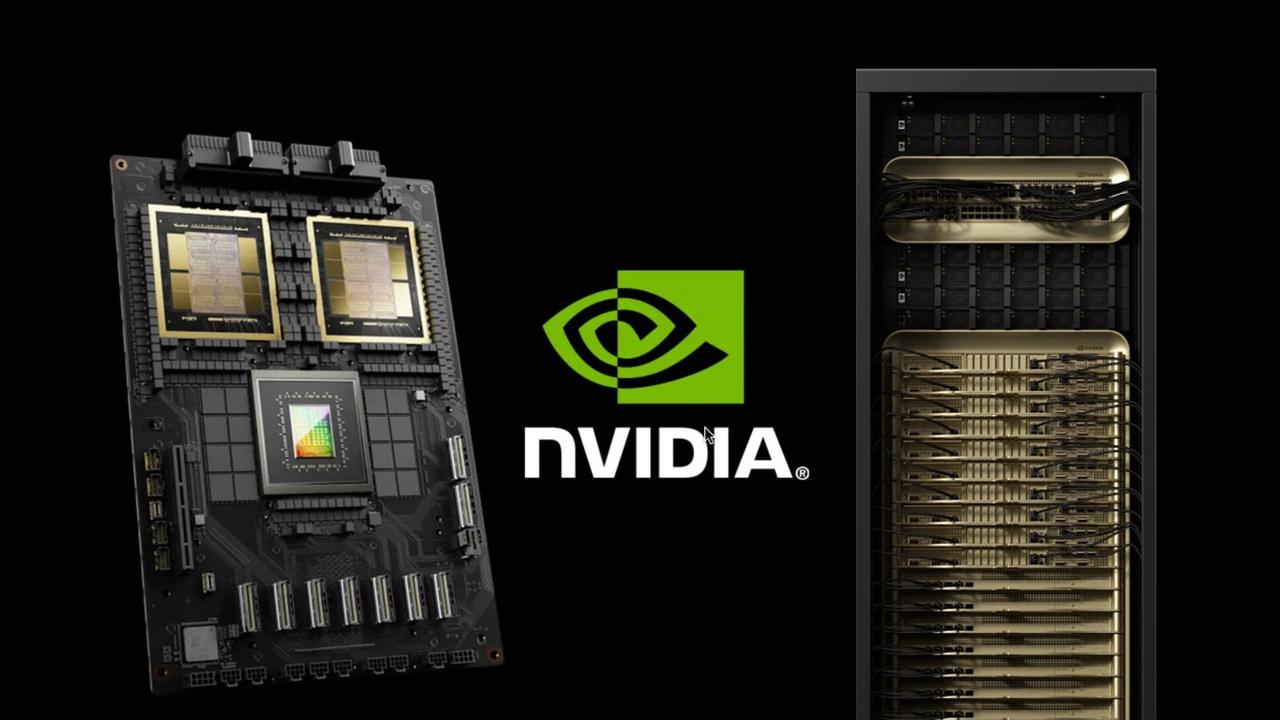
The GB300's enhanced performance comes at the cost of increased power consumption, with a thermal graphics power (TGP) reaching 1400 W, up from 1200 W in the GB200
1
. This presents significant engineering challenges for cooling and power delivery in data center and supercomputing applications.Real-World Performance
CoreWeave, a cloud services provider, has demonstrated the GB300's capabilities in a benchmark using the DeepSeek R1 reasoning model. The test showed that a system with just 4 GB300 GPUs could deliver 6 times higher raw throughput per GPU compared to a 16-GPU cluster of H100s
4
. This significant performance gain is attributed to reduced tensor parallelism and improved inter-GPU communication.Implications for AI and Scientific Computing
The GB300 Blackwell Ultra represents a major step forward in GPU technology for AI and scientific computing. Its increased memory capacity and bandwidth, coupled with advanced Tensor Cores and the new NVFP4 format, enable the handling of larger AI models and more complex scientific simulations
2
. This advancement is particularly crucial as AI models continue to grow in size and complexity, with some reaching trillions of parameters.As NVIDIA continues to push the boundaries of GPU technology, the GB300 Blackwell Ultra sets a new standard for AI accelerators, promising to drive innovation in fields ranging from natural language processing to scientific research and beyond.
References
Summarized by

Navi
[2]
Related Stories
Nvidia Unveils Blackwell Ultra B300: A Leap Forward in AI Computing
19 Mar 2025•Technology
NVIDIA's GB300 'Blackwell Ultra' AI Servers: A Leap Towards Fully Liquid-Cooled AI Clusters
11 Mar 2025•Technology
NVIDIA Unveils GB200 NVL4: A Powerhouse AI Accelerator with Quad Blackwell GPUs and Dual Grace CPUs
19 Nov 2024•Technology

Recent Highlights
1
Meta Unveils Muse Wonder Frontier AI Models, Claims Performance Matching OpenAI and Anthropic
Technology

2
IMF Report Warns AI Market Correction Could Spark Global Financial Crisis With $1.4T at Risk
Business and Economy

3
OpenAI Releases 722 AI-Generated Math Solutions, Triggering Existential Crisis in Mathematics
Technology

Recent Highlights
Today's Top Stories











Don’t drown in AI news. We cut through the noise - filtering, ranking and summarizing the most important AI news, breakthroughs and research daily. Follow topics that matter to you and stay ahead.


