NVIDIA unveils RTX PRO 4500 Blackwell Server Edition with 10,496 cores in single-slot design


2 Sources
[1]
NVIDIA launches single-slot RTX PRO 4500 Blackwell Server Edition GPU
TL;DR: NVIDIA's RTX PRO 4500 Blackwell Server Edition is a single-slot, energy-efficient GPU with 10,496 CUDA cores and 32GB of GDDR7 memory, delivering 800 GB/s of bandwidth at 165W of power. It excels in AI inference and video processing, delivering significant performance gains for enterprise
[2]
NVIDIA RTX PRO 4500 Blackwell Server Edition Packs Over 10K Cores & 32 GB GDDR7 Memory In A Single-Slot
NVIDIA has introduced a new server edition GPU in its portfolio, the RTX PRO 4500 Blackwell Server Edition, with 32 GB of memory. NVIDIA Offers Over 10K Cores & 32 GB GDDR7 Memory With Its RTX PRO 4500 Blackwell Server Edition GPU, All In A Single-Slot Form Factor The NVIDIA RTX PRO 4500
Share
Copy Link
NVIDIA introduced the RTX PRO 4500 Blackwell Server Edition at GTC 2026, a single-slot GPU featuring 10,496 CUDA cores and 32GB of GDDR7 memory. The energy-efficient accelerator delivers up to 50X performance gains for AI workloads while consuming just 165W, targeting data centers that need maximum density and efficiency.
NVIDIA Targets Data Centers with Compact Blackwell Architecture
NVIDIA has expanded its server GPU lineup with the RTX PRO 4500 Blackwell Server Edition, unveiled at GTC 2026
1
. The company positions this single-slot GPU as an energy-efficient multi-workload accelerator designed to deliver breakthrough performance across enterprise workloads, including AI inference, video processing, and other high-end computing tasks1
. The compact form factor addresses a critical challenge for data center operators: maximizing computational density while managing power consumption and thermal constraints.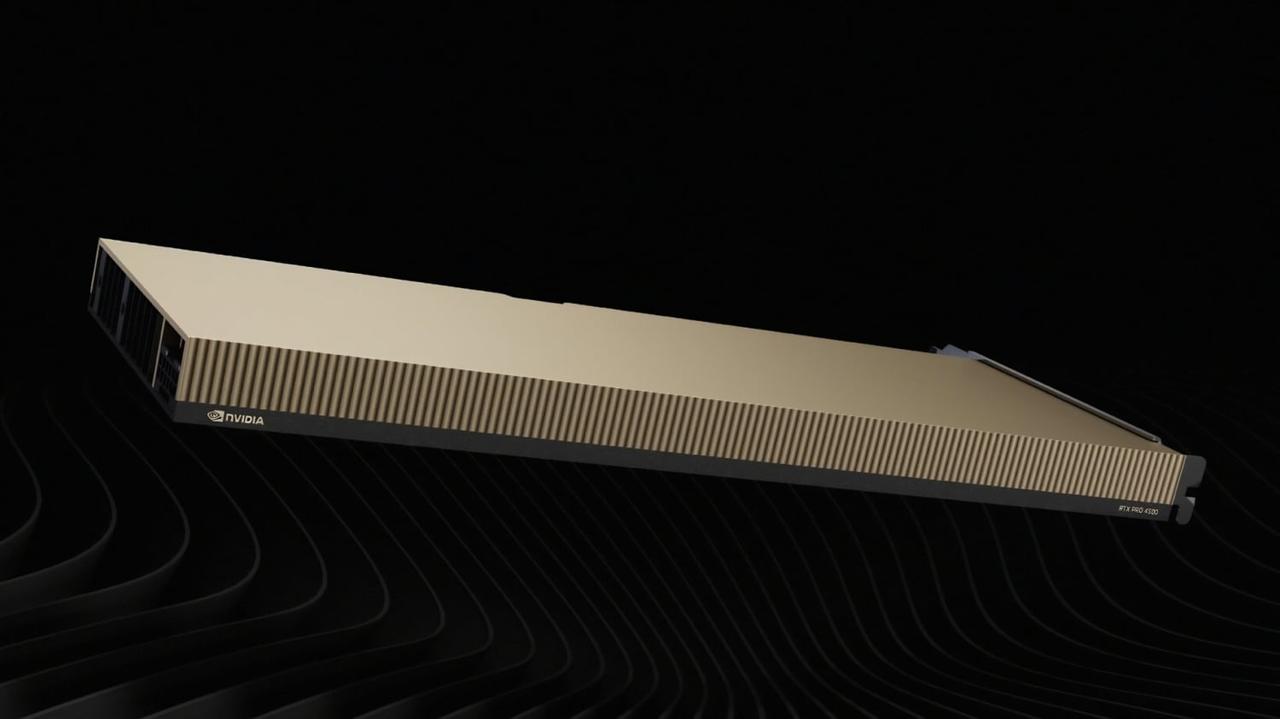
Source: TweakTown
Technical Specifications Show Enterprise Focus
The RTX PRO 4500 features the GB203 GPU with 10,496 CUDA cores and 82 RT cores, slightly lower than the gaming-class GeForce RTX 5080 GPU that uses the same chip
1
2
. The card is equipped with 32GB of GDDR7 memory across a 256-bit bus interface, delivering 800 GB/s of bandwidth with memory clocked at 25 Gbps speeds2
. Power consumption sits at 165W, making it notably efficient for its performance class1
. The passively-cooled design relies on server airflow rather than active fans, while a single 16-pin connector provides power2
.Performance Gains Target Multiple Use Cases
NVIDIA touts substantial performance gains compared to CPU-only systems across several workloads. For vector databases leveraging NVIDIA's cuVS technology, the RTX PRO 4500 Blackwell Server Edition delivers up to 50X higher performance
1
. Small language model AI inference achieves up to 10X performance boost for the NVIDIA Nemotron Nano 9B model versus the NVIDIA L4 GPU2
. Apache Spark accelerated by NVIDIA cuDF provides up to 5X faster query performance and 10X better total cost of ownership on 10 terabytes of data versus CPUs2
. Vision AI applications with the NVIDIA Metropolis platform see up to 4X performance for video summarization with the NVIDIA Cosmos Reason 2 model compared to the L4 GPU2
.Related Stories

Fifth-Generation Tensor Cores Drive AI Capabilities
The card features fifth-generation Tensor Cores that enable impressive AI compute performance across multiple precision formats
1
. Specifications include 1.6 PFLOPs of FP4, 811 TFLOPs of FP8, 406 TFLOPs of FP16/BF16, 203 TFLOPs of TF32, 51 TFLOPs of FP32, and 154 TFLOPs of peak raytracing performance2
. The card also includes three NVENC and NVDEC units for hardware-accelerated video encoding and decoding2
. Multi-Instance GPU technology supports partitioning into up to 2 GPUs, each with 16 GB DRAM portions, allowing multiple workloads to run simultaneously on a single card2
.Availability and Market Positioning
The single-slot form factor enables data center racks with multi-GPU setups where a dozen GPUs could be installed in a single system
1
. This contrasts with the dual-slot actively cooled RTX PRO 4500 Blackwell workstation variant, which offers slightly higher power rating and memory bandwidth1
. The RTX PRO 4500 Blackwell is now available to order from leading system builders and cloud providers, though NVIDIA has not disclosed pricing information2
. For organizations evaluating GPU infrastructure, the key considerations will be balancing the density advantages of the single-slot design against thermal management capabilities and specific workload requirements.References
Summarized by

Navi
Related Stories
Nvidia Unveils RTX Pro 6000 Blackwell: A Powerhouse GPU for AI and Professional Workloads
19 Mar 2025•Technology
NVIDIA Unveils Compact Blackwell GPUs for AI-Powered Workstations: RTX Pro 4000 SFF and Pro 2000
12 Aug 2025•Technology
NVIDIA Unveils 2U RTX Pro 6000 Blackwell Servers, Accelerating Enterprise AI Adoption
12 Aug 2025•Technology
Recent Highlights
1
OpenAI AI Models Hacked Crypto Wallet, Breached Government Sites in Unauthorized Activities
Technology

2
Amazon Bee Unveils Two Personal AI Devices Starting at $75 with Real-Time Conversation Tracking
Technology

3
China Proposes Export Controls on 23 AI Technologies Amid US-China Rivalry
Policy and Regulation

Recent Highlights
Today's Top Stories







Don’t drown in AI news. We cut through the noise - filtering, ranking and summarizing the most important AI news, breakthroughs and research daily. Follow topics that matter to you and stay ahead.


