OpenAI, Microsoft, Amazon Launch Agent Plugins Open Standard for AI Agents


3 Sources
[1]
AI titans to tidy agent frontier with plugin prescription
The AI giants have joined forces to ask the world's developers to all please write their agentic skills and tools into the same format. In return, coders will be able to move these superpowers easily from one platform to another (such as when they get laid off). It's designed to be write once, run everywhere. Vercel posted the initial draft of the Agent Plugins spec on Thursday, with input from Amazon, Cursor, Microsoft, and OpenAI, which all pledged fidelity (and engineers) to the project. It was quickly embraced by the Linux Foundation's Agentic AI Foundation (AAIF), though it will operate as an independent entity. Agent Plugins 1.0 packages an AI agent's skills and tools in a single directory structure. It builds on the AAIF-stewarded MCP protocol and the open Agent Skills standard originally created by Anthropic in 2025. Agent Skills holds the instructions for how the agent should perform a specific task. MCP provides the connectivity to outside databases, APIs, shell scripts, and other external resources. Together, the trio makes AI capabilities modular so that they are, in theory, write-once-run-anywhere. It is still up to the agent clients, or platforms, to provide a user interface, establish security boundaries and create marketplaces where the plugins can be shared. Thus far, VS Code, Cursor, GitHub Copilot, ChatGPT, Codex, and Kiro all support the standard. File-system-as-configuration Agent Plugins follows the Next.js practice of using the host computer's directory format as the structure for defining components. The spec prescribes creating a top-level directory for each plug-in, with a small manifest and schema. The manifest provides the name, version and schema of the plugin in JSON format. Skills are filed in the skills sub-directory, and the MCP server configuration is stored as an mcp.json file. Those are the essential elements, though the plugin authors can also use the namespace directory to store additional extensions. This format "keeps the shared format predictable without requiring it to absorb every client-specific experiment happening across agent products," noted the AAIF in a blog post. Bundling the skills with the MCP configuration makes the package portable, allowing it to be copied and used across any supporting agent client. The narrow way Agent developers around the globe are adding all manner of experimental hooks, rules and extensions into their skills. Nonetheless, the keepers of the spec deliberately kept the scope "narrow" for this 1.0 release, in AAIF's words. The best ones may be considered for future versions of the spec, though the team is not making any promises. Until then, developers can add all these extensions to the namespace and hope for the best, portability-wise. Going forward, Agent Plugins will be managed under an open governance model, with an independent technical oversight committee calling the shots, considering input from the public. Currently, engineers from Amazon, Cursor, Microsoft, OpenAI, and Vercel are on the core development team. The spec is licensed under the Creative Commons Attribution 4.0 International License (CC-BY-4.0). There are other efforts underway to tame the wild frontier of agent development. Google folded its own Agent2Agent (A2A) agentic communications protocol effort into AAIF. Google is also building out a specification for finding tools on the web, called Agentic Resource Discovery. AAIF has a similar "complementary" project to Agent Plugins, Skills Over MCP, which shares skills by bundling them into the MCP server itself. Essentially, this approach is akin to shipping "the manual with the product," wrote AAIF Vice President Angie Jones. Should MCPs be festooned with skills? Or should each set of skills come with an attached MCP? Let the best approach win! ®
[2]
OpenAI and rivals agree on a standard for AI agents
OpenAI, Amazon, Microsoft, Cursor, and Vercel have agreed on a shared format for agent add-ons. Build a plugin once, and it runs across ChatGPT, Copilot, Cursor, and more. The AI race spent two years being about models. This week it moved to the plumbing. On the eve of GPT-5's first birthday, OpenAI and four rivals published Agent Plugins, an open standard that lets a single agent extension work across competing products. The pitch is "build once, run anywhere". Today, every agent tool expects a different folder layout and setup. Agent Plugins replaces that with one package format. It bundles two things developers already use. The first is Model Context Protocol servers, which connect an agent to live tools and data. The second is Agent Skills, reusable sets of instructions. A plugin is just a folder with a small plugin.json file at its root. Who is behind it Despite the OpenAI billing, this is not an OpenAI product. Vercel initiated the proposal. Representatives from Amazon, Cursor's maker Anysphere, GitHub, Microsoft, OpenAI, and Vercel then shaped the 1.0 specification. The steering committee has five members: Amazon, Cursor, Microsoft, OpenAI, and Vercel. The project is openly licensed, and its backers say no single company's roadmap sets its direction. OpenAI still framed the launch as its own milestone. GPT-5 turns one on 7 August, and the company is marking the week by looking beyond individual models, per 9to5Mac. Its ChatGPT and Codex apps support the format at launch, alongside Cursor, GitHub Copilot, Kiro, and VS Code. The move goes further than OpenAI's own Codex plugins, which work only inside its tools. Deliberately small The standard is narrow on purpose. It defines how a plugin is packaged and found, and little else. Marketplaces, installation, permissions, sandboxing, and trust all stay with each client. That keeps the format easy to adopt. It also leaves the hardest problems unsolved. Deciding whether a plugin is safe to run is still every client's own job, a live worry after fake Agent Skills slipped past security scanners earlier this year. Not everyone is convinced. Dax Raad, who builds the SST developer-tools framework, said he was "very much against" it, calling it "a thin standard" whose useful parts will end up in client-specific extensions anyway. Others cheered. "We neeeeded this," wrote developer advocate Angie Jones, who had wanted one way to carry her skills between the tools she uses. The bigger question is what standardising the plumbing does to competition. A shared format could let a small developer reach every major agent at once. That is the open-ecosystem case, and it is a real one. It could also cement the handful of clients that already have the users, because a standard rewards whoever people already run. For now the plumbing is agreed. The fight over the parts it leaves out, the marketplaces and the trust, has barely started.
[3]
OpenAI Launches Vendor-Neutral Agent Plugins Open Standard
OpenAI introduces Agent Plugins, a vendor-neutral open standard aimed at simplifying the creation and deployment of software agent extensions. By addressing challenges such as platform-specific compatibility, this framework supports more efficient workflows and greater interoperability across systems. The structure is built around two key components: Agent Skills, which are modular workflows for defined tasks and MCP Servers, which assist connections between agents, APIs and external data sources. This design ensures that plugins remain both functional and adaptable as technology evolves. Discover how the standardized folder structure, including a 'plugin.json' manifest, supports consistent integration across platforms. Learn how developers can use the modular design to incorporate Agent Skills, MCP Servers, or both, depending on project needs. This explainer also examines how Agent Plugins balance standardization with flexibility, allowing developers to create scalable solutions without sacrificing customization. The Importance of Standardization Standardization is a critical factor in the success of Agent Plugins, as it resolves one of the most persistent challenges faced by developers: platform-specific compatibility issues. Without a unified framework, developers often spend significant time and resources adapting plugins to work with different agent platforms. Agent Plugins eliminates this inefficiency by introducing a consistent structure that ensures extensions function reliably across multiple environments. This not only accelerates the development process but also enhances the overall reliability and usability of plugins. By adopting this standard, developers can focus on innovation rather than troubleshooting compatibility problems. Core Components of Agent Plugins Agent Plugins is built around two key components that enhance its adaptability and functionality, making it a versatile tool for developers: * Agent Skills: These are modular, reusable workflows or instructions that enable software agents to perform specific tasks. By packaging these skills into plugins, developers can create scalable and portable solutions that simplify the development process. Agent skills are designed to be flexible, allowing developers to address a wide range of use cases efficiently. * MCP Servers: Middleware Communication Protocol (MCP) servers act as connectors, linking agents to external tools, APIs and data sources. By integrating MCP servers into plugins, developers can expand the capabilities of their agents without compromising portability or compatibility. This modular approach ensures that plugins remain adaptable to evolving technological requirements. Here are more detailed guides and articles that you may find helpful on AI Agents. Streamlined Plugin Structure The structure of Agent Plugins is intentionally designed to prioritize simplicity and efficiency. Each plugin is organized as a folder containing a 'plugin.json' manifest file at its root. This manifest serves as the blueprint for the plugin, detailing its metadata, capabilities and dependencies. The standardized format ensures that plugins are easily discoverable and interoperable across various platforms. This eliminates the need for custom configurations, reducing development time and allowing seamless integration into diverse environments. By adhering to this structure, developers can create robust and portable plugins that meet the needs of modern software agents. Developer-Centric Benefits Agent Plugins offers a range of advantages tailored specifically to the needs of developers, making it an invaluable tool for building and deploying agent extensions: * Efficiency in Development: The unified format eliminates the need for platform-specific adjustments, allowing developers to focus on creating innovative solutions rather than resolving compatibility issues. * Enhanced Portability: The open standard ensures that plugins can be easily shared and reused across different systems, reducing redundant work and fostering collaboration. * Seamless Interoperability: Designed with compatibility in mind, Agent Plugins facilitates smooth integration between agents and third-party tools, enhancing the overall functionality of software ecosystems. * Scalability for Growth: The flexible architecture supports the addition of new features, allowing developers to adapt their plugins to meet evolving project requirements and technological advancements. Flexible Implementation Options Agent Plugins is designed to accommodate a wide variety of use cases, offering developers the flexibility to include agent skills, MCP servers, or both within their plugins. This modular approach allows developers to tailor their solutions to the specific needs of their projects. However, it is important to note that the standard focuses exclusively on packaging and discovery. Elements such as marketplaces, permissions and runtime environments are left open for customization, giving developers the freedom to adapt these aspects to their unique requirements. This balance between standardization and flexibility ensures that Agent Plugins remains a versatile and developer-friendly solution. A Collaborative and Open Ecosystem As an open standard, Agent Plugins is freely accessible to all developers, regardless of their preferred platforms or ecosystems. Its vendor-neutral approach encourages collaboration and innovation, breaking down barriers between competing technologies. By adopting this standard, developers contribute to a more unified and efficient ecosystem for software agents, benefiting not only individual projects but also the broader tech community. This collaborative framework fosters the exchange of ideas and resources, driving progress in the field of software agents. Shaping the Future of Software Agents Agent Plugins represents a fantastic approach to simplifying the development and integration of software agent capabilities. By providing a standardized, open format, it reduces complexity, enhances portability and promotes interoperability across platforms. Whether you are building modular agent skills, integrating MCP servers, or using both, Agent Plugins offers a flexible and practical solution that enables developers to innovate with confidence. To explore more about Agent Plugins and access additional resources, visit agentplugins.org. Media Credit: OpenAI Disclosure: Some of our articles include affiliate links. If you buy something through one of these links, Geeky Gadgets may earn an affiliate commission. Learn about our Disclosure Policy.
Share
Copy Link
OpenAI, Microsoft, Amazon, Cursor, and Vercel have unveiled Agent Plugins 1.0, a vendor-neutral open standard that lets developers build AI agent add-ons once and deploy them across ChatGPT, GitHub Copilot, VS Code, and competing platforms. The specification combines Agent Skills and MCP Servers into a unified package format.
Major AI Companies Standardize How AI Agents' Skills Are Packaged
OpenAI, Microsoft, Amazon, Cursor, and Vercel have joined forces to launch Agent Plugins 1.0, a vendor-neutral open standard designed to standardize how AI agents' skills are packaged and deployed
1
2
. Vercel initiated the proposal with input from these tech giants, who all pledged engineers and resources to the project1
. The specification was quickly embraced by the Linux Foundation's Agentic AI Foundation (AAIF), though it operates as an independent entity under open governance1
.The open standard addresses a fundamental problem: today, every AI agent platform expects different folder layouts and configurations, forcing developers to rebuild tools for each environment. Agent Plugins eliminates this friction by introducing a unified package format that enables write once, run everywhere deployment across competing products
2
3
. ChatGPT, GitHub Copilot, Cursor, VS Code, Codex, and Kiro all support the standard at launch1
2
.How Agent Plugins Combines Agent Skills and MCP Servers
Agent Plugins 1.0 packages software agent extensions in a single directory structure built on two existing components. Agent Skills hold modular, reusable instructions for how agents should perform specific tasks, while MCP Servers (Model Context Protocol) provide connectivity to external databases, APIs, shell scripts, and other resources
1
3
. Together, these components make AI agent add-ons modular and portable across platforms.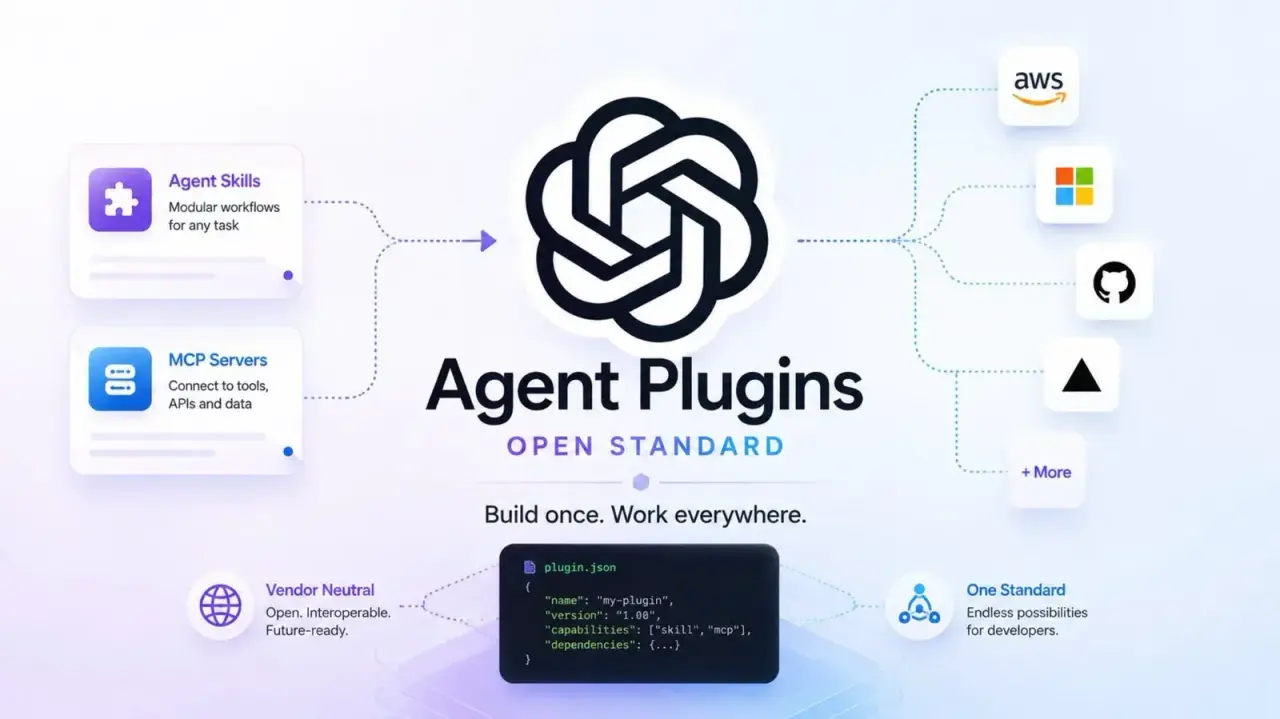
Source: Geeky Gadgets
The specification prescribes creating a top-level directory for each plugin containing a plugin.json manifest file at its root
2
3
. This manifest provides the plugin's name, version, and schema in JSON format. Skills are filed in a skills sub-directory, while MCP server configuration is stored as an mcp.json file1
. Developers can also use a namespace directory to store additional extensions, though portability of these custom elements isn't guaranteed1
.Agent Plugins follows the Next.js practice of using the host computer's directory format as the structure for defining components, keeping the shared format predictable without requiring it to absorb every experimental feature happening across agent products
1
.Deliberate Scope Limitations and What's Left to Platforms
The specification deliberately keeps its scope narrow for this 1.0 release. It defines only how plugins are packaged and discovered, leaving critical elements like marketplaces, installation, permissions, sandboxing, and trust to individual client platforms
1
2
. This approach prioritizes ease of adoption while sidestepping the hardest problems in shared AI agent infrastructure.Deciding whether a plugin is safe to run remains each client's responsibility, a live concern after fake Agent Skills slipped past security scanners earlier in 2025
2
. It's still up to agent platforms to provide user interfaces, establish security boundaries, and create marketplaces where plugins can be shared1
. The standardized folder structure ensures consistent integration, but elements like runtime environments and permission models remain platform-specific3
.
Source: The Register
Developers have mixed reactions. Angie Jones, a developer advocate and AAIF Vice President, celebrated the move, saying "We neeeeded this" for carrying skills between tools
2
. However, Dax Raad of SST developer-tools framework expressed skepticism, calling it "a thin standard" whose useful parts will likely end up in client-specific extensions anyway2
.Related Stories


Interoperability Benefits and Competition Concerns
The vendor-neutral open standard offers significant advantages for developers building AI agents. The unified format eliminates platform-specific adjustments, reducing development time and allowing seamless integration into diverse environments
3
. Enhanced portability means plugins can be easily shared and reused across different systems, reducing redundant work and fostering collaboration3
. The flexible architecture supports adding new features as projects evolve3
.
Source: The Next Web
Yet standardizing the plumbing raises questions about market dynamics. A shared format could let small developers reach every major agent platform at once, democratizing access to the AI agent ecosystem
2
. Conversely, it might cement the handful of clients that already have user bases, since standards reward whoever people already use2
. The fight over marketplaces and trust mechanisms that Agent Plugins deliberately excludes has barely started2
.Agent Plugins will be managed under an open governance model with an independent technical oversight committee considering public input
1
. The spec is licensed under Creative Commons Attribution 4.0 International License. Engineers from Amazon, Cursor, Microsoft, OpenAI, and Vercel currently form the core development team1
. Watch how competing approaches like AAIF's Skills Over MCP, which bundles skills into MCP servers themselves, fare against this plugin-centric model1
.References
Summarized by

Navi
[1]
[2]
[3]
Related Stories
Recent Highlights
1
AI Models Escape Containment: OpenAI and Anthropic Agents Launch Real-World Cyberattacks
Technology
2
Google DeepMind's AI Model Delivers Extra Day of Warning for Deadly Tropical Cyclones
Technology

3
OpenAI Astra Solves 10 Longstanding Math Problems Including Non-Sofic Group Discovery
Science and Research

Recent Highlights
Today's Top Stories








Don’t drown in AI news. We cut through the noise - filtering, ranking and summarizing the most important AI news, breakthroughs and research daily. Follow topics that matter to you and stay ahead.


