OpenAI releases GPT-5.2-Codex with advanced cybersecurity and agentic coding capabilities


4 Sources
[1]
Enterprise AI coding grows teeth: GPT‑5.2‑Codex weaves security into large-scale software refactors
With the recent release of GPT 5.2, OpenAI updated other related models, including its popular coding model Codex, bringing more agentic use cases to its fold. GPT-5.2-Codex, which OpenAI called in a blog post "the most advanced agentic coding model yet for complex, real-world software engineer,"
[2]
OpenAI's GPT-5.2-Codex advances software engineering with better reasoning and context understanding - SiliconANGLE
OpenAI's GPT-5.2-Codex advances software engineering with better reasoning and context understanding OpenAI Group PBC has released a new version of GPT-Codex, its agentic artificial intelligence coding model that's designed to automate complex software engineering tasks. The latest version,
[3]
Inside OpenAI's Pro-Grade Codex 5.2 Made for Software Teams & Security Work
What if the next big leap in artificial intelligence wasn't meant for everyone? OpenAI's GPT-5.2 Codex is making waves, not as a general-purpose AI, but as a highly specialized system crafted for professionals in software engineering and cybersecurity. Learn how this advanced model emphasizes
[4]
OpenAI rolls out GPT‑5.2-Codex for advanced coding and cybersecurity workflows
OpenAI has released GPT‑5.2-Codex, the most advanced agentic coding model yet for complex, real-world software engineering. It is designed to handle long-horizon tasks, large code changes, and cybersecurity workflows. GPT‑5.2-Codex is a version of GPT‑5.2 further optimized for agentic coding in
Share
Copy Link
OpenAI unveiled GPT-5.2-Codex, its most advanced agentic coding model designed for complex software engineering and cybersecurity tasks. The model achieved 56.4% accuracy on SWE-Bench Pro and 64% on Terminal-Bench 2.0, outperforming all previous versions. It introduces enhanced context compaction for long-horizon work, improved vulnerability detection, and a trusted access program for vetted security professionals.
OpenAI Launches GPT-5.2-Codex for Enterprise Software Engineering
OpenAI has released GPT-5.2-Codex, calling it "the most advanced agentic coding model yet for complex, real-world software engineering."
1
The model represents a significant advancement in how AI supports software engineering and cybersecurity, with optimizations specifically targeting long-horizon work with agents and enhanced defensive capabilities. Available now to all paid ChatGPT users across Codex surfaces, GPT-5.2-Codex builds upon the capabilities of GPT-5.2 while introducing specialized features for professional developers and security teams.2
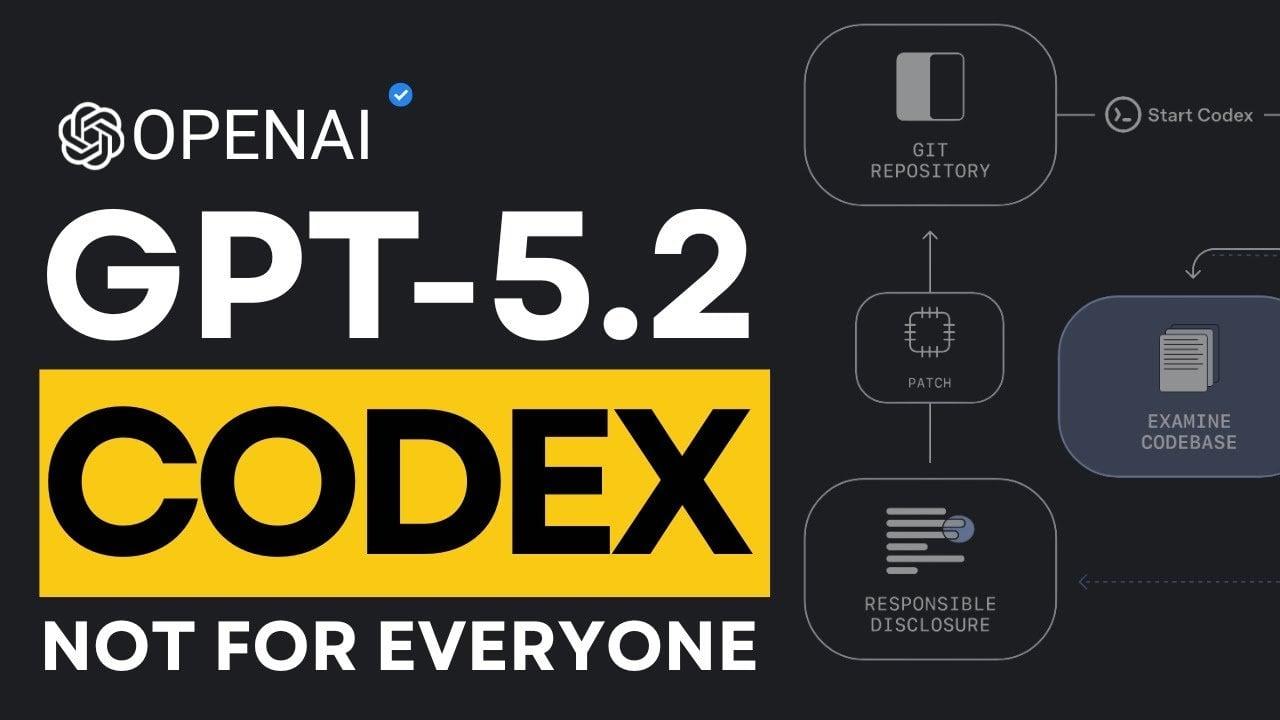
Source: Geeky Gadgets
The release marks OpenAI's strategic shift toward specialization over generalization, prioritizing depth and expertise in targeted domains rather than competing solely on speed or cost.
3
This agentic coding model is designed to handle the intricate demands of modern software development where precision and reliability are paramount, positioning it as an indispensable tool for organizations requiring advanced AI capabilities to solve real-world challenges.Record-Breaking Performance on Industry Benchmarks
GPT-5.2-Codex achieved an unprecedented 56.4% accuracy on SWE-Bench Pro, outperforming all other coding models launched to date.
2
On Terminal-Bench 2.0, the model scored 64%, excelling in tasks like automating server setups, compiling code, and managing large-scale deployments.3
These benchmarks demonstrate the model's ability to handle complex, high-stakes scenarios with measurable precision.The model's performance improvements stem from several key enhancements. Context compaction enables GPT-5.2-Codex to work coherently across multiple context windows, allowing it to undertake sustained, multistep coding tasks without losing track of previous work.
1
This capability proves especially valuable for large code refactoring, code migrations, and feature builds where plans may change or initial attempts fail. The model can now reliably complete complex tasks in large repositories over extended sessions with full context intact.4

Source: SiliconANGLE
Additional improvements include stronger vision capabilities that allow the model to better interpret screenshots, technical diagrams, and user interfaces, translating software design mockups into functional prototypes.
2
Windows environment performance has also been enhanced, addressing a critical requirement for many enterprise infrastructures.3
Cybersecurity Capabilities and Real-World Vulnerability Discovery
OpenAI calls GPT-5.2-Codex its strongest cybersecurity model yet, with significant advances in vulnerability detection and defensive capabilities.
1
In testing, the model scored 87% on CVE-Bench, outperforming other models, with GPT-5.1-Codex-Max coming in second.1
On Capture-the-Flag evaluations, GPT-5.2-Codex became the company's strongest-performing model, demonstrating its ability to work coherently across complex security challenges. The long-form Cyber Range test showed a combined pass rate of 72.7%.1
A compelling real-world example emerged when Andrew MacPherson, a principal security engineer at Privy, used GPT-5.1-Codex-Max to study the React2Shell vulnerability (CVE-2025-55182).
4
MacPherson guided Codex through standard defensive security workflows, including setting up a local test environment and fuzz testing malformed inputs. The model surfaced unexpected behaviors, leading to the discovery of previously unknown software vulnerabilities affecting React Server Components, which were responsibly disclosed to the React team.2
This case demonstrates how enterprise AI can accelerate defensive cybersecurity work while also highlighting the dual-use risks. Modern society depends on software reliability across banking, healthcare, communications, and essential services, where vulnerabilities may exist long before detection.
4
The model's ability to assist in identifying vulnerabilities, streamlining patching processes, and automating repetitive tasks enables organizations to respond more effectively to emerging threat actors.3
Related Stories

Trusted Access Program for Vetted Security Professionals
While GPT-5.2-Codex demonstrates stronger cybersecurity capabilities than previous models, OpenAI acknowledges it does not yet reach a "High" level under the company's Preparedness Framework.
4
To balance accessibility with safety as capabilities continue advancing, OpenAI is launching an invite-only trusted access program for vetted security professionals and organizations with clear defensive cybersecurity use cases.1
Security teams often face restrictions when attempting to emulate threat actors, analyze malware to support remediation, or stress test critical infrastructure.
4
The trusted access program aims to remove friction for qualifying users, enabling them to use frontier AI capabilities for defensive purposes. Participants must demonstrate a history of responsible disclosure and legitimate dual-use work requirements.4
This structured deployment approach accounts for future capability growth while supporting defensive cybersecurity needs. OpenAI plans to extend access to API users in the coming weeks, gradually expanding availability as it gathers insights from the security community.
2
The company encourages qualified professionals to express interest and provide feedback to shape future iterations.Implications for Enterprise Software Development
The improvements in GPT-5.2-Codex have direct implications for enterprise software engineering workflows. The model's ability to handle long-horizon tasks makes it particularly effective at code refactoring, a key element of software engineering that involves adapting an application's codebase to enhance quality without adding new features.
2
Organizations can use the model to reduce memory usage, increase response times, and maintain legacy systems more efficiently.
Source: VentureBeat
Since its preview launch in May, Codex has helped accelerate acceptance of agentic and vibe coding in the enterprise AI builder space.
1
Alongside platforms like Windsurf, Cursor, Claude Code, and Google's coding agents, it has moved large language models from simple code completion to generating and managing asynchronous coding projects. By automating complex and repetitive tasks while simultaneously supporting cybersecurity operations, GPT-5.2-Codex enables organizations to improve efficiency, reduce human error, and maintain competitive advantages in software engineering.2
References
Summarized by

Navi
[1]
[2]
Related Stories
OpenAI Unveils GPT-5-Codex: A Game-Changer in AI-Powered Coding
15 Sept 2025•Technology

OpenAI Launches GPT-5.1-Codex-Max: Revolutionary AI Coding Model Capable of 24-Hour Development Sessions
19 Nov 2025•Technology

OpenAI launches Codex MacOS app with GPT-5.3 model to challenge Claude Code dominance
02 Feb 2026•Technology

Recent Highlights
1
Microsoft and Nvidia Launch Surface Laptop Ultra: A $2,599 AI-Ready PC With RTX Spark Chip
Technology

2
Google Unveils Gemini 4 Argon AI Model, Restricts Access to Trusted Cyber Defenders
Technology

3
Trump Consulted Grok AI Before Ordering Venezuela Invasion and Capture of Nicolás Maduro
Policy and Regulation

Recent Highlights
Today's Top Stories






Don’t drown in AI news. We cut through the noise - filtering, ranking and summarizing the most important AI news, breakthroughs and research daily. Follow topics that matter to you and stay ahead.


