4 Sources
[1]
Samsung's shares surge as much as 6% company ships next-generation AI memory chip samples
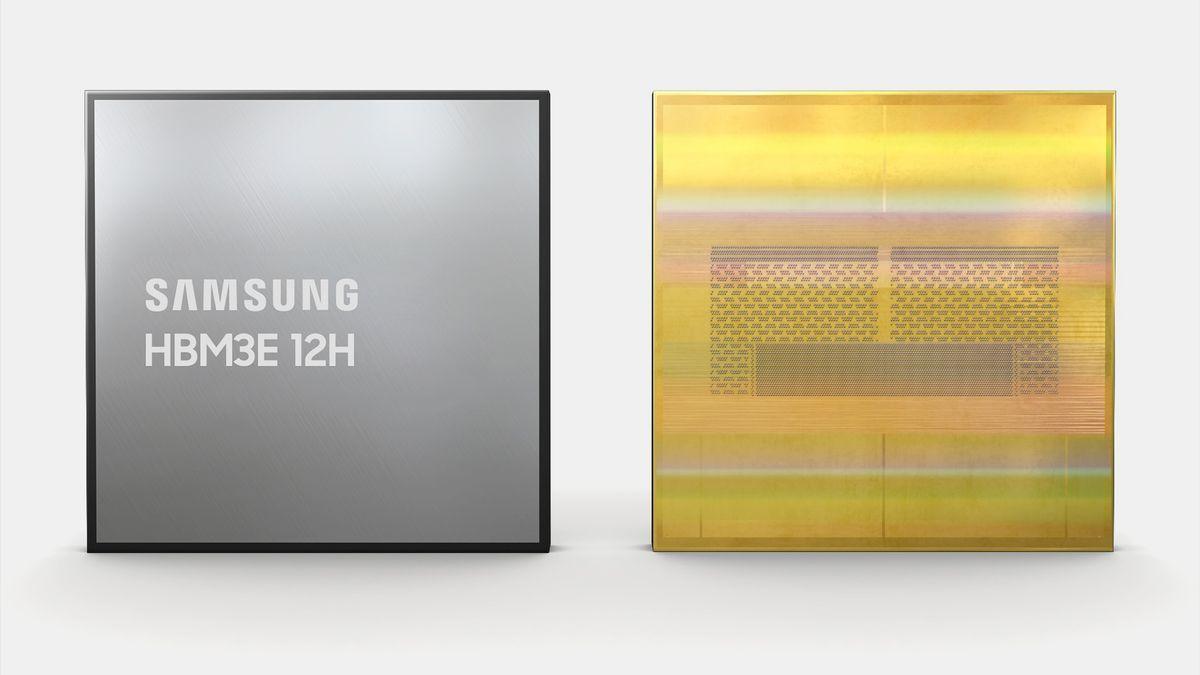
Shares of Samsung Electronics surged as much as 6.51% after the company said it had begun shipping samples of its latest high-bandwidth memory chip to its customers globally. Samsung's 12-layer HBM4E chip, which it described as an industry first, can reach speeds of up to 16 Gigabits-per-second "with improved energy efficiency and thermal performance," the company said in a press release. High Bandwidth Memory chips, such as those produced by Samsung, SK Hynix and Micron are used in advanced artificial intelligence systems. They help processors handle large amounts of data quickly, required by AI accelerators such as Nvidia's Rubin graphics processing units and Google's Ironwood Tensor Processing Unit. Samsung's 12-layer HBM4E, which stacks Dynamic Random-Access Memory vertically, has a 48-gigabyte capacity, representing more than a 30% increase compared with the previous generation, the company said. The South Korean chipmaker added that there are plans to expand the lineup to include an 8-layer 32GB and a 16-layer 64GB configuration, depending on customer requirements. "Through our advanced manufacturing capabilities and preemptive infrastructure investments, we will continue to drive the growth of the global AI memory market," said Sang Joon Hwang, executive vice president and head of memory development at Samsung Electronics. The news comes after Samsung began shipping HBM4 chips to customers in February, as it seeks to narrow the gap with SK Hynix and strengthen its position in the next-generation AI memory market. Shares last traded 3.67% higher at 310,500 won.
[2]
Samsung Electronics Begins Shipment of Industry-First HBM4E Samples
Samsung's 12-layer HBM4E achieves speeds of up to 16Gbps with improved energy efficiency and thermal performance Proven processes from HBM4 production experience and technology enhancements support increasingly demanding next-generation AI workloads Samsung Electronics, a global leader in advanced memory technology, today announced that it has begun shipping the industry's first 12-layer HBM4E samples to major global customers, further strengthening its leadership in the next-generation HBM market. Following the industry's first mass production and commercial shipment of its industry-leading HBM4 earlier this year, Samsung now extends its HBM roadmap with the introduction of HBM4E samples, addressing the rapidly evolving demands of AI computing and hyperscale infrastructure. "Following the successful mass production of HBM4, Samsung has once again demonstrated its distinct technological edge with HBM4E," said Sang Joon Hwang, Executive Vice President and Head of Memory Development at Samsung Electronics. "Through our advanced manufacturing capabilities and preemptive infrastructure investments, we will continue to drive the growth of the global AI memory market." Samsung's HBM4E delivers a stable pin speed of 14 gigabits-per-second (Gbps), with performance scalable up to 16Gbps to support increasingly intensive data processing requirements. This represents more than a 20% increase over its HBM4, while delivering memory bandwidth of up to 3.6 terabytes-per-second (TB/s) per stack, helping maximize computing performance for large language models (LLMs) and next-generation AI systems. Samsung's 12-layer HBM4E is offered in a 48-gigabyte (GB) capacity, representing more than a 30% increase over the previous generation, with plans to expand the lineup to include 32GB (8-layer) and 64GB (16-layer) configurations in accordance with customer requirements. The HBM4E sets itself apart by taking full advantage of Samsung's comprehensive semiconductor capabilities and leveraging the same leading-edge technologies refined through the company's HBM4 production experience. This includes the industry's most advanced 6th-generation 10-nanometer (nm)-class DRAM process (1c) and Samsung Foundry's 4nm logic base die, allowing the HBM4E to secure enhanced process stability and manufacturability. Design and process optimization across both memory and logic architectures of Samsung's HBM4E also improves performance, power efficiency and yield. In particular, advanced low-power design technologies and optimized packaging structures improved energy efficiency by 16% and thermal resistance characteristics by more than 14% compared to the previous generation. These enhancements also enable more effective heat dissipation, allowing prolonged reliability and lower energy consumption in next-generation data centers with intensive workloads. Samsung plans to begin mass production for HBM4E aligned with customer schedules, following initial sample shipments and optimization. Feedback from global customers on Samsung's HBM4, introduced in February, have been highly positive, especially for its performance and energy efficiency. The HBM4 was the first in the industry to enter mass production and has successfully set the bar for the industry with speeds of 11.7Gbps in its system in package (SiP) tests. As stable supply of Samsung's HBM4 continues to grow, the company's latest HBM4E using the same combination of core and base die is anticipated to enter mass production to further accelerate innovation in next-generation AI systems. With its comprehensive portfolio spanning memory, foundry, logic design and advanced packaging, Samsung will continue to ensure a stable semiconductor supply for the booming AI market.
[3]
Samsung Stock Rises After Shipping Faster HBM4E Chips for Next-Gen AI Systems
Samsung shares rose sharply after the company said it had started shipping samples of its latest high-bandwidth memory chip to customers worldwide. The move places Samsung deeper into the race for advanced AI memory, where speed, capacity, and early supply remain key for chipmakers serving data centers and AI processor firms. The South Korean company said its new 12-layer HBM4E chip can reach speeds of up to 16 Gigabits per second. It also offers 48GB capacity, more than 30% above the previous generation. The announcement lifted Samsung Electronics shares by nearly 6% in Friday trading.
[4]
Samsung Electronics ships faster HBM4E chip samples to customers; shares jump
SEOUL, May 29 (Reuters) - Samsung Electronics on Friday said it started shipping samples of its latest high-bandwidth memory (HBM) chip to customers, pulling ahead of rivals in distributing a new version of the product critical to AI data centers and sending its shares higher. The South Korean tech company said the new chip, the 12-layer HBM4E, is more than 20% faster than its previous-generation HBM4 products. Samsung said the chip uses its latest 1c DRAM process technology - sixth-generation, 10-nanometer-class DRAM - alongside Samsung's 4-nanometer foundry logic base die. The rollout is part of Samsung's efforts to regain momentum in the HBM market after falling behind rivals like SK Hynix and Micron in supplying advanced artificial intelligence memory chips, particularly to Nvidia. The move also comes just three months after Samsung began shipping its HBM4 chips to customers in February, showcasing the company's efforts to strengthen its position in the next-generation AI memory market by supplying samples of its latest products. In April, Samsung said it planned to ship the first samples of its HBM4E chips in the second quarter. Samsung's customers include major AI players like AMD, Nvidia and Google, among others, as demand surges for advanced memory chips used in AI servers and processors. EARLY MOVER ADVANTAGE Shares of Samsung Electronics rose as much as 6.5% in morning trading, compared with a 2.3% rise for the benchmark KOSPI. Shares of SK Hynix were trading up 1.2% at 0207 GMT. Analysts said the gains reflected Samsung's latest HBM announcement and optimism over the outlook for its AI chip business, after Anthropic named Samsung a strategic infrastructure partner in its latest funding round. Anthropic said it had raised funding at a post-money valuation of $965 billion, naming Samsung, Micron and SK Hynix as partners whose technologies play a critical role in the supply of memory, storage and logic chips. Samsung was the only one of the three companies specifically referenced for its logic chip capabilities, raising investor expectations that the relationship could eventually lead to additional foundry business following Samsung's $16.5 billion supply deal with Tesla, unveiled last year. "In the HBM market, early movers tend to secure the bulk of orders, so gaining market share in the initial stages is critical," said Jeff Kim, head of research at KB Securities-Jefferies. Kim noted that Samsung had entered the HBM3 and HBM3E markets later than rivals, which limited the volume of orders it was able to secure. "But if Samsung successfully completes the qualification process for HBM4E, the HBM vendor structure, which has largely centred on SK Hynix and Micron, that could shift toward SK Hynix and Samsung, considering Samsung's manufacturing capacity," Kim added. SK Hynix led the global HBM market with a 57% share in the fourth quarter of 2025, followed by Samsung at 22% and Micron at 21%, according to Counterpoint Research. Kim also said Samsung could benefit in the foundry business, as Taiwan's TSMC is expected to have its advanced-node capacity fully booked for the next several years. "That raises expectations that Samsung, as one of the few companies capable of producing advanced chips, could win more orders for advanced-node manufacturing," he said. (Reporting by Heekyong Yang and Jack Kim; Editing by Ed Davies and Thomas Derpinghaus)
Share
Copy Link
Samsung Electronics began shipping samples of its industry-first 12-layer HBM4E AI memory chip to global customers, achieving speeds up to 16 Gigabits-per-second with 48-gigabyte capacity. The announcement sent shares surging as much as 6.51% as the company aims to close the gap with SK Hynix and Micron in the advanced AI memory market crucial for next-generation data centers.
Samsung Electronics has begun shipping samples of its latest 12-layer HBM4E AI memory chip to major global customers, marking a significant step in the company's efforts to strengthen its position in the advanced AI memory market
1
. The announcement sent shares surging as much as 6.51% in Friday trading, reflecting investor optimism about Samsung's competitive positioning in the rapidly expanding high-bandwidth memory chips sector4
. Shares last traded 3.67% higher at 310,500 won, significantly outpacing the benchmark KOSPI's 2.3% rise4
.
Source: Analytics Insight
The new HBM4E delivers a stable pin speed of 14 gigabits-per-second, with performance scalable up to 16 Gigabits-per-second to support increasingly intensive data processing requirements
2
. This represents more than a 20% speed increase over Samsung's HBM4, while delivering memory bandwidth of up to 3.6 terabytes-per-second per stack2
. The chip's 48-gigabyte capacity marks more than a 30% increase compared with the previous generation, with plans to expand the lineup to include an 8-layer 32GB and a 16-layer 64GB configuration depending on customer requirements1
. These high-bandwidth memory chips are critical components in AI accelerators such as Nvidia's Rubin graphics processing units and Google's Ironwood Tensor Processing Unit, helping processors handle large amounts of data quickly1
.Source: Samsung
Samsung's 12-layer HBM4E leverages the company's comprehensive semiconductor capabilities, utilizing the industry's most advanced 6th-generation 10-nanometer-class DRAM process (1c) alongside Samsung Foundry's 4nm logic base die
2
. Advanced low-power design technologies and optimized packaging structures improved energy efficiency by 16% and thermal resistance characteristics by more than 14% compared to the previous generation2
. These enhancements enable more effective heat dissipation, allowing prolonged reliability and lower energy consumption in AI data centers with intensive workloads2
. "Through our advanced manufacturing capabilities and preemptive infrastructure investments, we will continue to drive the growth of the global AI memory market," said Sang Joon Hwang, executive vice president and head of memory development at Samsung Electronics1
.Source: Market Screener
Related Stories
The move comes just three months after Samsung began shipping its HBM4 chips to customers in February, showcasing the company's accelerated efforts to narrow the gap with competitors in shipping samples to AI customers including AMD, Nvidia, and Google
4
. SK Hynix led the global HBM market with a 57% share in the fourth quarter of 2025, followed by Samsung at 22% and Micron at 21%, according to Counterpoint Research4
. "In the HBM market, early movers tend to secure the bulk of orders, so gaining market share in the initial stages is critical," said Jeff Kim, head of research at KB Securities-Jefferies4
. Kim noted that Samsung had entered the HBM3 and HBM3E markets later than rivals, which limited the volume of orders it was able to secure, but successful completion of the qualification process for HBM4E could shift the vendor structure toward SK Hynix and Samsung, considering Samsung's manufacturing capacity4
.Analysts noted that investor gains also reflected optimism over Samsung's AI chip business after Anthropic named Samsung Electronics a strategic infrastructure partner in its latest funding round at a post-money valuation of $965 billion
4
. Samsung was the only one of three memory partners—alongside Micron and SK Hynix—specifically referenced for its logic chip capabilities, raising expectations that the relationship could eventually lead to additional foundry business following Samsung's $16.5 billion supply deal with Tesla unveiled last year4
. With Taiwan's TSMC expected to have its advanced-node capacity fully booked for several years, Samsung could benefit as one of the few companies capable of producing advanced chips4
. Samsung plans to begin mass production for HBM4E aligned with customer schedules, following initial sample shipments and optimization, with feedback from global customers on Samsung's HBM4 being highly positive for its performance and energy efficiency2
.Summarized by
Navi
[3]
19 Sept 2025•Technology

30 Oct 2025•Business and Economy

10 Feb 2026•Technology

1
Policy and Regulation

2
Policy and Regulation

3
Technology