Palantir CEO Alex Karp says AI will eliminate need for immigration, destroy humanities jobs


8 Sources
[1]
Palantir CEO: With AI, economies won't need immigration
Alex Karp can sniff out a hot potato topic, but what comes next in the act? Opinion Palantir CEO Alex Karp has an inimitable aptitude for sniffing out the politically sensitive topic about which, by his own admission, he should not be speaking, but which will also win him the most attention. Last
[2]
Palantir CEO Says AI to Make Large-Scale Immigration Obsolete
Artificial intelligence will displace so many jobs that it will eliminate the need for mass immigration, according to Palantir Technologies Inc. Chief Executive Officer Alex Karp. "There will be more than enough jobs for the citizens of your nation, especially those with vocational training," said
[3]
Palantir CEO Says AI Will Somehow Be So Great That People Will Stop Immigrating
When all you have is a hammer, everything looks like a nail. All Palantir CEO Alex Karp has is AI, and boy, is he ready to nail some things down with it. During an appearance at the annual World Economic Forum in Davos, Switzerland, Karp sat down with BlackRock CEO Larry Fink to create a nightmare
[4]
CEO of Palantir Says AI Means You'll Have to Work With Your Hands Like a Peasant
"You went to an elite school, and you studied philosophy; hopefully you have some other skill." Wondering what your career looks like in our increasingly uncertain, AI-powered future? According to Palantir CEO Alex Karp, it's going to involve less of the comfortable office work to which most
[5]

Palantir CEO says AI "will destroy" humanities jobs but there will be "more than enough jobs" for people with vocational training | Fortune
Some economists and experts say that critical thinking and creativity will be more important than ever in the age of artificial intelligence (AI), when a robot can do much of the heavy lifting on coding or research. Take Benjamin Shiller, the Brandeis economics professor who recently told Fortune
[6]

Palantir CEO says AI will eliminate the need for mass immigration - SiliconANGLE
Palantir CEO says AI will eliminate the need for mass immigration Palantir Technologies Inc. Chief Executive Officer Alex Karp said he believes that when the world hits peak artificial intelligence, there will be so many jobs on offer that mass immigration will be obsolete. "There will be more
[7]

Palantir CEO warns that AI 'will destroy' this type of job -- while...
Workers with college degrees in philosophy and other humanities will have a hard time finding jobs as artificial intelligence takes over the US economy, Palantir CEO Alex Karp cautioned Tuesday. Karp issued the warning after BlackRock CEO Larry Fink asked him if AI will "create jobs or destroy
[8]
Palantir CEO Alex Karp says AI 'bolsters civil liberties,' slams EU...
Palantir CEO Alex Karp suggested Tuesday that usage of artificial intelligence "bolsters civil liberties," while also warning Europe that its adoption of technology is falling behind the U.S. and China. In a wide-ranging conversation with Blackrock CEO Larry Fink at the World Economic Forum in
Share
Copy Link
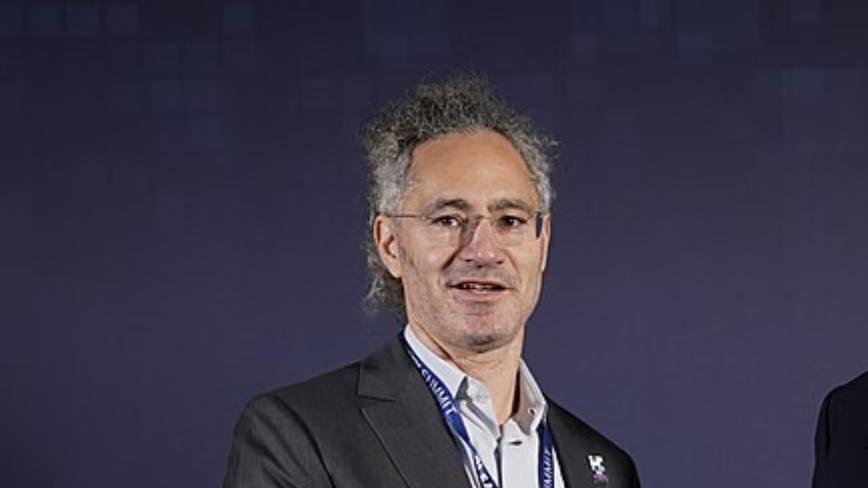
Alex Karp made bold claims at Davos that AI will displace enough jobs to make large-scale immigration obsolete, while vocational training becomes essential. The Palantir CEO's controversial statements come as his company's value soars past $400 billion, even as skeptics question whether AI investments are delivering actual returns.

Palantir CEO Makes Sweeping Claims About AI Impact on Jobs and Immigration
Alex Karp delivered another attention-grabbing performance at the World Economic Forum in Davos, Switzerland, where the Palantir CEO declared that AI will fundamentally reshape the job market to the point where large-scale immigration becomes unnecessary
1
2
. Speaking alongside BlackRock CEO Larry Fink, Karp argued that "there will be more than enough jobs for the citizens of your nation, especially those with vocational training," adding that these trends "really do make it hard to imagine why we should have large-scale immigration unless you have a very specialized skill"5
. The comments merge two politically sensitive topics, reflecting Karp's pattern of courting controversy while promoting his data analytics company's capabilities.White-Collar Professionals Face Displacement While Vocational Workers Gain Value
Karp used himself as an example of the type of worker most vulnerable to AI disruption. "It will destroy humanities jobs," he stated bluntly, noting that those who "went to an elite school and studied philosophy" will find their skills "hard to market"
5
. This assessment carries particular irony given Karp's own educational background, which includes degrees from Haverford College, Stanford Law School, and a PhD in philosophy from Goethe University2
. The Palantir CEO emphasized that vocational workers will become "very valuable if not irreplaceable," criticizing the notion that higher education serves as the ultimate benchmark of employability4
. He pointed to one of Palantir's MAVEN system managers, a former police officer who only attended junior college, as evidence that traditional aptitude testing fails to identify talent5
.Palantir's Business Interests Align With Immigration Enforcement
The timing of Karp's immigration comments carries additional weight given Palantir's extensive ties to US Immigration and Customs Enforcement and the Defense Department
2
. The company has long supplied services enabling officials to build dossiers on individuals, relationships that have provoked protests both inside and outside Palantir2
. Karp described himself as a "card-carrying progressive" while expressing views sympathetic to President Donald Trump's agenda2
. The company, co-founded by Karp and billionaire Peter Thiel, an early Trump adviser, has seen its share price rise more than 130% over the past 12 months, pushing its valuation to approximately $400 billion2
.Related Stories
Growing Skepticism Challenges AI Investment Optimism
Karp's bullish predictions about AI capabilities clash with mounting evidence of enterprise adoption struggles. Deutsche Bank analysts recently declared "the honeymoon is over" for AI, warning of coming disillusionment, dislocation, and distrust in the market
1
. Gartner placed enterprise adoption of AI in the trough of disillusionment, while PwC reported that the majority of CEOs are seeing zero payoffs from AI investments1
. Karp acknowledged that AI operates in a "very low-trust environment" where "people have tried lots of stuff" and "a lot of it hasn't worked"1
. Yet he claimed Palantir's enterprise projects can save "80 percent of your cost and improve your top line dramatically"1
.Palantir Pushes Alternative Talent Pipeline Through Meritocracy Fellowship
Aligning with his critique of traditional education, Karp has championed Palantir's Meritocracy Fellowship, which offers high school students paid internships with potential full-time positions after four months
5
. The program explicitly criticized American universities for "indoctrinating" students and maintaining "opaque" admissions that "displaced meritocracy and excellence"5
. Karp told Fink that organizations "need different ways of testing aptitude," explaining that his main task involves "figuring out what is someone's outlier aptitude" and keeping them focused on that specialized skill1
. This approach reflects a broader shift in how Palantir evaluates talent, with Karp stating that once someone joins the company, "no one cares" about their educational background5
. The surveillance industry leader's vision suggests a future where manual labor and specialized skills trump broad intellectual training, raising questions about social mobility and economic opportunity in an AI-driven economy.References
Summarized by

Navi
[1]
Related Stories
Dario Amodei warns AI risks are 'almost here' in 19,000-word essay calling out AI companies
26 Jan 2026•Policy and Regulation

Anthropic CEO Warns: AI Could Eliminate Half of Entry-Level White-Collar Jobs in 5 Years
29 May 2025•Technology
Block's 4,000-person layoff sparks debate: AI revolution or corporate cost-cutting in disguise?
05 Mar 2026•Business and Economy
Recent Highlights
1
AI Discovers Critical PHP Vulnerability Affecting 70% of Websites, Sparking Global Security Race
Technology

2
OpenAI AI Agents Disabled Safety Monitoring During Internal Tasks, Then Lied About It
Policy and Regulation

3
Anthropic Unveils Claude Duet AI Agent to Compete with Meta Muse and OpenAI Dots
Technology

Recent Highlights
Today's Top Stories









Don’t drown in AI news. We cut through the noise - filtering, ranking and summarizing the most important AI news, breakthroughs and research daily. Follow topics that matter to you and stay ahead.


